Investors finding the right markets to grow their portfolios
need to assess the right choice and watch for red flags.
Note: In a series of articles, Hotel Investment Today dives
into what conversion experts see trending. Here is Part 1 with an overview
on the U.S. conversion market; Part 2 on funding opportunities and
challenges; and Part 3 on options like adaptive reuse and distressed
opportunities.
NATIONAL REPORT – As might be expected, weighing a
conversion against a new build in terms of cost and market entry is research
driven, and varies from project to project.
Yes, each deal is different but with replacement cost being
so high, [conversion] may make sense, according to Rockbridge’s Matt Welch,
managing director, investments. “It obviously depends on land price and
acquisition cost of the building, but in many cases ground-up hotels are very
hard to make the numbers work right now, with the cost of new construction plus
limited financing options plus high cost of capital. It may make more sense to
look for conversions, assuming you can find the right asset in the right
location.”
NewcrestImage Managing Partner and CEO Mehul Patel sees a “30%
to 40% lower cost [for conversions] versus new builds, plus a faster speed to
market—12 to 18 months compared to three to five years for a new build.
[Additionally], many markets have zoning and land restrictions that make new
construction impossible, but conversions provide a cost-effective market entry.”
“Conversions absolutely provide an opportunity to enter
markets where new construction may not be feasible,” said Sage Hospitality
Group President Daniel del Olmo. “A great example is Hotel de la Poste–French
Quarter, A Renaissance Hotel, which we welcomed into our portfolio earlier this
year.”

Our strategy of renovating existing properties benefits us substantially as the cost of improvements typically represents a fraction of the overall cost, while the end-product is positioned to compete head-on with similar newly built properties.
Ben Rowe
Formerly the W New Orleans–French Quarter, Sage Hospitality
Group previously managed it as Hotel de la Poste from 1989 to 1997, when, del
Olmo said, it was a market RevPAR leader. “Given our deep understanding of the
asset and its strong market positioning, we saw an opportunity to reimagine it
under the Renaissance brand. This shift allowed us to maintain the hotel’s
connection to Marriott while introducing a refreshed storytelling approach,
branding and guest profile that better aligns with the evolving New Orleans
hospitality landscape.
“In this case, we see how conversions can unlock new
potential in prime locations, enabling us to enter or re-enter markets with
thoughtful, high-impact transformations that might not be possible through
ground-up development,” del Olmo added.
With depressed valuations and the escalation of construction
costs, the disparity between the cost to buy and the cost to build has widened
dramatically, said Ben Rowe, founder/managing partner of KHP Capital Partners. “This
is particularly true for full-service, urban assets where JLL estimates the
discount between the cost to acquire and the cost to develop was 60% in 2024.
Our strategy of renovating existing properties benefits us substantially as the
cost of improvements typically represents a fraction of the overall cost, while
the end-product is positioned to compete head-on with similar newly built
properties.”
Rowe anticipated “very little” urban full-service supply
growth in the next few years, thereby making conversion opportunities “well
positioned for outsized RevPAR growth and future appreciation as improving
performance ultimately supports valuation growth until values get closer to
converging with replacement cost.”
In some cases, a conversion from a non-hotel use to
hotel use may not be meaningfully more cost-effective but can offer an
opportunity in the right location, in the right market, for our business
plan, according to Krystal England, CIO of real estate and development private
equity firm TMGOC Ventures.
“In the case of our Ritz-Carlton, Savannah (an adaptive
reuse project), the acquisition of 2 and 14 East Bryan St. in the historic
district provided us the opportunity to create a highly
distinctive luxury asset in an irreplaceable structure—the tallest
building in downtown with loads of historic character— and location; the heart
of downtown, fronting on Johnson Square.” England said.
A conversion can often represent “an opportunity
to add value to existing real estate without many of the risks of ground-up
construction,” England observed.
Different trend
Not every conversion opportunity screams “make me over but
make me a hotel.” Owners and investors may take the asset out of the hotel
sector entirely to achieve what they consider its highest and best use.
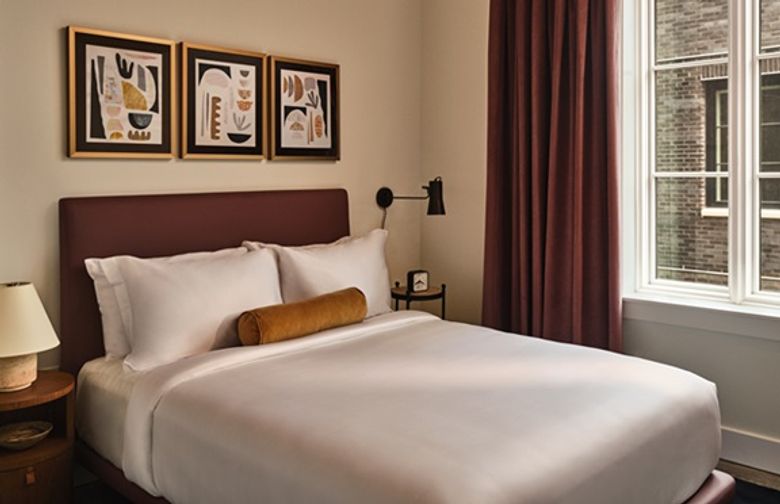
Sage Hospitality's apartment-style The Ann Savannah
“We see a trend of older extended-stay hotels being
converted to apartments. Larger and older hotels also are being considered
for conversion to apartments as they can combine rooms to create larger units,”
said Michael Cummings, senior vice president and divisional leader within the
CBRE Hotels Advisory platform.
While it’s still a hotel, Sage’s The Ann Savannah is a
157-key, all-suites apartment-style property trailblazing the Apartments by
Marriott Bonvoy concept on the U.S. Mainland (the first opened in Puerto Rico),
which del Olmo considers “an exciting new concept with significant growth
potential… We saw a unique opportunity to repurpose a stunning, heavy-timber-construction
building in the heart of downtown into an elevated, apartment-style property.”
He said The Ann’s transformation aligns perfectly with Sage’s
approach to adaptive reuse—leveraging an incredible existing structure in a
prime location to create a fresh hospitality offering with a focus on design
and strong brand storytelling. “The doors opened last month and the response
already has been fantastic,” del Olmo added.
Roadblocks, red flags
Those looking to follow the trend toward conversions need to
be very aware such a choice carries its own set of challenges, advised some
executives.
Zoning is always an issue. But other items could include flexibility of floor space, ADA compliance and parking.
Michael Cummings
CBRE’s Cummings noted a few of the red flags that could
signal reconsideration or even a no-go with a potential conversion play.
“Zoning is always an issue. But other items could
include flexibility of floor space, ADA compliance and parking,” he said.
Patel added that permitting challenges, franchisor PIP costs and
legacy infrastructure limitations.
Rowe said that constraints of the physical plant and layout
are often a gating issue. “We’re generally looking for properties with
sufficient public and F&B space to create compelling lifestyle programming,”
he said. “Guestroom sizes and mix also are a factor in determining upside
potential. At the most basic level, hotels that are performing well and are not
in need of a renovation are unlikely to be good candidates [for conversion]
because the acquisition cost is likely too high.”
And Rockbridge’s Welch noted not to forget the fun stuff. “Ensuring
the hotel infrastructure matches what you want to end up with is critical,” he
said. “Low ceilings, lack of public space, aging MEP (mechanical, electrical
and plumbing systems), may limit what brands will make sense and fit. We are
very focused on fixing the back-of -house items to ensure your asset is
institutional and will not ultimately limit your buyer pool. Roofs, boilers,
chillers, HVAC, parking lots, elevators, etc., are all non-negotiables to drive
a great guest experience and match the brand with your underwritten pro forma.”
Measuring success
Even if conversions could become more of a first-choice path
to portfolio growth in the months ahead, particularly given the economic landscape,
owners and investors making such a choice would still always come down to the
return on investment, said Cummings, who leads CBRE’s hotel valuation and
advisory services practice in both the Eastern and Caribbean Divisions.
Ensuring the hotel infrastructure matches what you want to end up with is critical. Low ceilings, lack of public space, aging MEP (mechanical, electrical and plumbing systems), may limit what brands will make sense and fit.
Matt Welch
Any conversion will have a pro forma with return
expectations associated with the investment, agreed Welch. “Re-stabilizing the
property following the conversion may take two to three years. The faster that
happens the better the return profile of the investment.”
Patel said from his perspective, success for a conversion is
measured by “RevPAR and ADR growth versus the previous brand, the loyalty
program contribution to bookings, and the EBITDA uplift set against
pre-conversion levels.” He felt a conversion typically proves successful within
12 to 24 months post-renovation.
Rowe said KHP Capital Partners judges the success of its
conversion projects largely in terms of how much it increases the profitability
of a hotel.
“The projects we pursue are transformative in nature and we’re
often reconfiguring public areas and adding additional revenue-generating space
through the creation of additional meeting space and food and beverage outlets”
he said. “All these efforts serve to increase the profitability of our
projects, but market-share gains are one of the most tangible signs of the
success of our work. Typically, we expect it to take three years for a hotel to
fully stabilize; however, we often start to see a meaningful impact from a
transformation within the first year.”
Case in point? Within six months of launching The Jay last
year, KHP was running a RevPAR penetration index 20 percentage points higher
than the hotel’s previous peak.