In Part 3 in our series about conversions, we look at how
reinventing interesting and unique real estate via adaptive reuse remains an
intriguing play.
Note: In a series of articles, Hotel Investment Today dives
into what conversion experts see trending. Here is Part 1 with an overview
on the U.S. conversion market and Part 2 on funding opportunities and
challenges.
NATIONAL REPORT – Standing inside a 150-year-old building
with arms folded and eyes sweeping the interior, an observer was once quizzed
by an eager, if anxious, seller: “What do you see?” The one-word answer perhaps
said it all: “Potential.”
Indeed, it is potential, for those in the industry who can
see beyond what exists right now to what could be in time when the conversion
path includes adaptive reuse.
Reinventing interesting and unique real estate via adaptive
reuse remains an intriguing conversion play, one that allows owners and
investors to secure largely one-of-a-kind opportunities in a given market.
Next-level conversions
“Adaptive-reuse projects are absolutely part of our hotel conversion
considerations,” said Denver-based Sage Hospitality Group’s President Daniel del Olmo,
noting they represent “a small but growing” portion of the company’s 65-hotel
portfolio.
Del Olmo cited two projects that show the range of sites
that can embrace or morph into hotels.
“The first one that comes to mind is The Crawford, a luxury
independent hotel in Denver’s Union Station. We recently completed a
multimillion-dollar renovation, working closely with preservationists and
designers to honor the building’s historic architecture. Every detail tells a
story, and it has since become a symbol of Denver and a stunning showcase of
adaptive reuse,” he said.
Another Sage project is the 241-key Hotel Per La, Autograph
Collection in downtown Los Angeles. Housed in the former Bank of Italy
building, del Olmo said the dramatic architecture and design details were
carefully preserved, creating a distinct sense of place and style.
“These buildings have a 'wow factor’ that we are committed
to maintaining through design and storytelling —not just for our guests, but
for the surrounding communities as well,” he said.
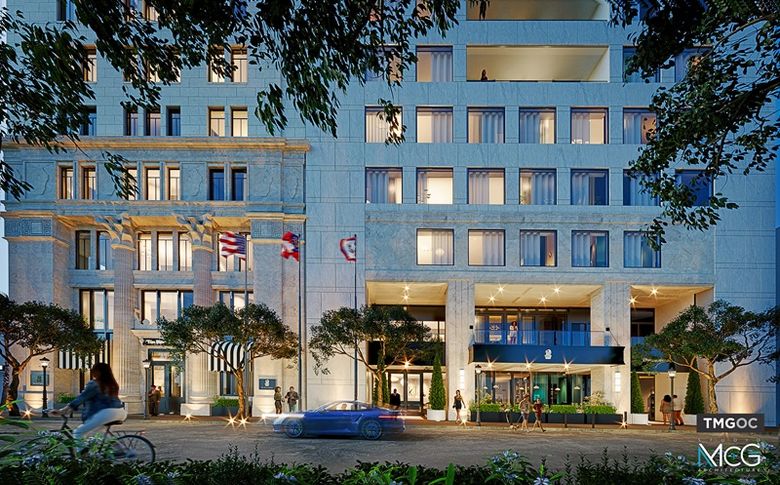
TMGOC's Ritz-Carlton Savannah, Georgia
Charleston, South Carolina-based Real estate and development private equity firm TMGOC
Ventures will be in the heart of the Savannah, Georgia, community when it
brings the Ritz-Carlton brand to the city via adaptive reuse of office space in
an historic building.
CIO Krystal England cited the Ritz-Carlton, Savannah
project, currently in pre-development, as a “great example of how
we are
using conversions strategically as a lower-risk approach for
high-barrier markets. It
also highlights how developers can maintain the historic charm
of iconic cities like Savannah, while giving a landmark new
life, in this case, bringing the iconic Ritz-Carlton brand to
one of the country’s most sought-after cities for the
first time.”
Even here, the initial project underwent a “conversion” of
sorts. Originally slated to house a 104-room Ritz-Carlton at 2 East Bryan
St. with 20 Residences occupying 14 East Bryant St., the adaptive reuse is now
focused solely on the hotel, which will offer 168 rooms across the adjacent
locations.
“TMGOC pivoted away from the permanent residences in favor
of more guestrooms to meet the market’s strong leisure and business travel
demand,” said England, adding the investment firm’s current
pipeline contains a number of rebranding and management
conversion opportunities.

Most buildings aren’t a good fit for conversion, but the opportunity set is more interesting than it’s been in a decade. In fact, the first deal in our latest fund is an adaptive reuse conversion of the Johnston Building in Charlotte, North Carolina.
Ben Rowe
For Grapevine, Texas-based NewcrestImage, the trend toward adaptive-reuse projects
aligns with its strategies, particularly in high-barrier, urban markets. “Our
NYLO Providence Warwick [Rhode Island] acquisition, a former textile mill, was
converted into a Hilton Tapestry hotel,” said Managing Partner and CEO Mehul
Patel, adding such projects currently represent about 10% to 15% of the
company’s pipeline.
Matt Welch, managing director, investments at Columbus, Ohio-based Rockbridge,
said the firm has done a variety of adaptive-reuse projects over its history,
but noted the cost of capital and cost of executing the renovation have become
a large obstacle to execute on these types of large projects. “However,
incentives can often help bridge the gap on economics,” he said.
The industry’s move toward sustainability also plays a major
role in such projects, observed del Olmo.
“Repurposing an existing building significantly reduces
construction waste and carbon footprint [and] also allows for a quicker
turnaround compared to ground-up development, making it a more-efficient way to
bring a new hospitality experience to market,” he said. “Additionally, many of
these projects are in prime, historic locations, allowing us to preserve
architectural character while revitalizing key urban areas.”
An example for Sage is the Nines, a Luxury Collection Hotel
in Portland, Oregon, that was converted from the former Meier & Frank
department store and is now LEED Silver Certified. “A testament to the
sustainable benefits of keeping and adapting a building rather than demolishing
and rebuilding,” del Olmo said.
Adaptive reuse is one of the three primary investment
strategies for San Francisco-based KHP Capital Partners pursues and across its past four funds, approximately
15% of deals have fallen into this category.
“Given the severe distress in office today, we’re seeing
more opportunity to acquire these buildings and take advantage of historic tax
credits and other incentives to create like-new product at a deep discount to
what it would cost to actually build new,” said KHP Founder and Managing Partner Ben Rowe. “Most
buildings aren’t a good fit for conversion, but the opportunity set is more
interesting than it’s been in a decade. In fact, the first deal in our latest
fund is an adaptive reuse conversion of the Johnston Building in Charlotte,
North Carolina.”
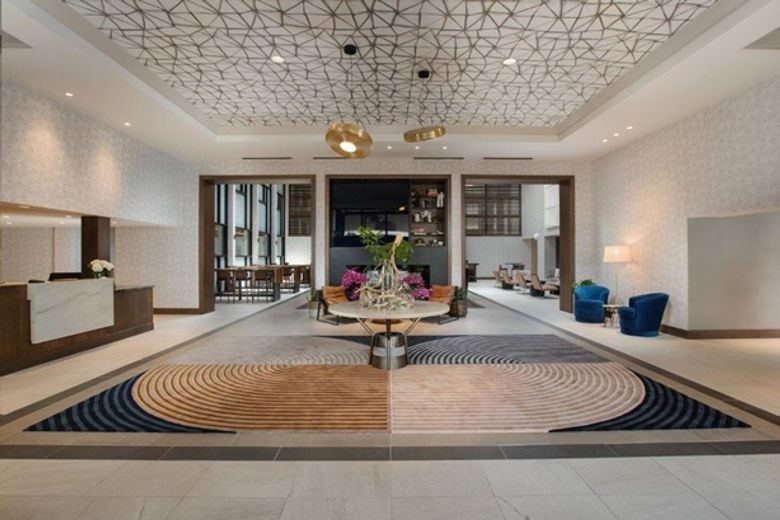
Lobby at NewcrestImage's Beeman in Dallas Park Cities
KHP is converting the distressed historic office building
into a 240-key soft-branded lifestyle hotel that will feature 10,000 square
feet of meeting space, a destination restaurant and a coffee shop on the first
floor, a second-floor parlor bar and a rooftop bar. It’s slated to open in
2026.
Finessing Distress
Owners and investors also are trending toward a range of
distressed assets when looking for conversions.
“Absolutely,” said Welch. “Distress can come in various
forms, whether that be asset-level distress (brand related, asset needs
capital, etc.), market distress (market softened or changed, too much new
supply, etc.), or capital-structure distress (over leveraged, loan maturity, partnership
issues, etc.). All of these may lead to needs for capital infusions and
re-orienting the business plan, which may include conversions.”
In some cases, added TMGOC’s England, the distress
is driven by the selection of the wrong brand or management by
the seller.
NewcrestImage actively seeks well-located distressed
properties with strong repositioning potential with Patel noting that key
factors include location, structural viability and brand flexibility.
One property meeting the criteria was The Beeman Hotel in
Dallas Park Cities, which NewcrestImage acquired and repositioned into a
296-key boutique destination in the Mockingbird Station neighborhood that
highlights the local art and music scene.
Distressed assets offer some of the best opportunities,
according to Rowe, citing the “lingering distress” tied to the impact of COVID
now amplified by higher borrowing costs and more-restrictive lending terms.
“There are many individual owners with underperforming
assets that are over-leveraged and are facing loan maturities where they have
few good options. Many of the assets also are in need of renovation, which is
further weighing on performance and valuation. These are exactly the kind of
value-add opportunities we’re looking for,” he said.