In a series of articles this week, Hotel Investment Today
takes a deep dive into what’s trending for popular conversion plays.
NATIONAL REPORT – The current pace of hotel conversions “has
started to pick up” with owners, developers and investors now looking at this
path vis-à-vis PIPs, according to Michael Cummings, senior vice president and divisional leader
within the CBRE Hotels Advisory platform. “Most companies had been able to
delay their brand-mandated property improvement plans as a result of the
pandemic. These PIPs have now come due and are no longer being
extended. As a result, owners and operators are looking at the ROI on
these expensive PIPs,” he said, conceivably producing a motivating factor for
conversion.
Conversions can include a variety of plays: brand to brand,
independent to brand and vice versa, distressed assets, adaptive reuse
(historic, office and other opportunities).
Setting the pace
“We see growing opportunity in the renovation and
repositioning of existing hotels,” said Ben Rowe, founder/managing partner of KHP Capital
Partners in San Francisco. The real estate private equity firm recently did two
brand conversions, notably turning the former Le Méridien San Francisco into
The Jay, Autograph Collection, and has two more in the works as of 2Q25,
including the conversion of the Pan Pacific Hotel in Seattle into a 1 Hotel. He
noted conversions represent 40% of KHP’s 18-hotel portfolio. “Over half of the
deals we did in our last two funds involved a brand conversion,” Rowe said.

Conversions are an attractive, cost-efficient alternative. We are proactively assessing distressed assets, repositioning underperforming hotels and identifying adaptive-reuse opportunities to expand our portfolio.
Mehul Patel
Conversions are a key strategic pillar for Grapevine, Texas-based
NewcrestImage, according to Managing Partner and CEO Mehul Patel. “We anticipate a strong pace
heading into Q2 due to shifting market dynamics,” he said. “Rising construction
costs, interest rates and supply-chain challenges have made new-builds less
viable. So, conversions are an attractive, cost-efficient alternative. We are
proactively assessing distressed assets, repositioning underperforming hotels
and identifying adaptive-reuse opportunities to expand our portfolio.”
The overall pace has been consistent over the last few
years, with multiple hotels in various stages of renovation/conversions for Columbus,
Ohio-based investment firm Rockbridge, which has “a robust pipeline of
potential conversions,” said Matt
Welch, managing director, investments. “It is difficult to bridge the
bid-ask gap between buyers and sellers as the cost of these renovations are
significant and difficult to finance efficiently. We have ongoing renovation
projects throughout our portfolio, a variety of which are contemplating a brand
change.”
Of its 82 hotels—63 majority owned—conversions represent 12%
of Rockbridge’s portfolio. So far, there are two conversions planned for this
year, Welch noted.
Denver-based Sage Hospitality Group’s President Daniel del Olmo pointed
to a strong start to the year, completing three conversions: the transformation
of W New Orleans into Hotel de la Poste; the conversion of the Hotel Alpenrock
in Breckenridge, Colorado; and the repurposing of a residential building in
Savannah, Georgia, into The Ann, which, he said, “marks the first Apartments by
Marriott Bonvoy to open in the continental U.S.”
Sage is always looking for strategic conversion
opportunities, del Olmo continued. “As we head into Q2, we have four to five
transitions in the pipeline, including one conversion in the South that I’m
especially excited about, as we’ll be collaborating with our in-house creative
team at Sage Studio to bring it to life,” he said. “We remain open to
conversion opportunities that align with our vision and add value to our
portfolio.”
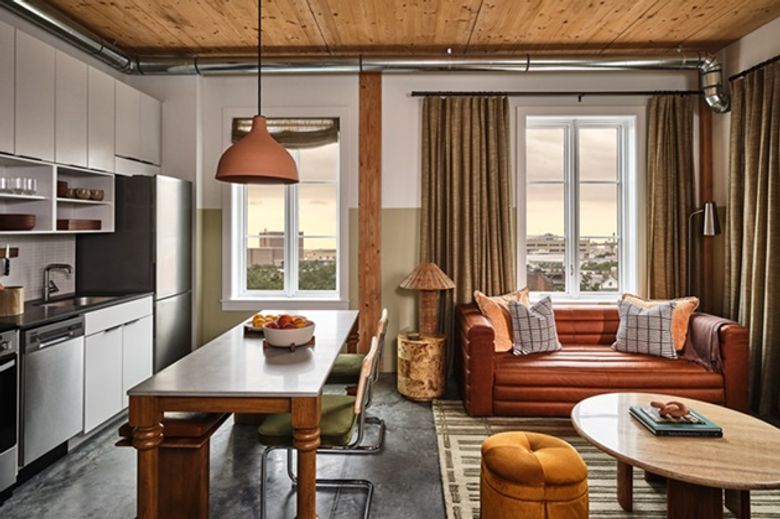
Sage Hospitality repurposed a residential building in Savannah, Georgia, into The Ann, the first Apartments by Marriott Bonvoy in the continental U.S.
Real estate and development private equity firm TMGOC
Ventures, Charleston, South Carolina, as of January 31 had 22 hotels in its
portfolio, 19 of which are branded, and has executed on a number of conversion
plays over the past 12 months.
Company CIO Krystal England noted, for example, “TMGOC has completed
several management conversions, including transitions to Lexima Hospitality,
our affiliate management company, as well as third-party managers.”
She added conversions represent “roughly 54%” of the
portfolio, and TMGOC’s 2025 pipeline “contains a number of rebranding
and management conversion opportunities.”
The drivers
Like CBRE’s Cummings, Rowe echoed the pandemic’s effects
have continued to impact investment in hotel assets. “As owners have struggled
to cover operating shortfalls and debt service, a huge portion of property
improvement plans have been deferred… and the pressure to meet brand
requirements is growing. The lack of renovation also is now weighing on
performance in many cases. This is a real challenge for owners that don’t have
access to capital to renovate,” he said.
Rowe acknowledged, as a buyer, “these are exactly the kind
of value-add opportunities we’re looking for. These can be opportunities not
just to renovate, but also to reposition; not just to execute the PIP, but in
the right situations, to shift to a lifestyle positioning either within the
existing brand system or with a new branding approach.”
In the event properties need capital investment, we are always looking to see how we can add value and drive the greatest ROI on the investment, which may justify a brand change.
Ben Rowe
Welch agreed that underperforming properties “will always
get the most attention” for a potential brand conversion. “Similarly, in the
event properties need capital investment, we are always looking to see how we can
add value and drive the greatest ROI on the investment, which may justify a
brand change.”
England added that as RevPAR growth generally
has flattened out across the country, TMGOC is looking for ways
to achieve attractive returns that aren’t necessarily dependent
on market growth. “In many existing and operating assets,
creating this value can come in part from a change in brand and/or
management,” she said.
For example, last year when TMGOC in a JV with Certares
acquired The Ray Hotel in Delray Beach, Florida, it replaced Hilton
management with HHM Hotels as a third-party manager.
Patel said NewcrestImage is encouraged to convert by several
macro and microeconomic factors. He cited capital efficiency, market demand,
operational advantages and brand diversification.
“Conversions allow us to maximize asset value at a fraction
of the cost of new development [while] certain markets have strong demand but
limited new supply, making conversions the best way to enter high-barrier
locations,” Patel said. “[Additionally, a] faster speed-to-market with
conversions means we can reposition assets more efficiently than waiting for a
ground-up project.”
Reflagging properties under higher-performing brands aligns
well with long-term revenue growth, Patel added, particularly in terms of
loyalty-driven guests.
When it comes to brand conversions, Sage’s del Olmo said a
key driver is the local market. “We analyze neighborhood dynamics to identify
opportunities where a rebrand can better serve the area,” he said. “For
example, if there is a growing demand for a lifestyle hotel but little
competition nearby, repositioning an existing property under the right brand
can create a strong market advantage. Our Sage Restaurant Concepts team also is
very involved in these discussions; we see the F&B as a crucial part of the
local appeal.”