Here’s
why Nate Siehr and The Big Key Group are developing a standalone branded
residential project in Orlando aimed at upper-upscale customers.
NATIONAL REPORT — Nate Siehr
said his company’s goal is not just to be like other luxury-branded residential
developers.
“We think that there's a real
opportunity for people wanting something in a more affordable price point and
we’re trying to reach that consumer,” said Siehr, co-founder and principal of Miami-based The
Big Key Group.
The Big Key is developing the
322-key Ambar Residences Orlando (a soft brand the company created), which will
be the first branded residential project under the Apartments by Marriott brand
in the U.S. The three-tower project is scheduled to open in late 2028 and will
be managed by Dallas-based Coury Hospitality.
The Big Key serves as the
general partner, with about 80% equity in the project (which will be further
diluted with further investments), alongside other limited partner investors.
Siehr has a deep background in
hospitality, including 12 years at Marriott. He left there with the intention
of following his own path and buying his own hotel. That ultimately led him to
The Big Key Group and the company’s first development.

Our preference is to have some sort of branded residential component if we can, just because of what it brings to the property in terms of returns and operations.
Nate Siehr
While Siehr said Big Key wanted
to pursue this branded residential path because of his hospitality experience
and his partner’s (Rodrigo Gana) residential experience, that doesn’t mean the
company will only do this type of development.
“We're not 100% married to doing
all branded residential projects. Some of our pipeline projects include
traditional hotels with a branded residential component. Our preference is to
have some sort of branded residential component if we can, just because of what
it brings to the property in terms of returns and operations,” he said.
Partnering with Marriott was an
easy choice, Siehr said.
“Marriott's been in the branded
residential business for the longest, 25 years, and obviously it resonates very
well with the buyers,” he said. “If you don't have a great brand that brings
that operational excellence and reputation and value to the property, the brand
is just a decoration. So being with Marriott was really important.”
Buying a branded residential
unit requires an understanding of the property's long-term value, Siehr said.
“They're not just buying square
footage with the name on it. They're investing with the confidence of how it
will be delivered over time,” he said. “That goes for us, too, as the manager
of that property going forward. [Marriott’s] platform continues to expand… So
that's obviously great for us as the developer.”
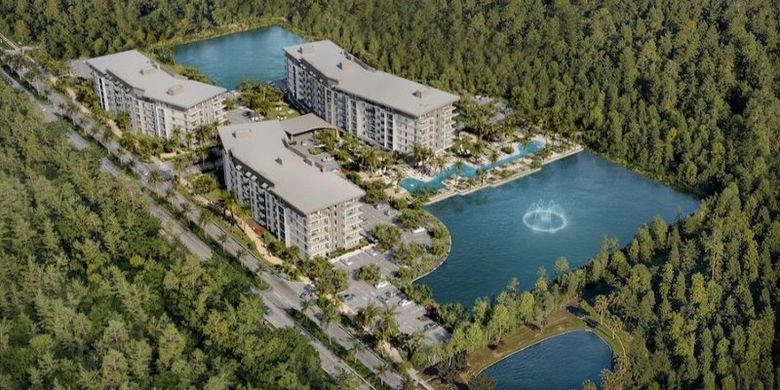
The Big Key is developing the standalone branded residential Ambar Residences Orlando (a soft brand the company created).
Siehr said the company is
working on a couple of projects in its pipeline; one could be a comparable
mirror-image project in Orlando.
“We're still open to the
decision of whether to repeat the Ambar name, or whether to just start from
scratch and create a whole new, unique brand identity and ecosystem for that
project,” he said, noting the company is also looking at doing a smaller Tribute
portfolio project with some branded residential.
South Florida is really the test
case for branded residential right now, but Siehr said there is still room for
development in different price points.
“It's a lot of the ultra-luxury,
trophy asset [projects]. I'm not saying we're opposed to that, or that we don't
see that in our future at any point, but we're really happy focusing on this
upper-upscale price point… bringing the aspects of branded resident ownership
to a different consumer class. That's very appealing to us,” he said.
“What appeals to us about
broader Florida is the depth and repeatability of demand,” he said. “A lot of
these ultra-luxury projects are one-time purchases, whereas, being in the space
that's upper upscale… we really enjoy it addresses that multi-generational
travel market.”
What appeals to us about broader Florida is the depth and repeatability of demand. A lot of these ultra-luxury projects are one-time purchases, whereas, being in the space that's upper upscale… we really enjoy it addresses that multi-generational travel market.
Nate Siehr
But Florida is a competitive
market for branded residential. Does that mean there is a ceiling on the number
of potential customers? Siehr says no.
“That's where the location comes
into play. You really have to understand your consumer. You have to understand
the market and the sales will inform that certainly going forward,” he said. “I
don't think you necessarily run out of customers at some point. You could, in
theory, oversaturate a market, but I don't see that saturation in Orlando. It's
one of the deepest leisure markets in the country. You can see the depth of the
customer demand.”
There are still plenty of areas
in Florida that present great opportunities for branded residential, according
to Siehr.
“You see a really high
concentration of branded residential products in the Miami area. But I don't
think you've seen that extrapolation to interior Florida, and along the coast.
In the upper upscale price point, you've seen brand residential components up
and down the coast, through South Florida on the West, and up through Palm
Beach in the East. But you haven't seen that in the northern half of the state.
There's a lot of opportunity there.”
As branded residential continues
to mature, it will become more nuanced, Siehr said.
“That's a healthy thing… for a
long time, people associate branded residences with this exclusive
top-of-the-market, hotel-adjacent towers in iconic urban locations and buyer
profiles concentrated solely at the high end. That segment is obviously still important.
It's not going away.
But
the idea of branded residential is growing, both with and without hotels, and
spreading throughout the vertical pipeline of brands... that suggests it's
bringing value to those customers at lower price points. It's less about
attaching a brand to a piece of real estate for the sake of doing so, just for
the premium. It's about matching it with the right brand. Soft brands allow you
to do that.”