Analysts
say private equity or high-net-worth individuals or groups are the most likely
buyers for the luxury assets. But will they sell as a portfolio or in pieces?
INTERNATIONAL
REPORT — With Dallas-based REIT Braemar Hotel & Resorts announcing last
week that it was putting itself up for sale, there are any number of scenarios
that could play out over the next year and maybe only one certainty — it almost
certainly won’t be another REIT acquiring Braemar’s portfolio.
“There are a
couple of different ways that this could play out. Does the whole company get
sold in a matter of a few months? If that’s the case, that’s probably a larger
private equity firm,” said Michael Bellisario, an analyst for R.W. Baird.
“Or does this get split up to multiple buyers and multiple transactions,
which is certainly possible.”
Bellisario said
there are a number of ways to slice and dice Braemar’s portfolio of nine
resorts and five urban properties.

You definitely have two portfolios with the urban [hotels] and the resorts. But even within the resort, the Caribbean assets might be a different buyer than the U.S. resorts. Then you have the Wine Country assets, which are fully unencumbered. That could be a different buyer.
Michael Bellisario
“You definitely
have two portfolios with the urban [hotels] and the resorts,” he said. “But
even within the resort, the Caribbean assets might be a different buyer than
the U.S. resorts. Then you have the Wine Country assets, which are fully
unencumbered. That could be a different buyer.”
Private equity
could be a likely buyer for a lot of these properties, while high-net-worth
individuals or groups could be likely buyers for the trophy asset-type of
properties, which include the REIT’s California Wine Country assets (like the
Bardessono Hotel and Spa or the Hotel Yountville, both in Yountville,
California).
“What we’ve
historically seen are private equity types of buyers for these [types of
assets]. I would be surprised if a full portfolio got sold as one entity,” said
analyst Patrick Scholes of Truist Securities. “These are trophy assets and
certainly what we’ve seen is that the public markets really don’t give the full
value to trophy assets and probably at this moment they would be better
privately owned.”
“For the luxury 5-star hotels, that buyer pool is deep, but maybe not as deep as it was 10
years ago or even three years ago, but there’s lots of high-net-worth capital,”
Bellisario said. “There are lots of high-net-worth groups that have partnered
with private equity firms to do deals. Those groups are probably not writing a
billion-dollar equity check to buy the whole company, though.”
There’s a lot of
capital on the sideline, Bellisario said. The difference with this transaction
is that it involves a willing seller.
“That’s the big
thing. Generally, these assets are better performing, which is why you may not
have seen a lot of transactions. There hasn’t been a seller motivation,
necessarily. These assets don’t transact very often. So, when they do, you have
people that come out and bid on them,” he said.
A challenge for
Braemar is that there’s a lot of leverage for buyers, especially with what the
final value for the REIT’s stock price ends up being, Bellisario said.
“It almost feels
like it’s a giant game of Tetris because the longer the process takes you
would think that means it’s more likely that it’s getting broken up, but also
there’s risk to that,” he said.
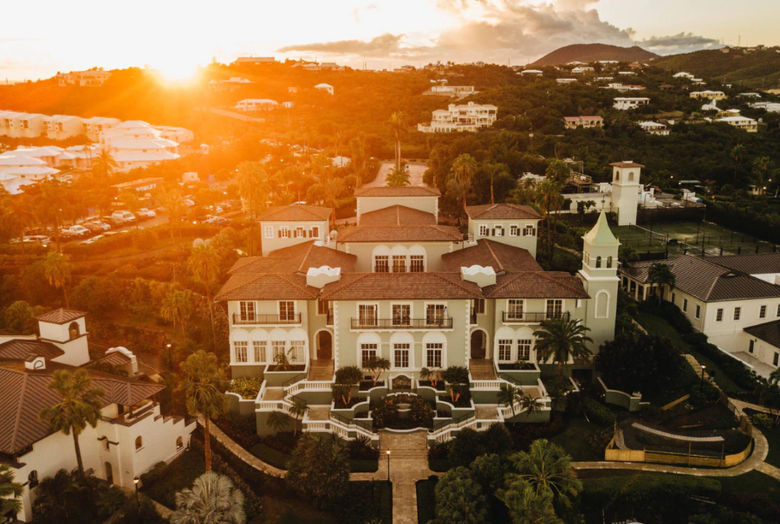
The Ritz Carlton St. Thomas in the Caribbean is part of Braemar's portfolio.
Value of the assets
After Braemar’s
sale announcement, Bellisario posted a note spelling out several different
valuation scenarios, one at $3 per share, another at $5 per share and another
at $7 per share, which are similar metrics to Strategic Hotels & Resorts’
sale in 2015 (which Braemar mentioned in its news release as a comparison to
this sale). He said the $3-5 per share range is what Baird is assuming, which
could represent a $300 million change in the portfolio’s real estate value.
Ultimately, there
is value for the buyer in buying the portfolio in one transaction, Bellisario
said. But there’s also risk.
If someone is buying the portfolio, you would think that some of the value is that they’re paying a little less upfront because they’re the ones that are going to take the risk to sell the assets to someone else.
Michael Bellisario
“If someone wants
to buy the whole thing for $4 a share, and they’re a legitimate buyer and they
can finance it, do you say no to that, thinking, maybe we can sell it in pieces
over the next year for $5 (a share),” he said. “If someone is buying the portfolio,
you would think that some of the value is that they’re paying a little less
upfront because they’re the ones that are going to take the risk to sell the
assets to someone else.”
Bellisario also
said Braemar, spelling out the $480 million termination fee for its advisor,
Dallas-based Ashford Inc., as well as $25 million termination fees for other
Ashford-owned subsidiaries, project manager Premier Project Management and
management firm Remington Lodging & Hospitality, helps simplify a
potential transaction as well.
“There’s no more
negotiation to be done because we all know what the price is. It’s a cost,” he
said. “It simplifies the negotiation, for sure.”
Braemar set those
fees to expire on July 1, 2028, but Bellisario said he doesn’t read too much
into that date, almost three years from now.
“I expect Braemar
not to be a public company by the end of next year. That’s a long way away from
now… They’re giving themselves wiggle room… The closer we get to the outside
date, the worse the outcome is, maybe, because then it’s not sold.”