The
luxury hotel REIT said it doesn’t believe it “can flourish in today’s market
environment” and will begin the sales process immediately.
DALLAS —The board of directors of
Dallas-based Braemar Hotels & Resorts Inc. announced that it is initiating
a process for the immediate sale of the REIT that includes nine resorts and five urban properties.
In addition, Braemar and its advisor, Dallas-based Ashford Inc., agreed that “while a fair and reasonable calculation of all amounts due to Ashford would be significantly higher,” Ashford will accept a $480 million termination fee for its advisory agreement. Ashford already received $17 million of the company sale fee upon the execution of the letter agreement, which will be credited against the company sale fee in the event Braemar is sold prior to July 1, 2028.
Braemar’s buyer also will be required to assume agreements with two Dallas-based Ashford subsidiaries, project manager Premier Project Management, LLC, and management firm Remington Lodging & Hospitality, LLC. But there is a $25 million cancellation fee for agreements with those companies as well.
“Historically,
Braemar shares have traded at a significant NAV discount primarily due to the
external advisory agreement with Ashford Inc., which has negatively impacted
the company's cost of capital,” wrote R.W. Baird analyst Michael Bellisario. “Braemar has had numerous activists over the
years, and the company previously has pursued strategic alternatives. This
sales pursuit appears more geared toward a sale or liquidation given the
agreed-upon $480 million (~$6.50/share) termination fee, in our view.”
Bellisario added, “Net, net – the termination
fee clarity is a positive for prospective buyers, but the amount is a
significant drag on the net per-share value that ultimately could accrue to BHR
shareholders.”
At the end of the day, Bellisario said outcomes could include an outright portfolio sale or several
smaller portfolio sales (including single-asset dispositions). “We believe
buyer interest is relatively strong for high-RevPAR luxury hotels/resorts.
We would note that Braemar has evaluated strategic alternatives
previously.”
Braemar’s board formed a special committee
of independent and disinterested directors to explore a range of strategic
alternatives, aimed at maximizing both near- and long-term shareholder value.
The board ultimately said it was in the best interests of the company and its
shareholders to pursue a sale. Braemar, with its financial advisor,
Milwaukee-based Robert W. Baird & Co. Inc., said it is initiating the sale
process immediately.
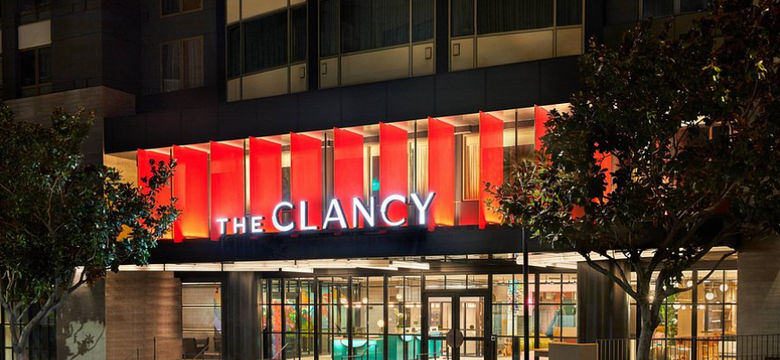
Braemar said it has a letter of intent to sell The Clancy hotel in San Francisco later this year.
Braemar has a predominantly luxury hotel
portfolio that has seen RevPAR growth of 2.9% through the first half of the year. But the
company said in the release, “It is not believed that a luxury RevPAR lodging
REIT like Braemar can flourish in today’s market environment due to the
historically low EBITDA multiple lodging REITs are achieving as well as the
ongoing activism the company has received.”
It used the example of Strategic
Hotel & Resorts, another luxury lodging REIT that, after several years of
undervaluation, was ultimately sold by Blackstone to Chinese conglomerate
Anbang Insurance Group in 2016.
Last year, Braemar faced a board challenge
and proxy fight from an activist investor, New York City-based Blackwells
Capital. Blackwells nominated new members for half of the company’s board,
which the REIT rejected.
Julian West, writing for AInvest, said
Braemar’s sale is exploiting a 120-basis point valuation gap between public
REITs (5.77% cap rate) and private luxury hotel markets (4.57% cap rate).
“The U.S. real estate market in 2025 is
marked by a stark dislocation between public and private valuations,
particularly in the luxury lodging sector,” the story said. Braemar… has become
a focal point for capital arbitrage opportunities. With a market capitalization
of just $0.17 billion as of August 2025, Braemar’s shares trade at a
significant discount to the intrinsic value of its 14-luxury hotel portfolio...
This mispricing, driven by structural inefficiencies in public REIT valuation
models, presents a compelling case for private buyers to capitalize on a rare
convergence of asset quality, market dislocation, and strategic flexibility.”
Beyond the value of its hotels, Braemar also
owns excess land at its Ritz-Carlton Sarasota, Four Seasons Resort Scottsdale,
and Ritz-Carlton Lake Tahoe properties. At the time of acquisition, this
excess land was attributed a value of $9.7 million at The
Ritz-Carlton Sarasota, which was acquired in 2018; $8.4 million at
The Ritz-Carlton Lake Tahoe, which was acquired in 2019; and $17.8
million at the Four Seasons Resort Scottsdale, which was acquired in 2022.

Hotel portfolios like the Braemar portfolio do not come to the market very often, and we believe the opportunity to acquire this iconic portfolio will attract significant buyer interest from around the world and result in an attractive valuation for shareholders.
Monty Bennett
Braemar also had $68 million of
positive net working capital through the first half of 2025 and, in early
August, said it was closing the sale of the Marriott Seattle Waterfront,
resulting in $50.8 million of net proceeds. The REIT also said it has
recently entered into a non-binding letter of intent with a potential buyer for
the sale of the 410-key Clancy hotel in San Francisco for $115 million. That
transaction is expected to close in the fourth quarter, subject to customary
conditions. Braemar’s current debt is approximately $1.172 billion, and
the current liquidation value of its outstanding preferred stock is
approximately $473 million.
“We've built a high-quality portfolio that
is well-positioned to attract significant interest from private market buyers,”
Braemar CEO Richard Stockton said in the release. “With improving economic
conditions, continued strength in industry performance, limited new room supply
and healthy consumer spending, I believe we are entering a favorable
environment for a potential sale.”
Rebeca Odino-Johnson, chairperson of the board’s special committee, added, “We explored multiple alternatives for
Braemar, including a potential internalization of management. However, given
the sustained disconnect between our share price and our iconic portfolio’s
intrinsic real estate value, the board believes pursuing a sale process is the
right step at this time, The board also believes that
this is the best opportunity for shareholders to realize a premium to the
existing share price.”
Monty Bennett, chairman of the board of Braemar Hotels & Resorts (and CEO of Ashford) said, “When we created Braemar back in 2013, our
hope was that Braemar’s high-quality portfolio and strong property performance
would result in an attractive valuation giving the company an attractive cost
of capital for growth. While Braemar has traded at a
similar multiple to its publicly-traded lodging REIT peers, the reality is that
the public markets have not been friendly to lodging REITs, including Braemar.
This fact, along with the constant shareholder activism that Braemar has
experienced, has led us to conclude that a sale of the company is the best way
to maximize value for shareholders.
“Hotel portfolios like the Braemar portfolio
do not come to the market very often, and we believe the opportunity to acquire
this iconic portfolio will attract significant buyer interest from around the
world and result in an attractive valuation for shareholders.”