Here
is a summary of awards presented at HICAP 2024 in Singapore for noteworthy
deals, sustainability, lifetime achievement and a rising star.
SINGAPORE
– Awards for Deal of the Year, Development of the Year. Single Asset
Transaction, Sustainable Hotels, Lifetime Achievement and Rising Star were announced
last week at the 34th annual Hotel Investment Conference Asia Pacific (HICAP) in
Singapore at the Fairmont Singapore & Swissotel The Stamford.

The HICAP Reggie Shiu Development of the Year Award went to the Six Senses Kyoto in Japan
Here’s
a roundup of the winners:
The Reggie Shiu Development of the Year:Six Senses Kyoto in Kyoto, Japan
As
the brand’s debut in Japan, the Six Senses Kyoto, developed by Samty Co. and
Wealth Management, is a landmark project that opened in April 2024 with an
undisclosed development cost. The hotel blends luxury with cultural
authenticity, overcoming pandemic-related challenges and budget pressures.
Design
features LEED Silver sustainability and incorporates Kyoto’s rich heritage
through biophilic elements, cultural artifacts, and locally sourced materials.
Finalists in the category also included lyf Ginza Tokyo in Tokyo, Japan and
Andaz Macau in Macau, China.

HICAP Single Asset Transaction winner: The QT Singapore
Single Asset Transaction of the Year: QT Singapore Hotel
Located
in the heart of Singapore, an iconic heritage building, previously known as
Hotel Telegraph on 35 Robinson Road, was revitalized through a strategic
acquisition by Phoenix Property Pte Ltd from Viva Ventures So Pte Ltd for an
undisclosed price, marking a significant milestone in the regeneration of
Singapore’s Central Business District.
The
acquisition team had to not just deal with ownership transfer, but also
operator change, financing, and planning of extensive asset enhancement
initiatives, within a four-month deal period from the Letter of Intent to the
completion, which was on 30 November 2023. With the planning of complex
coordinating work with international stakeholders, the acquisition team managed
to not just close the deal but also get QT Singapore Hotel’s doors open in just
nine months from the point of completion. Finalists in the category also
included Phoenix Seagaia Resort in Miyazaki, Japan and Adina Perth Barrack
Plaza in Perth, WA, Australia.
HICAP Lifetime Achievement Award: Robert Hecker, managing director, Pacific
Asia, Horwath HTL
The
award recognizes exceptional individuals who have distinguished themselves
through their accomplishments and contributions to expanding, enhancing, and
advancing the hotel industry in the Asia Pacific region and the world.
Hecker manages the Pacific Asia arm of Horwath HTL with offices in Tokyo,
Beijing, Shanghai, Hong Kong, Bangkok, Kuala Lumpur, Singapore, and Jakarta.
Since his arrival in the region with Horwath HTL in 1988, he has developed an
extensive background and expertise in the developing hotel and tourism
industries through his direct involvement in the planning and analysis of
projects across the region.
He has 45 years of experience, including work in hotel operations with Pacific
Plaza Hotels in northern California and conducting market and financial
analyses for hotels, resorts, cruise ships, convention centers, conference
centers, and restaurants with Laventhol and Horwath in San Francisco. He is a
frequent speaker at industry conferences and published numerous research
articles in industry publications.

The HICAP ISHC Rising Star Award went to Stella Blythe, CBRE
ISHC Rising Star Award: Stella Blythe, director, Hotels
and Hospitality, Asia, CBRE
The International Society of Hospitality Consultants (ISHC)
in partnership with HICAP, awarded Stella Blyth the Rising Star Awars Asia
Pacific.
Based in Singapore, Blythe is a director in the CBRE Hotels
& Hospitality Capital Markets team covering Asia. With over a decade of
experience, she has a proven track record in hospitality and real estate,
spanning transactions, capital markets, valuation, consultancy, and operations.
Her deep market knowledge has enabled her to advise on high-profile deals,
including the sale of a 300-key Singapore hotel and a 120-villa Maldivian
resort in 2023.
Prior to joining CBRE, Stella spent seven years at Savills,
initially at the global headquarters in London in a valuation role handling
sizable valuations and hospitality advisory assignments across EMEA, before
moving to Singapore in 2019 and changing her focus to brokerage and investment
sales in Asia.
Sustainable Hotel Awards
The
awards are designed to recognize hotels in the Asia Pacific region creating
innovative new methods, strategies, and technologies to face today’s
sustainable development challenge, while providing tangible examples of
sustainable best practices that can be replicated and adapted across the
region.
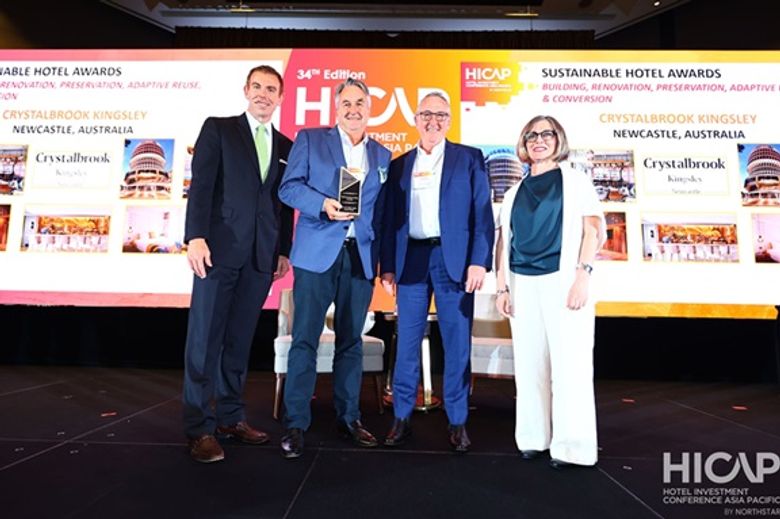
The HICAP Building, Renovation, Preservation, Adaptive Reuse, Conversion award went to Crystalbrook Kingsley, Newcastle, Australia
Building, Renovation, Preservation, Adaptive
Reuse, Conversion: Crystalbrook Kingsley, Newcastle, Australia
This
adaptive reuse of a 130-room luxury hotel that was once a Council
Administration Centre and is a result of architectural sensitivity, impressive
circularity, design precision, and sustainability-linked financing. The
renovation retains the 1977 architectural features of the original building.
Circularity is actualized with a deconstruction approach that recycles and
repurposes as much as possible, maximizing material salvage and diverting 900
tons of waste. The hotel sources recycled timber, wool carpets, and
eco-friendly furnishings from local suppliers. A system processes on-site food
and waste, turning it into compost-like material. Smart occupancy lighting and
air conditioning enhance both energy and operational efficiency.
Climate & Biodiversity Action: Six Senses Ninh Van Bay, Khanh
Hoa, Vietnam
This
resort is located in Khanh Hoa, Vietnam. The 62 pool villas and overwater
bungalows, several bars, and restaurants are on the beach, over the water,
between the rocks, or perched on the mountainsides. Since 2022, Ninh Van
Greens, the first in-resort solar farm in Vietnam, has consistently provided
electricity, organic produce, and hot water for the resort. Guests are invited
to share the responsibility by offsetting their carbon footprint, or by joining
the resort on their three major sustainability projects: black-shanked douc
langur conservation, coral restoration, and biodiversity preservation. The hotel’s
Sustainability Fund was injected to conduct biodiversity surveys identifying
300 species of flora and fauna. Among these, seven animal and 10 plant species
are listed as rare and precious in the Vietnam Red Book 2007 and the IUCN Red
List.
Positive Community Impact: Song Saa Private Island, Koh Rong
Archipelago, Cambodia
This
resort has a strong focus on the economic stability of the local community. As
well as prioritizing employment of local people, they enable the community to
increase the productivity and health of their fisheries through more
sustainable fishing practices and habitat preservation techniques. The hotel
also helps protect 10,000 ha of mangroves and seagrass in the Koh Rong Marine
National Park, which they helped to set up, supporting blue carbon
sequestration. Alongside this, they have provided education to 1,800 people and
supplies to local schools, delivered vitamins to local schools and healthcare
to 4,400 locals. Aware that access to clean water is a local issue, Song Saa
Private Island have distributed 200 water filters to the community and
installed rainwater harvesting and greywater recycling on site. They have also
worked to improve sanitation through recycling and composting program with the
local community.
Sustainable Design: Citadines North Walker
Sydney, North Sydney, Australia
This
252-key property in the Ascott Ltd. portfolio was designed with sustainability
at its core, targeting a 5-Star Nabers Energy Rating alongside 5-Star Green
Star Design. Located in a dense urban area, on a small site, the use of
composite steel and post-tensioned transfer structures resolved the constraint
of the site and addressed durability and resilience. The project incorporates
various energy efficiency strategies, compared to reference buildings this
hotel reduces operation greenhouse gas emissions by approximately 40% and peak
electricity demand by 30%. The façade design manages natural light reducing
glare and the need of artificial light efficiently. Water conservation,
rainwater harvesting allow for a reduction of 24% in potable water consumption.