Sean Hehir at Trinity Investments talks about transforming the
historic property from a Four Seasons and all of the projected ROI surrounding the $55
million renovation.
Sometimes, you spend a long
time pursuing a great hotel deal, and sometimes, the deal comes straight to
you.
The
latter was the case for Honolulu-based Trinity Investments with the 427-key
Ritz-Carlton Dallas, Las Colinas, which reopened in January after a $55 million
renovation and conversion from a Four Seasons to the luxury Marriott brand.
Sean
Hehir, president and CEO of Trinity Investments, said the hotel’s previous
owner, New York City-based Extell Development Founder and Chairman Gary
Barnett, contacted Trinity about selling the property.
“He
called my partner, Greg Dickens, and said, ‘I’d like to sell… Trinity is the
firm. We think that you’re the right buyer. This is my price. I don’t know if
it’s too high or too low, but I’d like to work with you directly.’ So that’s
where it started,” he said.
Hehir
said they didn’t know Barnett (except by reputation). But the more they looked,
it seemed like a great deal.
“We
thought as we looked at Dallas that we wanted to create a destination that
would negate the need to go to Hill Country [in Central and South Texas] or
other places for a staycation.”
Hotel Investment Today talked further to Hehir about how the second Ritz-Carlton in Dallas came together, and
we take a closer look at the renovations and the projected ROI behind them.
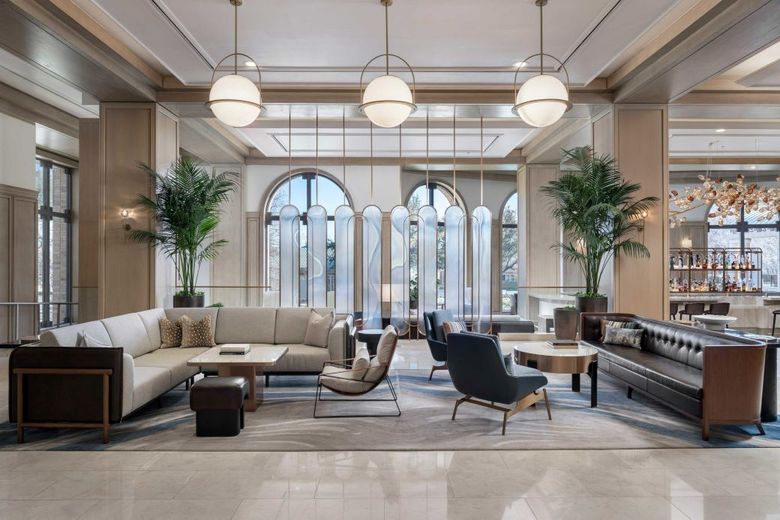
The lobby of the hotel has added a new bar.
Inside the deal
The
deal was a joint venture with Partners Group (which owns 70%). While the sales
price wasn’t disclosed (and Hehir wouldn’t offer it up), he did say, “We closed
on the number [Barnett] asked for.
“Large
firms like Partners Group rely on us for the in-house hospitality real estate
expertise,” Hehir continued. “We found the opportunity, we executed on the
renovation plan, and our team is asset managing it and interfacing with
Marriott on a day-to-day basis.”
He said while the property in Las Colinas (a planned community in the Dallas suburb of Irving, which has become home to many prominent corporate relocations) is urban, they had a lot of reasons to think of it as a destination.
“I’d say that’s a destination property with the demand feeders around it,” he said. “Then [add in] our ability to invest on a value-add basis and bring the capital and expertise to take that asset to the next stage of its ownership life. It hit all the buttons of what we wanted to do.”
Barnett
also owned the adjacent golf courses (which used to host a PGA event),
golf club and indoor tennis courts. They were purchased in 2022 by Century Golf
Partners and HKI America. Hehir said they negotiated a deal so that hotel guests could
use the facilities.
Hehir also said this is Trinity’s first deal in Texas, but he doesn’t think it will be its
last.
“What
we have focused on over the last seven, eight years are SMILE states, which
we define as Florida, Texas, Arizona, California and Hawaii,” Hehir said. “We
focus on more destination-oriented hotels… We’d love to do more in Dallas and
the surrounding sub-markets.”
Converting to a Ritz-Carlton
Hehir said there were no real roadblocks to the deal. Blackstone was an existing mezzanine lender on the project and was identified early on.
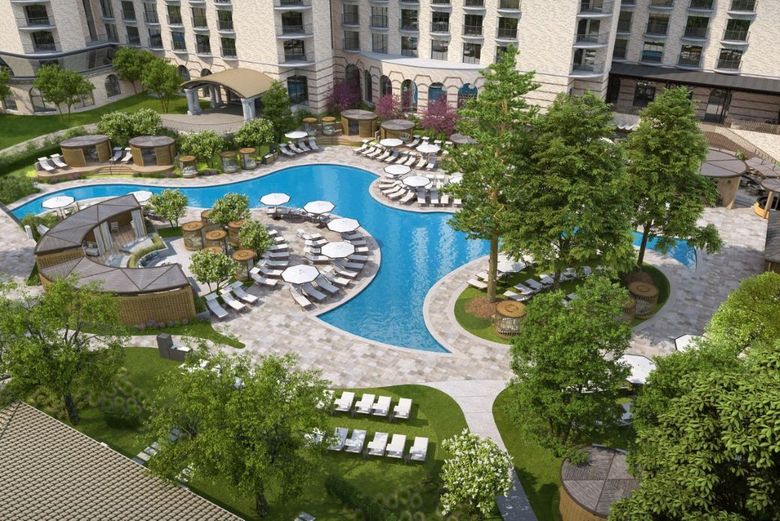
The resort's pool will feature more seating, luxury cabanas and a poolside bar.
Before
the sale, there was already an agreement for the Four Seasons to leave the
property because it was building a new $750 million hotel and residences in the
Turtle Creek area of Dallas.
Hehir
said that although Trinity has great relationships with many brands, it was a
simple decision to convert the hotel into a Ritz-Carlton.
“We
have a tremendous relationship with Marriott… We thought it would make an ideal
Ritz-Carlton,” he said. “We came to an agreement very quickly with Marriott and came up with the renovation plan.”
Hehir
said this was Trinity’s first time converting to a Ritz-Carlton, and it’s
something the company would happily do over again.
“Marriott
has been phenomenal to deal with,” he said. “They invested in this as well, and
it’s been a tremendous experience. They trust us with the design aesthetic and
so forth. We trust them on the management side. Plus, you are in their
marketing engine as you want to drive group business, etc.”
About the ROI
Hehir said that for Trinity, a big part of the renovations is spending a lot of time doing due diligence to develop the plan.

We’ve found that if you provide the product, consumers are prepared to pay for it. But you have to be in the right location. When you’re in the right location and provide the right product and amenities, it will cause people to come and then you’ve got to take care of them.
Sean Hehir
“We’ve turned investing on its head in terms of our asset management, and the project management team works hand in glove with our acquisitions team,” he said. “So, by the time the opportunity comes to our investment committee, it’s been fully vetted by those disciplines.”
Hehir said the property is right on track with Trinity’s typical timeline.
“Typically, once we close, we spend about the first year finalizing what that renovation plan is and the second year implementing that plan,” he said. “It starts to stabilize in year three and year four after that… We’ve been in the investment for almost two years now, and it’s cutting off its renovation soon.”
Hehir said the asset management team also spends much time on the P&L because expense margins are wrong or insurance is too expensive. “We’re constantly working the middle part of the P&L and driving occupancy, ADR, RevPAR, food and beverage and all of that.
“We’ve found that if you provide the product, consumers are prepared to pay for it. But you have to be in the right location,” Hehir said. "When you’re in the right location and provide the right product and amenities, it will cause people to come and then you’ve got to take care of them.”
Ultimately, Hehir said it can be a traumatic experience for a hotel to go through an ownership change and brand change simultaneously, but the on-property team has been great to work with.
“Gary was a phenomenal steward of the asset for the years he owned it. At the end of the day, that’s what we are. We’re stewards of these assets. We’re here to take care of it for the next period and to ensure that the team members and everybody else are taken care of along with it,” Hehir said. “Of course, at the end of the day, we’re in it to make money. But if people are well taken care of and you provide the right products and services, you’ll reach that goal.”
Inside the renovation
When
approaching renovations on a 38-year-old property, Hehir said the $55 million
in improvements focuses very much on the value-add. That
includes “activating” spaces like the lobby.
“Just
take the lobby bar, that previously was a zero revenue-generating space… Once
the space is activated like that, it draws additional people,” Hehir said. “We
saw that happen in Orlando. We saw that happen in Phoenix. We’ve seen that
happen in our in our other properties.”
While
many renovations have already happened, many more are still coming. The resort
pool will feature more seating, luxury cabanas and a poolside bar. The hotel already has 80,000 square feet of
meeting and event space.
The $55 million in renovations include 124 villas around the golf courses that serve as higher ADR, luxury guest rooms.
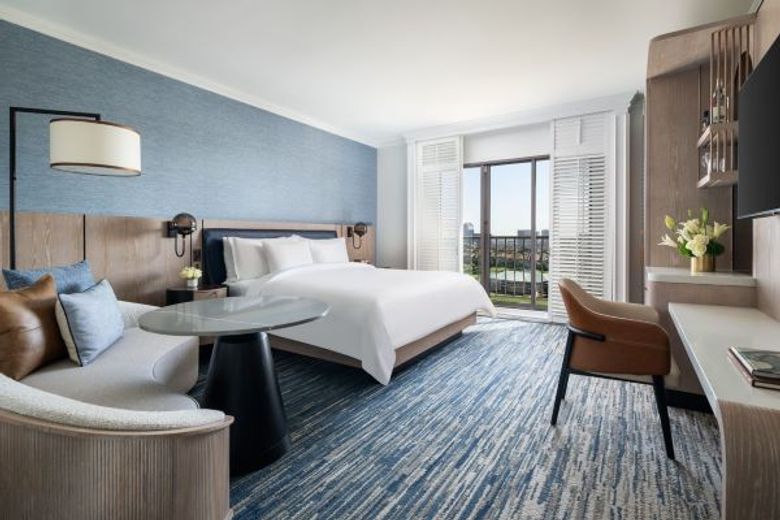
All of the 447 guest rooms were renovated as well.
“The villa product that we have around the golf course… that's
going to have its own personality and that's a different experience," Hehir said. "You
don't feel like you're staying in a hotel building. It feels more like you're
on a villa with these beautiful golf course views... So, it creates a different staycation
experience.”
F&B play
A
great deal of the renovations are in the food and beverage space, including new
bars in the lobby and pool, a Knife Italian restaurant opening this month from
celebrity chef John Tesar (who has been a fixture in Dallas and already has a
Michelin-star restaurant in Trinity’s Grand Lakes property in Orlando).
“When
we look at hotels, we look at them through the lens of a consumer,” Hehir said.
“And, let’s face it, nothing is worse than eating in a hotel restaurant.
Normally, they’re bland. They have no personality.”
With
the enhanced restaurants, “people don’t feel like they are eating in a hotel
restaurant. It’s a destination unto itself.”
Also
coming this month is a Ritz-Carlton Club on the second floor.
“What
we found with these club lounges is there's nothing worse than staying in a hotel and,
if you have kids, they charge you $50 for, and I’m exaggerating, a bowl
of cereal,” he said. “The beauty of these club lounges is that guests have the
option of paying up to access them… It becomes a hub so people can choose their
spots within these properties.”