It
may look like a dawdling start, but the chairman of the new joint company says
much progress has been made.
Update: On August 27, Accor named Ranju Alex as its CEO for South Asia (covering India, Bangladesh, Pakistan, and Sri Lanka).
Accor is a leading hospitality player and operates over 70 hotels in the region with over 30 hotels in the pipeline.
INTERNATIONAL
REPORT – Nearly five months since announcing a recalibrated partnership in
India, Accor and InterGlobe Enterprises are still without a CEO leading the new
company, which remains nameless, and have yet to obtain the regulatory
approvals to merge their earlier joint ventures into a single entity.
But
what appears as a dawdling start belies the headway that is happening inside.
According to chairman of the new company, Gaurav Bhushan, much progress has
been made in building its organizational structure, leadership and team,
details of which will be announced soon.
Hotel
Investment Today understands a top contender for the CEO position is an Indian
senior executive from Marriott International who has years of experience in
India. Marriott has 150 open hotels in India, twice that of Accor, and has just
signed six hotels with 1,000 rooms with Brigade Hotel Ventures, including a
Ritz-Carlton in Kerala.
The
new India domicile company will have an autonomous team led by a single CEO
reporting to its board and will be “completely localized,” said Bhushan, who
takes up the chairman mantle on top of his role at Accor as co-CEO of
Ennismore.
“Significant”
investment will be made on three areas: people, brands and technology, typical
of an asset-light company, he said. Development infrastructure will be
“substantially enhanced,” given the new target of 300 hotels in India by 2030.
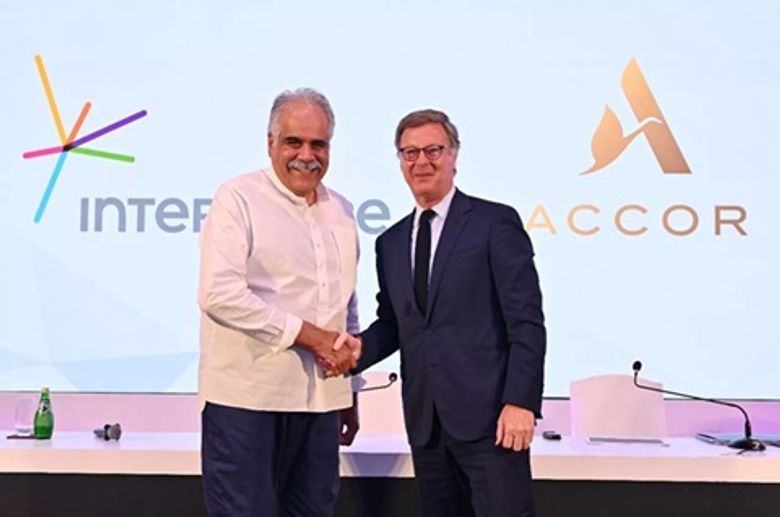
Rahul Bhatia (l.), InterGlobe Enterprises, signed a deal in April with Accor Chairman and CEO Sébastien Bazin.
“It’s
about strenghtening the size of our development team. It’s about making our
distribution and loyalty [program] stronger, and it’s about putting more brands
in place in India,” Bhushan said.
When
asked if a doubling of resources is on the cards perhaps, he said, “We’ve
announced that we want to go from 71 hotels in India to 300 hotels [by 2030],
and we will invest in the resources and whatever it takes to deliver the
target.” The existing joint venture operating company in India has around 50
people overseeing the operations of the portfolio.
InterGlobe
Enterprises appears to have greater control in the earlier JVs with Accor
through a bigger equity position. While Bhushan would not reveal the new equity
composition, he emphasized, “It’s a joint venture with joint control. We’ll
have a name with both Accor and InterGlobe in it.”
And
why is there no CEO appointment yet? “We’ve been at it, but finding the right
leader is not an easy task,” he said.
Red
tape in India is likely a factor in obtaining regulatory approvals. However,
Bhushan said this does not mean it will derail the growth target. “The existing
companies will continue with their own paths and operate independently until we
can put everything together into the new entity once we receive all the
necessary approvals. So, we are already growing through the existing operating
company, and the vast majority of growth is through asset-light development,”
he said.
All
signings – past, present and future – will be consolidated into the unified
company, save for ibis and Mercure, whose growth will be driven by Treebo,
following InterGlobe and Accor’s investment in Treebo.
Luxury,
lifestyle traction
Before,
Accor was mainly developing midscale and economy brands in India, but the chain
is now pushing the pedal on luxury and lifestyle development.

The India market is mature; the price points are at a level where it makes financial sense to develop luxury and lifestyle hotels in a more meaningful way. The evolution of the Indian economy, hospitality market and the Indian customer is probably the most important milestone in our strategy to double down on India.
Gaurav Bhushan
“We’re
putting new brands in the market with a much bigger team in place,” Bhushan
said. “Currently we’re operating nine brands in India, but we will more than
double this number in the next 24 months. So, the combination of brands and the
enhanced team is what will drive growth.”
He
added that there’s huge interest in Ennismore brands such as Mama Shelter,
Hoxton and Delano, and luxury brands such as Fairmont and Raffles. “There’s a
lot of buzz and excitement around bringing new products into the market,” Bhushan said.
Bhushan
declined to comment on why Accor is considering listing Ennismore in the U.S.
Speculation is also rife about another reorganization at Accor, including a
possible merger of Raffles and Fairmont into Sofitel Legend, Sofitel, MGallery
& Emblems, a platform led by its CEO Maud Bailey.
The
first Ennismore hotel in India is set to open in Mumbai this December.
Interestingly, the property will be a Morgan Originals, reflecting that India
investors aren’t afraid of experimenting or pioneering new brands. There are
only three open Morgan Originals hotels, two in London and one in Miami.
Fairmont
and Raffles are gaining traction. Fairmont Jaipur debuted in 2012; the second
Fairmont, in Mumbai opened last April – a gap of 13 years. But now, Fairmont
Udaipur Palace soft-opened last July, to be followed by Fairmonts in Agra,
Shimla Fagu and Goa Shiroda.
Likewise,
a third Raffles in Ranthambore will open by mid-2027, after Raffles Jaipur
(2024) and Raffles Udaipur (2021). Raffles Goa is scheduled to open in 2030.
“Life
is a lot about timing. Five or seven years ago, it was perhaps a bit early to
focus on a scalable luxury and lifestyle strategy,” Bhushan said. “But now, the
India market is mature; the price points are at a level where it makes
financial sense to develop luxury and lifestyle hotels in a more meaningful
way. The evolution of the Indian economy, hospitality market and the Indian
customer is probably the most important milestone in our strategy to double
down on India.”
Meanwhile,
progress has also been made on Accor’s partnership with InterGlobe's IndiGO.
“We’re on track to launch our loyalty points exchange in Q4 of this year and
enhancing our co-operation through cross marketing and other strategic
initiatives,” Bhushan continued. “This will have a strong impact on our
business, not just in India but in the Middle East and Southeast Asia, given
the strong outbound India market to these two regions.”
So,
how much time does Bhushan spend on India? “We already have a good team on the
ground, so I’ve been streamlining the organization, finding new talent, and so
on. Quite a lot of time, but it’s also going to be a great platform for
Ennismore to grow its brands in India. What is good for Accor in India is also
good for Ennismore in India.”