The
Provo, Utah-based third-party management company currently has a portfolio
heavily weighted on the West Coast and Hawaii but is open to growing anywhere
in the U.S.
PROVO, Utah — For Lodging
Dynamics, it’s not necessarily about pure numbers when growing its third-party
management business but more about finding the right fit with owners.
“Just as we expect owners to be
discerning when they choose a management company, we’re discerning when we
partner with owners,” said President and CEO Jamie Caraher for Provo,
Utah-based Lodging Dynamics Hospitality Group. “We want them to line up with our
core values and moral compass and we also want to make sure that we’re bringing
on hotels that make sense from a geography perspective and where our target
markets are.”
The company recently grew its
portfolio in California by adding the 294-key Residence Inn at Anaheim
Resort/Convention Center and 174-key SpringHill Suites Anaheim
Resort/Convention Center to its management portfolio. Newport Beach,
California-based T2 Hospitality sold the two assets earlier this year for $303
million to Provo, Utah-based Dynamic City Capital, which is Lodging Dynamics’
sister company and “strong partner.”

We’re excited about the growth we’ve had and our goal has been to add about four or five hotels to our portfolio every year. Over the last five years, we’ve achieved that. It’s a responsible pace. It’s the right pace so that we can scale the organization in the process.
Jamie Caraher
Lodging Dynamics’ portfolio is
about 28 hotels and around 4,300 rooms right now (about 70% of the properties
are select-service while the rest are lifestyle) and Caraher said more growth
is on the way.
“We’re excited about the growth
we’ve had and our goal has been to add about four or five hotels to our
portfolio every year. Over the last five years, we’ve achieved that,” Caraher
said. “It’s a responsible pace. It’s the right pace so that we can scale the
organization in the process.”
Caraher said the company’s board
isn’t concerned with being the biggest, but that’s not to say they are opposed
to growing more rapidly as well.
“The conversations I’m having with the board are
that our target is to get to 50 [hotels in the next two years], and then we’ll
pause,” she said. “Then we’ll talk about: Where’s our skill as an organization?
How is that impacting the people we serve? We want to be able to always say
that we’re going to be able to provide personalized service. The reality is you
can’t get to 100 hotels and provide personal service.”
Lodging Dynamics is a pure
management play and doesn’t have ownership stakes in any of its hotels. Caraher
sees that as an advantage.
“That makes us a little bit
unique. We don’t have any skin in the game, meaning that all of our owners
equally get our attention and our passion and commitment to a return on
investment,” she said. “Our owners tell us they feel that that is a separator from
other management companies.”
Prospecting for
owners
Nick Vitolano, who was recently
promoted to director of business development for Lodging Dynamics, said part of
that growth is growing organically by adding hotels from its current owners,
but it’s also about establishing new relationships as well.
“I always like to say it’s just
as much about prospecting for deals and properties as it is prospecting for
owners,” he said. “We want to make sure that we’re aligning with groups that
fit how we work, especially from a values and workflow perspective.
“We want to continue to remain
as much of a multi-unit operator as we can. But we understand that not
everybody has the unlimited pockets to just continue buying hotels.”
While Lodging Dynamics has a lot
of its properties on the West Coast, the company is open to growing anywhere in
the U.S.
“There’s a lot of noise around dissatisfied owners with
some of the larger operators and we think we’ll have a great opportunity to
organically grow through word of mouth, through our current owners and grow
through new management contracts,” she said.
“We’re excited about the opportunity to grow in our
current locations. So, that covers the western region, Hawaii and Florida. We’d
love to grow in all of those markets that we’re currently in.
“If an owner really aligns with
who we are as an organization… we’d honestly put the conversation on the table,
no matter where it was, because we know how valuable those relationships are.”
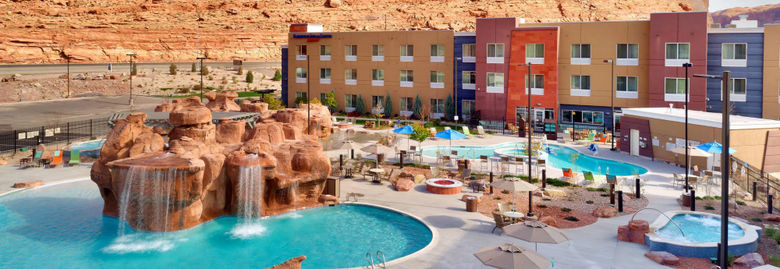
Lodging Dynamics has properties in leisure destinations, like this Fairfield Inn & Suites next to several national parks in Utah.
Unique portfolio
Vitolano said the company’s
current portfolio doesn’t just focus on large markets but also unique leisure
destinations like gateway properties next to National Parks.
“The thing about our portfolio
that really puts us in an advantageous position is where these properties are
located,” he said. “There’s been a lot of thought into making sure that these
were sustainable locations.”
Caraher said while the portfolio
size is smaller, “the quality of the assets is pretty profound.” She said the
company saw ADR grow about 3% in 2024 while occupancy stayed flat in the high
70s, with RevPAR also gaining slightly.
“Ultimately, it’s about market
share. Even if you have some markets where hotels are underperforming, then you
want to look at market share and how we are doing,” she said. “Our goal as a
company is to grow the top line, but we also want to make sure that we do a
really good job managing the middle. From a GOP perspective, our hotel
portfolio also grew significantly year-over-year. We had some hotels that
missed budget, but we had almost every hotel performing better than last year,
which is a good indicator.”