Learn how four hotel veterans are turning labor challenges into opportunities to improve productivity and profitability.
Editor's note: To view the complete free webinar on demand, register here.
NATIONAL REPORT — A “C-suite” is taking on new meaning for hotel owners and operators looking to wrangle labor challenges to protect GOP margins according to industry experts who spoke on Hotel Investment Today by Northstar’s (HIT’s) recent webinar, “From Cost to Catalyst: A Strategic Labor Playbook to Drive GOP and Asset Value.”
Drawing on first-hand experience, these thought leaders talked through new tactics and trends that reposition labor from a line item to a growth driver. They drilled down on the ways they are combining the “four c’s” —centralized tech, people-first company cultures, strategic rather than stringent cost controls and enterprise-wide commitment to engagement — to recast the labor “problem” as a solution for increasing GOP and asset value.
Providing a step-by-step walkthrough on how hoteliers can make that happen were:
• Shanell Marinuzzi, account manager, Actabl
• Charles Oswald, CEO, Aperture Hotels
• Kirk Pederson, president, Sightline by PM Hotel Group
• Chris Tatum, president-operations, full service, Aimbridge Hospitality
Mary Scoviak, custom and design content director, Hotel Investment Today by Northstar, was the moderator for the live Sept. 17, 2025, broadcast, which is now available on demand. Actabl was the topic sponsor. (The company collaborated on the webinar planning but had no influence over the editorial content.
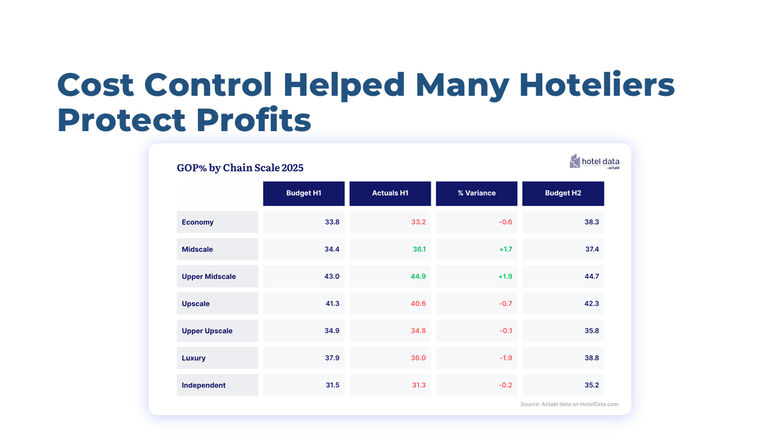
Actabl's data shows the gap between predictions and actual GOP% for H1 2025.
How to get ahead of 2026 labor trends
Targeting trending strategies, AI and technology, EBITDA erosion and guest/associate expectations were top-of-mind influences cited by Oswald.
“New technology helps us to better measure and manage labor. And AI is probably the biggest competitive advantage for any innovative company today,” he said.
These tools will be pivotal in addressing what Oswald views as a key near-term concern: EBITDA erosion largely driven by wage growth that outpaces the Consumer Price Index which, in turn, is outpacing RevPAR growth.
Tatum listed productivity as a continuing focus. Unlike mandated increased minimum wage rates or economic factors that are not within operators’ control, he noted that productivity gains made possible through a variety of operator data and training initiatives can play a central role in improving the P&L, “especially when we have markets that are struggling.”
Pederson said his company sees the lack of skilled labor as an important trend to watch. “The labor pool…continues to shrink every year. So, it's taking longer for us to find the right bodies to put in the right positions.” It is also requiring more proactive recruitment approaches, from expanding search efforts beyond the hospitality industry to implementing sophisticated screening software to provide a more holistic assessment of the candidate and better analyze the person’s skills, strengths and challenges.
Pederson described PM Hotel Group as “very focused” on not being substantially dependent on contract labor going forward.
“Post-COVID, dependence throughout the industry on contract labor continued to rise…We are trying to pull that back, obviously because of the cost…[but also because] the dedication and productivity you get by having your own employees versus contract employees is much, much higher,” said Pederson. He added that shifting from a high contract labor model can save “a good 10% to 15%” depending on the hotel.
“New technology helps us to better measure and manage labor. And AI is probably the biggest competitive advantage for any innovative company today,” said Charles Oswald, Aperture Hotels.
Oswald also underscored the important of not relying on contract labor.
“Contract labor is a very, very small mix of our workforce today. We've been able to bring the vast majority of those people inside bring those people,” he said. “Generally speaking, we only have contract labor at hotels that we recently took over. That said, it's important to have a labor management system where you can put in those hours and dollars separately from in-house labor that's swiping in and out in regular timekeeping systems. We do that so that we can monitor productivity and tackle any labor productivity issues before they metastasize into a bad P&L.”
Considering that, Pederson forecasted continuing emphasis on culture. “We’ve really seen that culture contributes to profit. If you're able to retain people, you obviously have a higher profit margin,” he said.
Marinuzzi, who during her prior 25-year hotel industry career was dubbed a “GM fixer” helping transition underperforming properties back to profitable productivity across multiple brands, tagged a trio of trends to watch. These include revenue compression on profit margins, the labor cost of associates outpacing inflation and operators who are right-sizing and using technology
“The market has compressed much more than I think any of us thought it would,” she observed.
Marinuzzi agreed culture “is huge” and having the right people in the right positions is key, particularly to help safeguard GSS.
The Ouch Factors
As Marinuzzi showed in the data, labor costs surged past hotel budget predictions, increasing 6.6% YoY as RevPAR simultaneously declined 15% in H1 2025. Utilizing technology is one solution, she said. “When I finally embraced technology…I reduced overtime by 50%. That wasn't just efficiency, that was money back to my bottom line at my property. The biggest difference between protecting returns and watching them evaporate is using technology to help you see your own blind spots…Profitability isn't just luck, it's discipline.”
The panelists agreed labor costs such as overtime, staffing levels and using contract labor are more controllable than trying to wrestle against (often government-mandated or negotiated) wage increases.
“Everyone, up to the chairman of the company, is watching the data weekly," said Kirk Pederson, Sightline by PM Hotel Group.
The specter of turnover haunts almost every property, which Tatum said “is devastating to the profit of hotels” and why it is so important to create an embracing culture. More-committed, retained employees help offset onboarding costs and are more likely to care about “their” property and “their” customers than contracted labor.
Tech: Leveled-up forecasting, balancing productivity and performance is key to protecting margins
To be nimble enough to handle fluctuating staffing challenges while trying to hold tight to a predictable budget that hits realistic numbers, Aimbridge has spent “a fair amount” of resources and time putting together better forecasting tools and actually incentivizes its teams, Tatum said.
Aperture emphasized precise tailoring in their model to ensure accuracy. “For labor modeling, we established a core labor org chart and productivity model for each product group,” said Oswald. “There's a compact full-service model, a premium select-service model, and a limited-service model. And then we upload those labor standards into our labor management system and we fine tune to match the unique physical attributes of each hotel building and the customer experience and desire at that location.”
Tatum noted another game-changer last year in its labor-management strategy was implementing a balanced scorecard throughout the organization. “By working on a balanced scorecard that takes into account our market share, our guest satisfaction scores, our associate satisfaction scores, and focusing on comps overall, they all intermingle…everyone is on the same page and focused on the same goals.”
Having a balanced scorecard approach should be a priority, Oswald concurred.
“That's something we've had since day one as well,” he said, noting any discussion on labor productivity needs to be “balanced” against quality performance.
“Anybody can have the world's fastest cleaning times but also have the world's dirtiest room. If we don't balance that quality and productivity right and watch it on a balanced scorecard and reward our leadership teams accordingly, we might be missing something,” he said.
Data: Company-wide tracking, hands-on approach maximizes the value of labor information
On a need-to-know basis, everyone needs to know. That’s the backbone of making data actionable and keeping both operators and teams accountable. “It’s a focus of our executive committee,” said Pederson. “Everyone, up to the chairman of the company, is watching the data weekly.” Marinuzzi concurred on the importance of frequent monitoring and added that it’s also key that team members themselves understand the numbers they need to hit on a daily basis.
“If you have the same system across all of your portfolio…once you train a GM at one of your hotels... if they're going to take over an underperforming hotel, they know how to fix it,” said Shanell Marinuzzi, Actabl.
Standardizing certain operating/tech systems has the dual benefit of increasing operational efficiency and creating opportunities for associate development.
“If you have the same system across all of your portfolio…once you train a GM at one of your hotels, they can now move to another hotel, pick up the systems they have, be able to know the processes, know the SOPs that need to happen [and] if they're going to take over an underperforming hotel, they know how to fix it. I see it as a key differentiator,” said Marinuzzi.
Even without an SOP across a portfolio, Marinuzzi said it is imperative for hoteliers to know how to use the technology they do have. “Make sure you understand how to use it and incorporate it, but also have a backup plan,” she said.
Culture: Retaining employees is a two-way dialogue
Culture is a core factor in retaining associates, the panelists agreed. Retention is hoteliers’ power tool for coping with these challenges – and that’s turning the cliché of “investing in people” into a vital action step that starts with taking employees’ lead about the work environment and training that matter to them now.
“We’ve really seen that culture contributes to profit. If you're able to retain people, you obviously have a higher profit margin,” Oswald said.
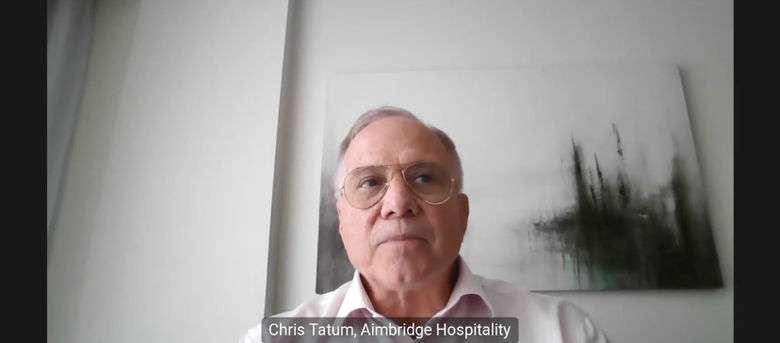
"Previous generations of hoteliers may have had to relocate a dozen times or more as they advanced their careers. Now, they want opportunities for growth without having to move," said Chris Tatum, Aimbridge Hospitality.
Guiding associates and recognizing their needs ultimately plays into profitability. “Previous generations of hoteliers may have had to relocate a dozen times or more as they advanced their careers. Now, they want opportunities for growth without having to move. They like where they are; their families like where they are,” said Tatum. “We’re also hearing from some team members that they don’t want to travel so much, that they want flexible schedules and that they don’t want to commute to an office every day. We have to look at how to respond to the needs of these talented associates in order to retain them and to recruit people like them to make Aimbridge a stronger company long term.”
“It’s not always about the money the employee is making,” Pederson stressed, adding that hoteliers need to capitalize on current employees’ drive to upskill. “We have a learning management system called the Foundry where our employees are given the opportunity to take courses in multiple topics. The participation rate outside of their individual job description is so high that you have to realize that employees want more out of a job than just a 9 to 5 and a paycheck. They want to feel like they're part of something.”
Stefani C. O’Connor is a journalist based in New York City.
The views and opinions expressed in this content do not necessarily reflect the opinions of Hotel Investment Today by Northstar or Northstar Travel Group and its affiliated companies.
Complete video transcript:
Mary Scoviak: Welcome everyone. I'm Mary Scoviak, custom and design content director for Hotel Investment Today by North Star. Thank you so much for joining our webinar today.
It's certainly on something that we feel is top of mind for most managers, from cost to catalyst, a strategic labor playbook to drive GOP and asset value. And certainly, we all know it is one operational cost that we can control. We also know that it is, right now, one of the biggest concerns for most operators, especially as there's pressure on margins.
So we're going to look at today what you can do about that, what the lay of the land is, and how you can change your strategies to help protect your GOP percentages, and also to improve guest satisfaction and employee retention.
Joining me today is a list of expert panelists to talk about this from the ground up, and also in terms of trends. I'm going to ask them to introduce themselves and tell us, in their view, what are the three key trends for 2026 and 2027 in terms of labor management and concerns about labor. Charles Oswald, start us off.
Charles Oswald: Oh, fantastic. Yeah. So I'm Charles Oswald, CEO of Aperture Hotels. Aperture Hotels is a boutique-sized third-party hotel management company that operates a portfolio of compact full-service, lifestyle and select-service hotels. Our portfolio runs coast to coast, from Florida beaches to California and from Texas to the Canadian border.
Thank you very much for inviting me to join the conversation today.
I'd say the three key labor trends that come to mind off the top of my head are probably AI and technology, the EBITDA erosion and people expect more. When it comes to I think technology, I think it's fantastic now that new technology helps us to better measure and manage labor and AI, of course, is probably the biggest competitive advantage for any innovative company today, but it enables productivity, right? So by definition, we'll probably see some when there's more productivity, that means less man hours to produce the same results, which obviously is ultimately going to lead to some changes in our org charts of our business in the future. When it comes to EBITDA erosion, I would say that that's largely driven by wage growth that outpaces CPI, which is outpacing RevPAR growth.
And so there are tools out there, I think, in the labor world, that can help us benchmark our pay rates make sure that they're the right competitive level in each of our sub markets. And when I say people expect more, I think it's both customers and employees, right? So customers, we've seen some revenue bifurcation and growth in RevPAR that differs for those experiential hotels versus, you know, say, limited-service properties. And so with that customer experience, obviously, often comes a little bit more of a labor commitment.
And then, with our labor group, they're expecting more, you know, better work life and experience and quality and rewards and so those are probably three things that affect us the most as we're running forward to 2026 and 2027.
Scoviak: Chris, would you introduce yourself as well?
Chris Tatum: Thanks, Mary. My name is Chris Tatum. I'm the president of the Full Service Division of Ambridge Hospitality. Aimbridge Hospitality, we manage hotels worldwide, about 1,000 hotels worldwide, from economy through luxury, from US, Canada, the Caribbean, Europe and in Latin America, I've been with the company for about a year.
Prior to this, I was with Marriott hotels for about 38 years, and then Davidson Hospitality for three years. Great to join you today.
Just the priorities for us right now. Number one is kind of what Charles talked about, obviously, productivity is always going to be a focus, especially when we have markets that are struggling and being able to respond to that and in a measured way, to balance, obviously saving money, but also continuing to provide good guest service and keeping associates and using technology to get data quicker, to be able to respond quicker, and be able to hopefully drive a little more money to the bottom line without impacting the other areas of service.
The other thing for us is, you know, providing leaders, strong leaders, opportunity for growth without having to move. We've got a lot of people who don't want to move anymore. They like being with their families. They like staying, they don't want to travel, like maybe in the past what we had to do. And so how do you provide them that opportunity for growth without having to relocate?
And the last one was flexible schedules. You know, the next generation, clearly, including my kids, clearly, would prefer to work certain days, certain times, be flexible, not have a nine-to-five job. And how do you position that correctly and be able to respond to the needs of these talented associates, which will allow us to retain them but also recruit them stronger for the company?
Scoviak: Thank you, Kirk.
Kirk Pederson: Hi, Mary, yeah, thank you for having me today. My name is Kirk Pederson. I'm president of Sightline by PM Hotel Group. Sightline was merged into PM Hotel Group in November of last year, and PM Hotel Group is an 85 hotel portfolio, ranging from select-service hotels all the way up to luxury hotels all the way across the United States.
I think the unique perspective I may bring to this conversation is my background working with the public real estate investment trust in the asset management world, in the acquisition and business development world, and also running a hospitality third-party management company. Labor is key in all of those disciplines. I will tell you the thing that kind of keeps us focused, or the areas that we're more focused on this year continue to be the lack of skilled labor. That labor pool is shrinking. It continues to shrink every year, and so it's taking longer for us to find the right bodies to put in the right positions.
We also are very focused on not being as dependent on contract labor post-COVID. You know, our dependence throughout the industry on contract labor continued to rise and continue to rise. We are trying to pull that back, obviously, because of the cost associated with contract labor, but also because of the dedication and productivity that you get by having your own employees versus contract employees is much, much higher.
The third, I think, is, you know, culture, culture, culture still remains key for us, and we've really, we've really seen that culture contributes to profit, right? If you're able to retain people, you obviously have a higher profit margin. So we're very focused on culture, and those are the three things.
Scoviak: Shanell, thank you, Kirk.
Shanell Marinuzzi: Absolutely, Mary. I'm so happy to be here as well. So my name is Shanell Marinuzzi. I'm an account manager at Actabl, and so in my career, I have been operating hotels for about 25 years, prior to coming over to Actabl in the last year.
And the things that I love working with hotels is I've worked with lots of third party property management companies through my career, including multiple brands such as Marriott, IHG, Hilton and Carlson throughout my year, and the thing that I've been known for over my course of my year is that I'm a GM fixer, where I will take over properties that are underperforming and teach them a different culture to be able to increase productivity and retain those top employees. So that's something that I'm known for across the industry.
The thing that I love that I'm doing now is now I get to help hoteliers on the tech side, as far as working with software to make sure that they're still improving and performing well in the market, as well as keeping those employees happy and retaining top talent.
Some of the three strategies or trends that I see on the on this, this side of it is, I would say their revenue compression and our profit margin is something that we're definitely keeping a close eye on as hoteliers, especially this year, the market has compressed much more than I think any of us thought it would. Another thing that I've noticed is that the labor cost of our associates is outpacing again, inflation and our growth similar to what Charles had mentioned. And then the last thing that I've noticed is that our operators are who are right-sizing and using technology, are actually performing and over performing in the market.
So that's something that I would look at, as far as that goes as well. And some of the ways that you're able to do a lot of these things is, again, employee retention, retaining those top talents and similar to what Kirk said regarding culture, culture is huge to make sure that you have the right people at the right time. Another way that you can look at this as well, when you're looking at your labor market in general and your labor team in general, is, do you have the right people in the right positions, where they do the best, where they perform the best. Do you have a morning person working your seven-to-three shift, or are they a night person who's now working a morning shift? That doesn't work very well for your customers, so your GSS could suffer as well. So those are some of the three key focus areas that I would look at as well.
Scoviak: Thank you all so much for that. We want to start our discussion by looking at where we stand right now with statistically, looking at RevPAR, looking at GOP growth.
Shanell, I'd like you to give us your metrics so that people know what where they are in the playing field, what the state of the situation is.
Marinuzzi: Absolutely thank you, Mary. I'm going to show some slides to help talk through what we have, what we have for you today. So we've pulled some data from our current ProfitSword customers. The data is aggregated and anonymized across the country, with approximately 2,000 hotels in the US market and all market segments for the first half of this year, and to provide the day that we are showing. We also have this data available to you for hoteliers on hoteldata.com and this will be updated regularly as a free resource to hoteliers.
So one of the things that we looked into as we dive into the data is overall, RevPAR has seen a large decline with what hoteliers had budgeted at the beginning of this year, RevPAR is down across the industry. Around 15% occupancy was the largest contributor to the RevPar decline, although you might be seeing differing factors in your local market, overall industry, RevPAR is a miss based upon the industry expectations of the first half of 2025 based again on what hoteliers were budgeting with RevPAR down, I always want to look at the next key focus area, which is our expense side. So when we look at our expenses, our largest controllable expense is labor. So as you can see, labor costs surged past hotel budget projections, outpacing inflation even of 6.6% year over year, when labor costs outpace budget this significantly, we have to look at ways to reduce labor expense. But the solution isn't reducing headcount. We all need our people.
Another way that I look at this is, where does each of my team members best perform, as I talked to earlier in our conversation, don't have an evening person working a night shift. For years, I personally ran my labor off of Excel spreadsheets, and I thought I had it all figured out prior to using technology. When I finally embraced technology my first year, I reduced overtime by 50% that wasn't just efficiency, that was money. Back to my bottom line at my property. The biggest difference between protecting returns and watching them evaporate is using technology to help you see your own blind spots.
So now I want to see again how that contributed to GOP. So we are seeing a clear trend, despite the headwinds we have seen thus far in 2025 even in this down revenue market, many of our Actabl customers who use our technology are protecting their own profit margins. Not just keeping up - they're outperforming the market and achieving growth. They're doing so by using discipline, labor strategies and technology to help see their blind spots to ensure they're achieving high GOP profitability isn't just luck, it's discipline. Labor is the biggest differentiator that protects your investment, and I believe will continue to do so in the coming year.
Scoviak: Thank you so much. Shanell, that was really helpful. Looking now at what it's like for the people on the ground and how they're going to cope with some of the challenges and the opportunities of 2026 and 2027.
I'd like to open the discussion with talk about costs. People projected that costs would moderate this year, that labor increases would be maybe three to 5% and then we had this explosion over what's going to happen with minimum wage, obviously, in very isolated markets at this point, but it's difficult to think that other markets would not follow suit. So looking at that, how much should people be bracing for increases in labor costs, and what can they do to offset that? Chris, why don't you take that?
Tatum: Yeah, I guess the first thing is, obviously, you're not going to control a lot of the wage increases. We don't have control. They're negotiated. And you know, we're going to have to work through and we just have to manage the business around that. I think, you know, for our teams, it's focusing on the things that we can control, rather than things we can't control. We can control overtime, which is a real focus for us.
And also, you know, we talk a lot about our teams. Turnover is devastating to the profit of hotels, and really thinking through on what motivates our team to stay and how do we do it, whether it be, you know, the benefits, whether it be the experience, whether it be their work, the work environment, all those things are so important because that's to me, that's the only way we're going to we're going to get around the challenges of wages. Because, like you said before, we still need to clean the rooms, we still need to check in the people. We still need to have the staff. There's a minimum staffing when you start to get down and lower occupancy, but keeping the right people and keeping the most talented people will be the most productive for us moving forward.
Scoviak: What do you what would you ballpark turnover as costing?
Tatum: Oh, gosh, you know, it depends which hotels and the value of their wages. But in general, I mean, the industry does almost like 50% turnover. Ours, fortunately, is a little lower than that. But you know, you think that every time you bring someone on, depending on who it is, a front desk person could take a month to get them trained on the front desk. And you multiply that out, it's pretty significant, let alone the other departments.
Scoviak: And how long before they're fully productive?
Tatum: Fully productive? A front desk person could be six months, you know, a housekeeper, obviously, depending on the experience they have, they can probably get up and running quicker. But you know, the skilled positions, the kitchen, those areas, you know, it takes a while to get into the processes of that hotel, and especially in the technology areas of the front desk, got to learn a whole new system, whole new processes. That can be very expensive for you.
Scoviak: Charles, I wanted to ask this is something we were discussing before we started, and that is the cost of contract labor and obviously overflow over time. But how are you using technology to help you benchmark the contract component in your labor strategy and how much of an improvement were you able to affect by instituting various kinds of technology and data-driven decision making?
Oswald: Good question. First off, contract labor is a very, very small mix of our workforce today. We've been able to minimize that and bring most people, the vast majority, inside and generally speaking, we only have contract labor at hotels that we recently took over, and we're watching that attrition away. So that's the good news. But then there's that question of how do you manage it while it's there.
It's important to have a labor management system where you can put in those hours and dollars each day, track what that is, separately from your in house labor that's swiping in and out in your regular timekeeping systems, and we do that so that we can monitor that productivity continually throughout the throughout the course of a week, and to, you know, tackle any labor productivity issues before they metastasize into a bad P&L, you know.
Kirk made a comment about contract labor. I think it was Kirk that said it. But there's a point there where we have to recognize in-house labor is probably going to take a little bit better they definitely do, on average, take a little better care of your property, a little better care of your customer. They're a little bit more committed to the operation. So where you can, you want to minimize contract labor and go with those who are going to be more engaged and work under your payroll.
Scoviak: Kirk, how do you use data to benchmark your portfolio so that you can see those trends, especially now when the booking windows are getting shorter and scheduling and looking at your needs is getting much more complicated?
Pederson: That is great, Mary, as long as the data is good data. I think one of the one of the challenges that we all have right is getting your teams to embrace the new technology right and to insert that data where they need to be inserting that data. I think one of the things that we do to make sure the teams are doing that is it's a focus of the executive committee. Every single week, we look at that data together, we know what hotels are inserting the data correctly and what hotels are not. And if you're not doing it, it clearly doesn't show well, right for those individuals who are called out for not participating. So it has to be a priority.
Mary, there is a ton of data available to us, and it's how important you make that data and the collection of that data, and then what you do with the data? You know, like I said, it's a focus of ours. Every single week our most senior team. It's not just the operations VP, it goes all the way up to the chairman of the company. We are looking at that data every single week. So it's very, very important. And you know, to Charles's comment about the contract labor.
Actually, I had a conversation with one of our EVPs of operations this week, and he said, and, you know, I just, I was walking down the corridor, and I saw one of our contract housekeepers take a freshly cleaned white washcloth and put it down under the door as a door stopper. Perfect. It's a perfect example of contract labor. They're not thinking about the bottom line of the hotel. They're not committed to the profitability of the hotel. They're just there to, you know, to do a job. And again, they're probably not trained as well as they need to be trained, because these are bodies that you know you're bringing in. There are other markets where you have contract labor that essentially becomes your labor, right? Contract labor that's been in your or working in your hotel for months and months and months, and then you're able to train them, and they don't use the washcloths to do things that others would use them to do. So it really depends on the market. But like Charles said, we're trying to wean ourselves off of that contract labor as much as we possibly can, because it creates more culture, and culture does create profit.
Oswald: Washcloth is better than the room service spoon sitting on the tray that's out in the hallway. So you know.
Pederson: I mean contract labor, you again, I don't, I don't want to be the downer here, but I've seen them actually take soiled linens and throw them away in the trash can, instead of sending them to laundry and have it so it just it impacts you in a lot of different areas.
Scoviak: Yeah. Shanell, I wanted to ask, obviously, all management companies know what they're supposed to be tracking. They know all the big numbers they're supposed to be using. What are some of the things, the benchmarks that they could add into their tracking, some of the things that you find that give them a lot of little nuggets of information that can be critical to protecting their GOP?
Marinuzzi: Yeah, absolutely, obviously, expenses is very, very important. We all look at that. We all know that's going to flow through to our bottom line. Other areas to really look at, though of controllable expenses that you think about is look at your cost and the employee retention side of it. Look at your tenure of your staff. And also look at your IDPs, I say, individual development plans for your team to be able to understand, like, what are their needs, what are they looking for, and then contribute their why as an individual to what your business plan is, the other thing I always like to measure, I know we all measure this every day at the hotel level, is GSS know how each individual person is protecting that GSS score and really understanding where they need to go. So there's lots of different ways that you can, lower or increase your GOP dollars. As far as those, and it really pertains to your team, is how I look at it.
It comes down to who's going to take care of your guests. Because if you have the right people at the right place, they will protect your GSS. They'll also protect your risk mitigation, or the points that you're giving back to customers if they're upset for any failures or things that happen at the hotel. So that's another area that I always paid attention to, is how much are we giving in points for different things that have fallen through the cracks, or ways that we can mitigate costs there as well.
Scoviak: Wondering too with so much attrition in the hotel industry, obviously the recent numbers for 2025 showed a 16% drop in open positions, which is great, but obviously that has not solved the problem. So when you're hiring, what kinds of strategies are you using to make sure that you get the right person for the job, but also that you are offering a competitive package that will keep them there without overspending or, you know, over-enticing these you know your candidates. Charles, go ahead.
Oswald: First of all, I think we always have to, we all have to recognize that your customers experience will never be better than your team members experience right so we do have to have the right people on board and deliver a great culture and engagement and have that sense of employee well-being. That starts with the hiring strategy, right? You can't overlook that aspect and how important it is.
The way we approach it is, you know, we cast a broader net where, you know, we have that single source job distribution that a lot of people see when we have an open role, and then we have some pre-screening processes depending upon the role, right? But the higher up you go in management, for example, you'll have not just behavioral assessments, but cognitive assessment that has to be completed and passed, and you have to be a highly recommended employee before we'll even continue to process you through the the interview process.
Scoviak: Is that for line employees as well as the executive team?
Oswald: There's a simple assessment for some line employee roles, and there is and then there's a more complete assessment that's both behavioral and cognitive for key management roles like general manager and director of sales, for example.
Scoviak: Thanks. Go ahead.
Oswald: So I think that pre-screening process is a really helpful way of saving hiring managers tons of time from thumbing through applications, resumes and all the time that it takes to sort of figure out who am I going to talk to? And you know, you might have plumbers and electricians that have applied to be your director of sales, and they're just not the right fit.
So if you kind of work through fit pre-screen now, you're dealing with a small group of people that have come through the funnel that's very focused, that have a high, a strong potential to be successful in that role as we go forward. And that's a piece. I just think a lot of management companies don't spend enough time on.
Scoviak: Chris. One of the questions I had is, you know, in terms of hiring and engagement, Shanell said that, you know, nobody expected these numbers to look like they did at the end of 2024, or going into 2025, when you're looking at the amount you're going to invest in hiring and training and all these things, how do you balance the need for nimbleness in order to respond to these situations, which seem to be really in flux right now, you know, and still make a predictable budget that you can hit with realistic numbers?
Tatum: Yeah, you know, we've spent a fair amount of resources and time putting together better forecasting tools. You know, it's, it's interesting looking at the data that Shanell shared with us, imagining staffing for that budget. However, those numbers actually coming in where they are, and then what do you do with those, those people that you've committed to jobs and that turnover is significant, and nobody wants to run a business that way.
So I think number one is having a good forecasting tool and understanding for us. We even, you know, it's so important to us, we actually incent our teams now they're part of their balance scorecard. They have to hit certain thresholds on on forecasting, because we know it's not only important to the owners that they know what the business is, but you can't operate unless you know what your what your sales volume is going to be. So I think that's the important part of it, and then making sure that the manager and the team, they can relate the expenses associated with turnover to the impact on their GOP. So same thing, you know, we have turnover thresholds that each of the hotels have, that their goal is, is to keep that down as low as possible. We know, in our business, in our industry, historically, it's been a pretty high turnover industry, but I think that's improving over time, because people are realizing the cost of turnover, investing in our associates and making sure they have the training and the support.
And a number of the panelists talked about culture. It's gotta be some place they love to work. I mean, we've got a lot of associates to come to our hotels, their best, their best meal of the day, experiences at our hotels. So we want to make sure we continue having that experience. People want to come. You gotta have people that want to come to work.
Oswald: Chris, you said something that so important, by the way, you mentioned the balanced scorecard, and I love hearing that from you. That's something we've had since day one as well. And I think that plays on something Shanell said earlier as well, that it's balancing this conversation of labor productivity with quality as well. Right? The quality orientation, anybody can have the world's fastest cleaning times, but also have the world's dirtiest room, right? So if we don't balance that quality and productivity right, and watch it on a balanced scorecard and reward our leadership teams accordingly, we might be missing something, or they might not understand their real purpose and what it is that they're there to accomplish.
Scoviak: Charles, when you look at your guest satisfaction scores, we've seen across the industry that hotels are really struggling to maintain their GSS. How much do those programs pay off and which of those incentives prove the most effective?
Oswald: Well, first I want to say that, on the whole, probably one of the largest contributing factors to declining guest service scores is we still do have this pandemic era, pandemic era overhang of PIPs that haven't been completed at properties, right? So there's a product decline on the average, and the newer hotels and recently converted hotels have this distinct advantage in product quality that's very current and above a lot of hotels where they might have just not the ability to implement their CapEx plans. So that is a part of it.
But back to the balanced scorecard, and you're talking about GSS focus. A balanced scorecard has to be a system, right? It's more than just a report that gives you a score in red, yellow and green boxes across a dozen key metrics. That has to filter down into rewards and incentive programs. And those rewards and incentive programs should be things that each individual role. You should know what your role is towards the overall organizational goal. So as a room attendant, for example, if I see profit margin as an item on the balance scorecard,I’m probably asking myself, well, how in the world can I really impact that? Well, we can be fast and clean. It's that simple, right?
So we find those very clear, concise and simple metrics to understand for each of those job roles, and then reward them for that. Then I think that their focus and alignment is right. It matches up to your culture, and they understand their role towards the achievement of the overall organizational goal.
Pederson: Sorry, I was just going to say both what Charles and Chris are saying, and Shanell has said it multiple times. It's not always about the money that the employee is making, right? It's about how they feel about going to work every day and being part of something, being part of an organization that cares, right, being part of an organization that trains them to do their job well, that gives them access to data and information.
We find we have a learning management system called the Foundry, and our employees, outside of doing the required training for their individual role are given the opportunity to take courses in a bunch of different topics, and the the participation rate outside of their individual job description is so high that you you realize that employees want more out of a job than just a nine-to-five and a paycheck. They want to feel like they're part of something. So again, that takes you right back to culture.
And you know, hiring the right people is not easy to do. It's taking a lot longer to hire the right people. We have 53 open salaried positions right now. That's a lot of salaried positions to fill across the country, right in a 100 hotel portfolio. That's a lot, but you could fill them tomorrow if you just took the next warm body. It's not about taking the next warm body. It's about finding the right person to put into the right job, because that's going to pay off, you know, down the road, but that's becoming harder and harder and harder to do, Mary.
We're having to go outside of the hospitality industry to find qualified people, or people with the right attitude and skill sets that we can train in the hospitality industry. Front desk has been a very challenging position for us to fill in certain markets, so you have to get creative. But again, making sure that that culture is there is extremely important to retaining individuals and giving them a great place to work.
Scoviak: So when you go to your owners, or even to the investors in, you know, the corporation. How do you justify “Well, we really need this, you know, six figure, five figure, whatever platform to help us out and everything?” Are they listening to these arguments for? How are you justifying the argument to institute upskilling. How are you justifying, you know, the fact that it might take you an extra X number of days to hire?
Pederson: Well, I will say, then you guys can respond to but we find that our owners of the larger, more full service multiple department hotels are much more engaged in the effectiveness of the tools that the team has provided to do that work in the data, as the hotel gets smaller, as there are fewer department heads, we find that owners aren't as engaged or aren't as interested in paying for the tool because. There is an expense typically, to these tools, yeah. But Charles, I know you have a lot of smaller hotels too. And I know you've got owners there that you have to convince every, every budget season, yeah.
Oswald: But I would just say this, what we put together, you know, as a system, as a tech stack, it works. You know, being a younger company, we're not bound to legacy technology solutions, and in so when we go out and we do our pitch, I mean, honestly, I hate to sound insensitive, but it's a little bit of a take it or leave it like, this is the package. We can't do a Chinese menu of pick this tech and pick that one and pick this system. No, it's all wired in, and this is part of what makes us efficient as an organization.
If my guys can go to one system, log in and see all of their hotel labor management dashboard or whatever the solution is, they're going to be more effective, they're going to be more consistent, and that that's part of what like when Chris was talking about forecast capabilities. Sure, one part is the revenues, but from an expense standpoint, if you want to have expense predictability, have a system, have a budget model, have things that are consistent, that you start with as your basic core foundation. Then you can fine tune your hotel labor models from there, but, but you got to have a core standard. So we, we don't, it's all or nothing and and we'll, we'll send them over to somebody else, if, if they don't like it.
Marinuzzi: Yeah, no. I was just going to say, I actually I like what you just mentioned, Charles and even Kirk on both sides of that as well. Because if you have the same system across all of your portfolio, the other thing that I see is that helps you be able to retain those employees. So once you train a GM at one of your hotels, they can now move to another hotel, pick up the systems that they have to be able to know the processes, know the SOPs that need to happen. So if they're going to take over an underperforming hotel, they know how to fix it.
So to me, I see as a key differentiator as you as an operator, to have streamlined software systems and different systems that you're going to use to say, We know this works, like Charles said, and so this is why we do the way, the things that we do, the way that we do it, you know.
Tatum: And Mary, I think one of the things COVID did bring to us is owners have become more much more educated and sophisticated about our business. They've seen where, if you have really strong talent and you have less turnover, the ability to recover from a challenging situation is much easier and much cheaper than trying to save a few bucks short term and impact long term. So you know, you realize, I'm sure, within all of our organizations, the strongest GM, stronger sales folks, they came out of this COVID unbelievably and impressed the heck out of them, the ones that needed more help and assistance, and maybe not as strong or not as successful. So I think owners have really realized the value of strong talent.
Scoviak: And is there, some people suggest there's a bidding war in the GMs? There's a lot of movement in them as they get courted by various places. How do you protect them?
Tatum: Good question. So I think, I think at the end of the day, I think GMs are no different than the rest of the associates. You know, besides being taken care of and paying a fair wage, we got to give them opportunity for growth. We're fortunate. We got a fair amount of hotels so we can give them a lot of options. But again, I was with Marriott for 38 years, and moved 16 times and never left the company. So it's difficult. There is a lot of competition for the best talent, and we've just got to make sure, as an organization, we keep an eye on the best talent and make sure we're giving them opportunities.
Scoviak: Shanell, I wanted to go back to something you said, and when we're talking about forecasting tools and how people are using them, when we look at a fluctuating economy like we have now, so you've got forecasting tools on one side. How can hotel use, use them better, smarter, faster, in order to plan, to have a plan B that's more workable, and also to make sure that they can protect their margins as there's a huge intraday swing or weekly swing, or whatever?
Marinuzzi: Yeah, absolutely, that's a great question as well. I think the biggest thing is to know how to use the technology that you have, so make sure that you understand how to use it and incorporate it, but also have a backup plan. So like in the hotel space, we always. Had an emergency plan, right? And so think of it like that, like, Okay, here's my budget, and then here's my secondary budget, in case anything else happens in the economy, or anything any more headwinds that could take place, and then controlling any expenses that you absolutely can control. There's a lot of them that we know they're not controllable, but there's so many expenses that you can control, so make sure that you're controlling those and forecasting appropriately based upon what you have seen from your brand or from your hotel leaders as well.
Scoviak: We're also seeing that in addition to the need for upskilling, there continues to be a need for flexible hours and a lot of things hybrid kinds of positions that didn't used to exist in hospitality. So when you look at that code, what do you have to offer now, and how does that affect what kinds of schedules you can create, how much you have to pay? What do you do to keep seasonal labor over in the low periods?
Pederson: Sorry, did you say Kirk, Mary, I think I heard you say Kirk, yeah. So I think, listen, there are so many different ways right to attack, you know, a problem, right? And if we are trying to solve a labor shortage, or we're trying to solve, you know, an individual's specific need, you have to be flexible, like there isn't any way around it today, and it depends on the position, right?
Clearly, there are positions where you have to be in the hotel, but when I think about revenue managers, regional sales managers, even directors of sales, a lot of those individuals want to work from home, or part of the week from home. It makes it more challenging to create culture when you don't have people together. And so there's a little bit of a push and pull there. But again, Mary, we've had to get creative. And in order to attract the best talent, if you're not flexible, they're going to go somewhere else where people are flexible.
Oswald: Well, I was just gonna say, I think you kind of hit it as you go up the org chart. It probably this flexibility and this adaptability was probably more accessible at the above-property level than it is at the property level, because we're in this highly personalized business. And you know, you can't clean a room remotely, but we can monitor how that's going through technology and know when to deploy our team to the properties.
And since so much of our duties as above-property managers is out there and not necessarily in the corporate office, you know, it's okay to be remote. I mean, they're just going to the airport and flying to the next property anyways, right? So, so that's that I think has been a big advantage of some of the technological changes that we've seen in the last few years. Our industry is probably not that much different than the commercial office space industry in the way that it's changed where you've seen vacancies in those buildings increase, and of the remaining office space that is leased, it's only about 52% utilized across the country today, and it's sort of like that at hotel management companies today, and maybe even more so.
Scoviak: What is the single biggest change that you introduced in 2024 and what was the impact of that change in terms of protecting your GOP? Let me start with Kirk.
Pederson: I still go back to the contract labor. Mary, it's labor is like that. That's where you have an impact. And that's that was probably the biggest or the lowest-hanging fruit at the time. And it's still, it continues to be an area of opportunity for us.
Scoviak: How much did that save you?
Pederson: Oh, I mean, you can say 10% to 15% Mary. I would say it depends on the hotel, right? But in those hotels where you're shifting from a high contract labor to a lower contract labor model, it's a good 10% to 15%.
Scoviak: And did you cover that with additional staffing or with overtime?
Pederson: In-house staffing. And less overtime and more productive people because they're committed to your mission, as opposed to being a third party that is not committed to mission.
Scoviak: And was, was there training for multitasking or upskilling for those people so that they could cover more than one position?
Pederson: You know that we talked. Talk about that. Mary, it doesn't happen as much as you talk about it. You know, the upskilling or providing people to work in multiple departments. Again, it's a great thing to say when there is an opportunity to do it, you're going to do it, but I wouldn't say that that drives, you know, a significant amount of cost reduction, Mary, by cross training or upskilling certain individuals to work in a different department.
Scoviak: Chris, what was the single most effective change you made in your labor management strategy?
Tatum: I think it was more of a process change across the board. You know, Charles mentioned earlier, we implemented a balanced scorecard throughout the organization with the same goals, through the hotels, through the organization, through corporate, everyone has the same balanced scorecard. Everyone's on the same page. You know, you can, as we talked about before, I could, I could go into any hotel and hit a GOP margin, but that's not going to make you successful long term. But by doing that, working on a balanced scorecard that takes into account our market share, our guest satisfaction scores, our associate satisfaction scores, and focusing on cost, you know, overall, they all intermingle. And so by making sure that everyone is on the same page and focused on the same goals, I think that was our biggest impact last year.
Scoviak: We've had some questions from operators about comps and looking at that when you're trying to put this data in and figure out how well you're performing on GOP, and we've got a lot of questions in a lot of cities that the comps don't have very clear swim lanes, and you've got people you know, jogging down from the upscale to the mid scale. People in midscale try and eat somebody else's lunch. How do you make sure that those comps are realistic, that reflects really where you stand in the marketplace?
Oswald: Revenue? Are you talking about wages?
Scoviak: GOP comps.
Oswald: Oh, GOP comps, I'll just say that there are some technology solutions that give us good comps today. For example, you know what we just saw that was broken out by price tier or property type here that was produced by Actabl that showed us everything from economy, midscale, upscale and luxury. There's similarly, you can go to hotel stats and you can look at your competitive marketplace at hotels like yours, and then benchmark across versus those comps.
We did that exercise last year in every single market that we operate, and found out that our hotels are actually it's kind of surprising, a pleasant surprise, but we're 400 basis points above our competitors in GOP for the trailing 12 months period. So we were able to get, you know, a mid 40s GOP across the trailing 12-month period. And a lot of that came through improving our annual labor productivity model. So if I were to just kind of, I think the national next question is, well, how do you do that? From our standpoint, you know, I believe that every good process like labor measuring and management starts with a great base case SOP.
So for labor modeling, we establish a core labor org chart and productivity model for each product group. So there's a compact full-service model, a premium select-service model and a limited-service hotel model. And then we upload those labor standards into our labor management system, and we fine tune them just to match the unique physical attributes of each hotel building and the customer experience that desire to that at that location. And that gives us like a really great way to measure and, you know, manage that, that labor attribute, and when what its contribution is towards our our GOP improvements for us, I can tell you that you know that that made benchmarking versus, like, an optimal number, like, how much should you guys spent, versus what you actually spent? And then measuring everybody's performance as a percentage of a variance versus the optimal performance. And now you've got everybody, whether you're in a big hotel or a small hotel, on a very fair and scalable measuring platform to benchmark their performance once against one against another.
Scoviak: Chris, when you go out to talk to your owners, what three things do they ask you about labor. Where are their pinch points? And where are they looking to you to improve?
Tatum: You know, again, I think the owners have been much more sophisticated than they were in the past. They understand a little more about productivity. You know, they don't understand about overtime, and now neither do I sometimes that how we can manage it better. So again, that's always fair. They always, I think, what you guys mentioned before, as far as benchmarking hotels, most of our owners have multiple hotels, and they're constantly benchmarking our hotels against their hotels.
We're fortunate we've got a fair amount of hotels in markets, so we can actually benchmark against our own hotels and see who's performing well and who's doing the better job, and then we can utilize those resources to help the other hotels to improve. But, obviously it's not going to go away. The owners are going to continue to look at opportunities to save money. But I will tell you the nice The good news is, most owners are in it for the long run. There are some there for the short run, but most of them are for the long run, and they know that investing in their associates and making sure that they're providing the guest service, and especially, you know, we manage a fair amount of branded hotels. You know there are, there are brand standards that still need to be followed. And you know that's always going to be a challenge moving forward, but you know, at the end of the day, we know in the long run, that's our success.
Scoviak: Shanell, you act in a consultative role with the operators. What kinds of things have you seen generate the biggest turnaround of individual properties, and what are we looking for in terms of ballpark results?
Marinuzzi: Yeah. So first and foremost, adopt some sort of technology as it relates to labor as well as BI or analytics, so that you know your numbers. Make sure your team knows the numbers that they need to hit. So incorporate it, similar to everyone else is talking about with the culture and adopting to that, making sure everyone knows, like, what number do they need to hit every single day, whether it's a minutes per room target for housekeeping or GOP metric or GSS for front desk side so making sure everyone knows those metrics and how to perform on those and then really just pulling in the data to be able to look at it.
I always coach and consult people and let them know have weekly labor meetings with your team. If you're on property, your GM should be having weekly labor meetings with their team, their executive team at the hotel level, to ensure that there's no unnecessary or unproductive overtime or unproductive labor. This could be for anything like meetings and things like that, where they're not cleaning rooms. So those are the three areas that I would look at when I'm going in as a consultant, to really get those metrics out of them so that you can really increase productivity. When I did this with different companies, we were able to reduce overtime by at least 40% in the first quarter. So it's something that it's very doable, but you have to be on top of it on a weekly basis, because otherwise, at the end of the month, you may say, oh, man, I overspent on my expense, on overtime, and you don't know why. And so those are the numbers you need to know.
Scoviak: And how are you working with them to integrate that into revenue forecasting so that they do have a more I guess they have a better grip. Obviously, they can't predict everything that's going to happen, but what changes can they make, or what are they should they be looking for in those forecasting tools that would make this more efficient for them?
Marinuzzi: Yeah, I look at integrations as a huge portion of what I'm always looking for. I want to make sure that my software solutions that I have integrate with my PMS or my property management system as well as my POS systems. Make sure, when looking at software technology companies, that those integrations are already built in so that you're getting those revenues on a daily basis, so that that feeds coming through, so that your number and the data is good as it's feeding through, so you're not second guessing that first and foremost, because data accuracy is so important, especially in this market that we live in.
And then the other thing is, I always look for technology that works better together. So if you find technology that works with two and you can do your BI and your labor components together, that's a great resource as well. So then you can use both and integrate it back and forth between the two systems.
Scoviak: We're starting to get some questions, so I'm going to have to sort of lean in to read this, because it's so small. But they're saying group sales is a relevant part of their hotel income, but the process is still very manual. Sales teams spent a lot of time on administrative jobs. So how can this be fixed? Chris, you have a lot of big hotels. So how do you do that?
Tatum: You probably have to go to Shanell. I mean, obviously it's the systems and processes that we have within the organization. And different companies have different processes and platforms for that. You know, for us, because we manage so many branded hotels, a lot of the brands have their own platforms that we're able to utilize. So, I mean, turn to Shanell in general.
Marinuzzi: Yeah, no, I'm happy to take that. Thank you, Chris, I would say again, integrations is huge. Make sure that your CRM a lot of hotels use Delphi, or a system where they're tracking their productivity. So make sure your CRM productivity tracker is tied into your BI or analytics tool that you're using, so that, again, all that revenue is flowing back and forth. And I also included my revenue managers or my on-property sales productivity people in my weekly meeting, so that I knew what was coming in every single week, as far as any group based business or anything that pops up throughout that week, so that we know what we need to be ready for at the hotel team level as well.
Oswald: Hey, just a comment on that too, and it's elaborating on the integration if, for example, in your CRM, your booking platform for groups, if that data then flows over into, say, Lighthouse BI, or whatever you're using from a revenue management standpoint, that's intersecting with all the PMs information, data and the rooms you have sold, and then that flows straight over into your BI and your tech stack, and you have productivity driven metrics in there for what the labor model is going to be. It just creates sort of a real time flow of information that helps us better manage our advantage our business.
But there's still going to be some manual process of the course for group sales and the booking process, if that's what the question was referencing. But I still think again, the integration creates a tech stack system where all that information flows can really make our lives a lot more productive. So our general managers aren't desk jockeys trying to take the information from here and copy and paste it over into there all day long. That's not a very productive way to manage.
Scoviak: Kirk. What's your experience?
Pederson: Sorry, I had to unmute myself there. I would echo exactly what Charles is saying, right? And to be just totally candid, I mean, we've had some issues with integration on certain things that we've had to fix over time. Having your time management system integrated, you know, into your BI tool, and having it integrated into your labor forecasting model is key. If you don't have that, it is all manual. And then when it becomes all manual, you're taking people away from doing their job that you want them to be doing. And now they've become processors of information, and, you know, data entry. So again, I would go back to what Charles is saying, having the right tech stack in place really helps, you know, reduce that labor, or the manual input labor that is so frustrating for the hotel teams.
Scoviak: I want to thank you all thank our speakers, Kirk Pederson, Charles Oswald, Shanell Marinuzzi and Chris Adam today for all of their insights. This webinar will be available on demand at the hotel investment today's site, so if you missed it or you want to share it with somebody who should see it, it's free and you can register for it on the site. We really appreciate your spending your time with us today, and we hope that you can put this information to work before the next fluctuation starts. Thank you all so much. Thank you.