John
Schultzel of Olympia Hospitality said the company has found a niche in the
college hotel space, which offers a nice mix with its destination and
select-service assets.
PORTLAND, Maine — Olympia
Hospitality has found a niche and a space it wants to be in. The company’s
portfolio is divided roughly into a third in destination/resort locations, a
third in hotels in or adjacent to a college and another third in more
traditional select-service hotels.
“If you think about
destination locations and you think about distinctive select-service… There’s
an opportunity to command higher rates if you execute above the brand standard…
You can be at a 70% market premium if you’re doing that well," said John
Schultzel, chief growth officer of Portland, Maine-based Olympia Hospitality.
“Then, if you extend that
to the college and university space, each hotel is bespoke to that campus. The
level of distinction is the common theme that we’re looking for,” he said.
Olympia isn’t looking for assets
at exits off major highways or suburban locations, Schultzel said.

We want the hotel to be specifically leaning into the destination storytelling on the boutique side, but ultimately, we want the hotel to be the gem in its group. If we can find those opportunities, those are the ones that I think we excel at.
John Schultzel
“We want the hotel to be
specifically leaning into the destination storytelling on the boutique side,
but ultimately, we want the hotel to be the gem in its group,” he said.
“If we can find those opportunities, those are the ones that I think we
excel at.”
Schultzel came to Olympia in
2001. The company was founded in the 1970s with Holiday Inn franchising up and
down the I-95 corridor on the East Coast. Olympia launched its third-party
management business in 2010 and now has about 42 locations, with roughly a
third that it owns.
While its current portfolio is
more based in the East Coast and Midwest, Olympia opened a hotel in Denver
about 18 months ago and hopes to “hop over the Rockies and get to the
Pacific” in the coming years, Schultzel said.
“We’ve been selectively
developing all along the way, but we do it gradually,” he said. “Then
we do see some transaction work. We’re always looking for the right fit to
acquire. We do have capital to put to work.”
Most of Olympia’s equity in
deals is from its principal, with investors and friends and family following
the company from deal to deal, Schultzel said.
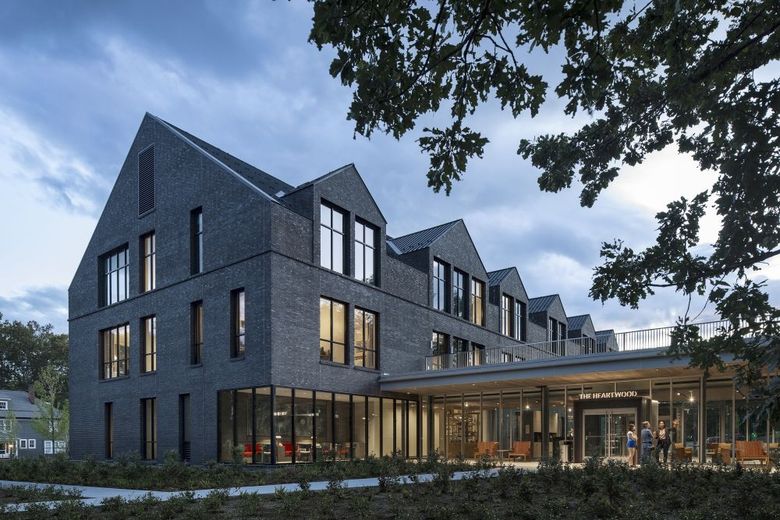
Olympia has a number of assets in college locations, like the Heartwood at Vassar in Poughkeepsie, New York.
Niche in college
hotels
If Olympia has a niche, it’s the
company’s hotels in college markets that are either owned by the college or
university themselves or strategically located near campus. The commonality of
those assets, Schultzel said, is that their primary purpose is to serve the
schools’ needs and then find other demand sources to fill in the blanks.
“That’s what makes the
projects sing. In some cases, that’s easy," he said. “But in a case
like Oberlin, Ohio, where Oberlin is a very small rural community, the school
is the source of business. What makes them similar is that
each tries to reflect the heritage, culture and identity of the campus where
they sit.
They're all leaning into the campus demand first, and then they are able to touch leisure travelers and select corporate travelers who don't want the standard experience.
John Schultzel
“They’re all leaning into
the campus demand first, and then they are able to touch leisure travelers and select corporate travelers who don’t want the standard experience. Then
suddenly, your Tuesdays and Wednesdays are doing what they're supposed to do in
hospitality. But your weekends are almost all school-related.”
Some of the college hotels
located on urban campuses or larger, land-grant universities usually can find a
developer that the school doesn’t have to participate in the ownership of,
Schultzel said.
“[Colleges] are more than
happy to get it off their balance sheet," he said. “But the smaller
liberal arts schools and the more austere, higher-ed destinations typically
don’t have enough demand for private developers to take that risk on their own. So, [the school] ends up wanting to or needing to own the asset… They're not
developers by trade and they certainly don't want to operate a business like
that.”
That’s where Olympia steps in to
operate the asset.
“This is not to throw shade
on the schools, but they’re a little less motivated by returns and traditional
real estate development parameters,” he said. “What they really care
about is making sure that the property is reputationally aligned with the
school.”
When the school is the owner of
the hotel, it ends up being a hub of activity, whether it be a meeting, a place
to interview potential faculty members or where prospective students and
families stay when they are visiting campus, Schultzel said.
“They’re very cautious and
thoughtful and responsible employers. So, even though the employees of the hotel
properties are employees of our company, there’s a relationship where the
employee feels like the school and the school are employing them wants that to
work,” he said.
Having that niche does present
growth opportunities, Schultzel said.
“The niche for us is really
on that mid- to small-school side, where the school is going to own the asset
and they need the hospitality expertise, either in development or operations
and that’s what we will continue to chase private development opportunities on
college markets,” he said.

Olympia also has independent assets like The Alfond Inn at Rollins in Winter Park, Florida.
Growth plans
Schultzel said Olympia expects
to add six to eight properties this year, which is a busy year for the company.
“We’re traditionally more
on the two to four per year range,” he said.
The third-party management
business offers an easier path to growth. Pre-COVID, the company had a growth
plan of having 50 in its portfolio by 2030. Schultzel said that given the
company’s recent rate of growth, Olympia could exceed that number in the next
five years.
“I don’t think that’s the
limit of our aspirations for the next five years. Given our recent pace of
growth, we’ll have an excellent chance to be somewhere in the 60 to 75
range,” he said. “The path to adding a management agreement is a lot
less rigorous than building a hotel. We're very reputationally driven in our
growth progress with the management company, and so, to some degree, growth
begets growth on the third-party side. That pace of expansion is going to be
more rapid for us.”
All the consolidation in
third-party management doesn’t concern Olympia. Schultzel said it’s to the company’s benefit.
For us, it's staying the course. We have no desire to merge with a larger firm partly because we've built our practice on the promise that they'll have availability to us.
John Schultzel
“We think the consolidation
is actually better for us. What I mean by that is I think the consolidation is
a desire to improve scale," he said. “The management company business
as a profit center isn’t particularly profitable, especially if you’re focused
on supporting boutique or independent because they require a lot of support on
the sales, revenue, management, marketing and food and beverage.
“For us, it’s staying the
course. We have no desire to merge with a larger firm partly because we've
built our practice on the promise that they’ll have availability to us,” he said. “I start these relationships when we add a hotel,
but the relationship doesn’t dissolve because we've moved on to the next five
things. Keeping our connectivity to the hotel, the customer and the client
first, and making sure that we don't ruin that in the place of growth.”