An
Ohana executive talks about why the 357-key Hyatt Regency in a Seattle suburb
perfectly fits the company’s acquisition strategy.
RENTON,
Washington — Austin, Texas-based Ohana Real Estate Investors announced on Monday that it
acquired the 357-key Hyatt Regency Lake Washington in the Seattle suburb of
Renton, Washington, from companies affiliated with Renton-based Seco
Development for an undisclosed amount.
The asset, a
large, full-service hotel, is a “bullseye” for Ohana, but the process of
closing the sale was anything but routine.

Ohana Managing Director of Investments Eddie Yu
When asked
how long it took the deal to come together, Eddie Yu, managing director of
investments at Ohana, told Hotel Investment Today, “This was a particularly long one; it’s probably
over a year that we’ve been working on it. We’re really glad to have finally
gotten it done, but there were a lot of challenges along the way. Our team
really stuck with it and navigated all the complexity.”
The asset
has had a complicated history over the past few years, including an investor
lawsuit and bankruptcy that was filed to help facilitate the sale. Media
reports said Ohana offered $157 million for the asset when it was first put on
the market in 2023.
Yu said
Ohana acquired the asset using its typical equity fund vehicle.
“It really
fits within our investment strategy. This is a bullseye. It’s great real
estate, newly built, in this case, and built to a very high spec. It’s in a
great location. It’s right on the lakefront. It’s not a well-known property,
but if you look at where it’s located, it’s one of the very few lakefront
hotels in Seattle, and it’s new to boot,” he said. “There’s just a great story
with it, where it’s a first-time hotel owner and a passion project for him, and
he did an amazing job developing it. We’re operational experts. So, we’re
inheriting that setup and I think we can take it to the next level with our
platform.”

We see a lot of potential in the market. Looking back across the last couple of years, this is probably one of the biggest pipelines we’re bringing from the end of one year into the next.
Eddie Yu
This is the
first acquisition of 2024 for the company, which still is in search of deals.
Yu said Ohana has about 10 potential deals in its pipeline right now.
“We see a
lot of potential in the market,” he said. “Looking back across the last couple
of years, this is probably one of the biggest pipelines we’re bringing from the
end of one year into the next.”
Ohana feels
that its asset operational expertise will help improve the Hyatt Regency Lake Washington’s ROI.
“The good
thing about this asset is that we think a lot of the underperformance is in the
operations versus needing anything,” Yu said. “It’s a credit to the seller that
he did an amazing job building it beyond the typical Hyatt Regency. We’re
really pleased with the physical quality of the property. It just needs the
intention and focus that our team of experts can bring.”
Complicated
history
The hotel
has had a complicated history. It was first developed in 2015 after a Hyatt
affiliate entered into a management agreement with Seco Development. The hotel
opened in 2017 in Southport, a $590-million, 25-acre, mixed-use waterfront
development in the Seattle area (which Seco also developed).
Seco’s Owner and
CEO Michael Christ was sued earlier this year by 49 Chinese EB-5 investors who
alleged that he managed the hotel project’s financing in ways that left them vulnerable when he originally put the hotel on the market in 2023.
According to the lawsuit, 199 EB-5 investors each contributed $500,000 to the
project and $99.5 million was put into a limited partnership, Southport Hotel
EB-5 LP, which Christ managed.
According to
The Registry, the hotel was first put on the market in 2023 after the
property’s senior and mezzanine loans matured. Ohana expressed interest and
reportedly offered $157 million for the property. However, the sale was stalled
because of the lawsuit.
We think there’s better revenue-generating potential and even expense savings when you have a modern property... We believe, over the long term, the ROI can compound faster at properties like that.
Eddie Yu
In October, the companies that owned that hotel, which
Christ owns, filed for bankruptcy as a way to sell the hotel and pay off about
$145 million in debt, according to a report in the Seattle Times. The filings
list $122 million in liabilities for the companies. The current status of the
lawsuit is unknown.
Why newer
is better for Ohana
Ohana
president and chief investment officer Franco Famularo spoke with Hotel
Investment Today last February about the company’s strategy. At the time,
Famularo said Ohana had a bias toward newer real estate and said there was a
“disconnect” in the market with full-service hotels. This asset hits on both of
those theories.
Yu said many
companies shy away from full-service properties because of the operational
complexities, but that’s something Ohana is happy to embrace. Hyatt, with whom
Ohana has had a long-standing relationship, will continue to manage the hotel.
Ohana likes
newer properties like the Hyatt Regency Lake Washington, Yu said, because they
usually have fewer capex requirements (which is the case with this hotel), but
he said there’s also a more subtle reason.
“There have
been a lot of modernizations in the hotel industry, whether it’s technology,
the way views are set up or the latest thinking on group space,” he said. “That
all gets put into new properties that aren’t in older properties.
“So, in that
sense, we think there’s better revenue-generating potential and even expense
savings when you have a modern property that’s designed with the most modern
thinking on architectural flows and things like that. We believe,
over the long term, the ROI can compound faster at properties like that.”
Credit
provider
Ohana also
provides credit for the hospitality industry, whether equity capital, debt
capital or for hotels with a displaced cash flow. Notably, the company recently
provided a $225 million loan mezzanine loan for the Fontainebleau Miami Beach
hotel, which was part of a larger $1.2 billion refinance, including a $975
million CMBS senior loan from Goldman Sachs.
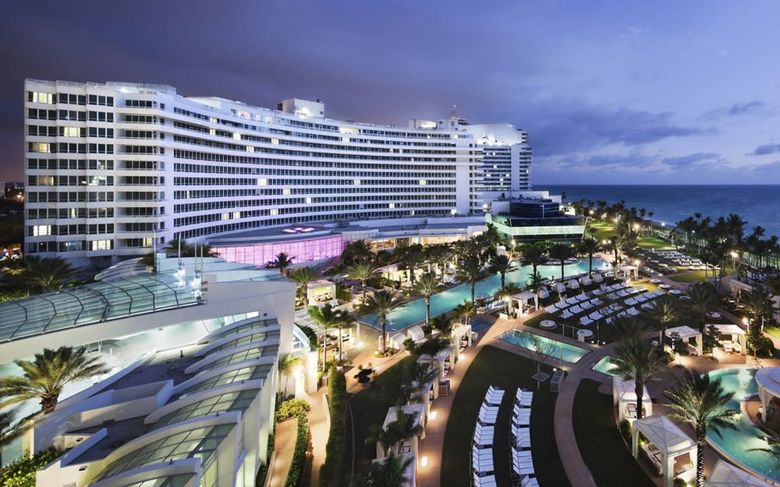
Ohana also provides credit, including a $225 million mezzanine loan for the Fontainbleau Miami Beach hotel.
Yu said the
investment profile for credit, which is funded by a subsidiary of the Canada
Pension Plan Investment Board (CPP Investments), CPPIB Credit Investments III, follows a lot of the same themes that make ideal hotel acquisitions for
the company.
“We still
love that newer, high-quality real estate. The deals we’ve done this year, even
around credit, have been related to brand new real estate or relatively new
real estate, and very iconic, super well-located real estate,” he said. “We’ve
financed a couple of very large, prominent resorts in Florida very recently,
and that fits exactly with our thematic approach to what kind of real estate we
want to bet on.”
Ohana’s love
of full-service assets also comes through on the credit side, Yu said.
“We think
that there’s a dearth of capital on the full-service side that really knows
what they’re doing,” he said. “That’s why we like full-service, not necessarily
only because we believe there’s a lot you can do in the sector.”