When it comes to anchoring revenues on F&B, Deepak Ohri
is quite a maestro. Can he make it work outside Thailand with his own company?
GLOBAL REPORT – To many people, Deepak Ohri comes across as
a colorful Asian hotel personality who cooks up the most incredulous ideas.
History has taught them never to take him lightly. His stunt, the One Million
Baht Dinner in 2007, which charges $30,000 per person for a 10-course feast
created by six 3-Michelin star chefs, heralded rooftop dining in Bangkok and
put Thailand on the map as a dining destination.
Ohri is spending his final month as founder and CEO of Lebua
Hotels & Resorts before starting a new challenge after 20 years with the
Thai group, which is owned by the Bualert family.
He is masterminding a plan to develop a string of luxury
boutique hotels in wine regions such as Napa and Sonoma in California;
Bordeaux, Burgundy and Champagne in France; Rioja in Spain; and Barolo in
Italy. As well, he is venturing into asset management in Southeast Asia.

The gap I see is not the Napa property. It’s the total company value when I connect six to eight vineyards [through hotels], which has never been done before.
Deepak Ohri
For these purposes, Ohri has established a U.S.-based
company called LAMH, and Bangkok-based LAMH Asset Management.
A feasibility study he commissioned Horwath U.S. to do
bolsters his ambition to develop the first hotel, which will be in Napa. Talks
are progressing well to acquire one of four hotels with 20 to 40 rooms. He said
investors will be either an SPV (special-purpose vehicle), or private family
offices he’s talking to in the U.S., London, Zurich and Liechtenstein.
The acquisition is expected to be completed by June and will
cost $40 million, including capex for refurbishments and new facilities such as
a fine-dining restaurant – but of course. Ohri said he has already secured the
commitment of a chef currently working in a 2-Michelin star restaurant in New
York City.
“In Napa, there are few 1-Michelin star restaurants and no
2-Michelin stars. There is one 3-Michelin star restaurant in Napa, French
Laundry by Thomas Keller, while another, SingleThread [Farm], is in Sonoma. I’ll
be the first to bring that kind of restaurant to a hotel in Napa,” he
said.
Ohri said the numbers he ran show the hotel should yield an annual
IRR of 30%. “Which means, within two and a half to three years, we could break even,
which is unheard of in the hospitality industry,” Ohri said. “In Napa, hotels
with great F&B can do 25% to 32% [IRR]. Without F&B or upscale F&B,
it's 15% to 18% because these hotels are working primarily on rooms revenue.”
Love the room rates
Ohri said he fell in love with Napa during a visit in 2021
and was astounded by its high room rates. “During low season, the room rate is
around $1,200 to $1,400. During harvest season, it’s around $4,000 to $5,000,” he
said, observing that privately-run hotels seem to do better than the luxury
global hotel brands. This is because, he said, they are more fun, less
educational in nature and have no corporate culture, as his Napa hotel will
be.
An all-suite accommodation with sizes ranging from 50 to
80sqm, Ohri eyes an average rate of $2,200 at the start. “I would love to work
with KPF [Kohn Pedersen Fox] on the design,” he added. The American
architectural firm’s hotel projects include Aman Tokyo, Rosewood Bangkok and
Atlantis The Royal Dubai, giving an inkling of the height of luxury he wants to
bring to Napa.
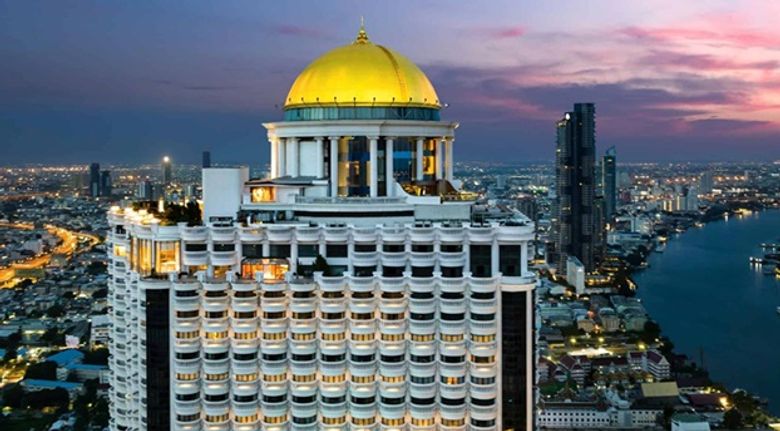
The Dome at Lebua Bangkok
Hardware aside, Ohri said he would elevate the experience
and enhance the service culture. “We’re going to change the way people visit
the vineyard, for instance. To begin with, the transportation will be different
from what the other hotels are providing. Then, we are going to do private
visits, so people won't be standing in a group of 30 to 40. They will have a
private sommelier with them to explain everything,” he said.
Napa is the start of something bigger, he said. “The gap I
see is not the Napa property. It’s the total company value when I connect six
to eight vineyards [through hotels], which has never been done before,” Ohri
said.
Horwath Pacific Asia Managing Director Robert Hecker
believes Ohri can conquer his new adventure given his “place-making”
experience, determination and attention to detail. Hecker was referring to how
Ohri catapulted the dull Lebua condominium in Bangkok to fame, by refashioning
its highest floors into an all-suite hotel and turning the golden dome on top
of the building into a vertical dining destination with 10 different F&B
concepts.
“His familiarity with luxury customers and delivering on
their product, service and experiential expectations, combined with some Asian
flair, puts him in good stead to bring a new and unique [offering] to Napa,”
Hecker said.
“The risks, of course, would be the same for anyone
attempting to produce a distinctive offering in a market already full of
top-notch offerings. It’s delivering luxury-level quality consistently,
creating surprises and exceeding expectations, and being sufficiently
capitalized to weather both the business build-up and potential disruptions.”
I always say, there are so many bottles of Coca Cola but until today nobody has the Coca Cola formula. So, I’ll be the Coca Cola for all the asset owners [laughs].
Deepak Ohri
Hecker also gave the thumbs-up to Ohri’s move into asset
management. “His experience in managing The Dome and Lebua as successful and
nicely profitable assets that are well recognized will attract interest from
those keen to learn and take advantage of such know-how to improve and maximize
the value of their own hospitality assets,” he added.
Indeed, Ohri is counting on his chops for creating F&B
revenue to draw owners to asset management.
“The bigger asset managers do not necessarily come from my
area of expertise, which is F&B. And that’s the area that has been
neglected. If a hotel is already doing 80% occupancy and an average room rate
of 7,000 baht, how much more value can you add to the asset? I’m coming in to
give a lot of value through creating experiences for the customer,” Ohri said. “Secondly,
I have good connections with OTAs and can lower the distribution costs for
these hotels and enlarge their distribution platform by giving them access to
certain travel agents.”
However, he admits it will be challenging because Asian
owners might not be open to asset management. “Most aren’t informed about it,
and Asians tend to be conservative. The second challenge is continuity because
once they feel they understand how to do it, they will say we can do it
ourselves,” Ohri said. “I’m prepared for that. But I always say, there are so
many bottles of Coca Cola but until today nobody has the Coca Cola formula. So,
I’ll be the Coca Cola for all the asset owners [laughs].”