Entrepreneur, hotelier Richard Bailey talks about the
potential of organizing a ‘brand’ that stands for true environmental and social
good.
ARUE, French Polynesia – The ESG movement isn’t exactly
receiving a lot of support these days, but small luxury developers like Richard
Bailey still see it as a road to greater profitability – not to mention doing
the right thing for the environment and staying on trend as Millennials, Gen Z
and Gen Alpha prioritize intentional transformative travel that creates a
positive environmental and social impact.
Take Bailey’s approach to providing air conditioning at The
Brando in Arue, French Polynesia. Built on the private island of Tetiaroa now
owned by actor Marlon Brando’s family trust, the 36-key ultra-luxury resort was
designed to be uber-sustainable. But traditional cooling of The Brando would
prove to be too expensive and not very sustainable. In fact, when still alive, Brando
said no fossil fuels will be allowed on the island or at the resort because he
had another idea. Brando discovered through a scientist in Hawaii that they
could use pipes to bring up the coldest deep ocean water, extract the cold and
circulate it into a system to cool the property.
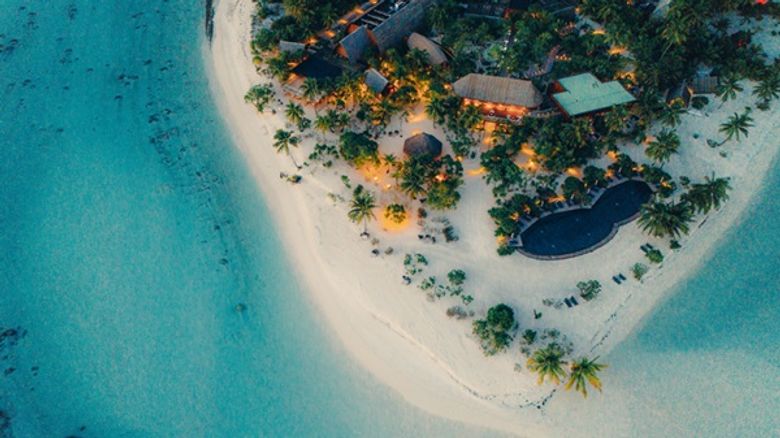
Aerial view of the Brando
First used at one of Bailey’s resorts in Bora Bora as
opposed to the local grid, the seawater air conditioning system at The Brando helps
hold the resort’s annual energy bill to $700,000, or less than half of their
competitors, according to Bailey. The system paid for itself by 2013 and now
the resort has free air conditioning energy, which is normally accounts for three-quarters
of all the resort’s energy costs.
In fact, The Brando is powered entirely by solar and coconut
oil biofuel and has a zero-carbon impact. In addition, through Tetiaroa
Society—the resort's long-term conservation partner and the nonprofit organization for all the
sustainability initiatives—an on-site Ecostation is used
as a research facility where scientists monitor local marine and birdlife and
where many guests flock to learn more from the scientists on site.
The resort also funds cultural preservation projects and
supports local employment and education programs.
Of the eight resorts Bailey’s Pacific Beachcomber group owns
or manages in French Polynesia, they have first and foremost built their
reputation by caring for their teams, said the Stanford and Harvard Business
School graduate who was working at CitiBank in New York before meeting a woman
in Tahiti who became his wife and changed the course of his life.
“Normally, we say, ‘take care of the guests and the P&L
will take care of itself,’ right? But we say, ‘take care of your staff and your
P&L will take care of itself.’”

Normally, we say, ‘take care of the guests and the P&L will take care of itself,’ right? But we say, ‘take care of your staff and your P&L will take care of itself.’
Richard Bailey
So, it’s simple to Bailey: if you care enough about the
environment and your team, you overcome obstacles.
The key word here, Bailey told Hotel Investment Today, is
“caring.” Unfortunately, he said, especially in the corporate world,
sustainability beyond reusing towels, removing plastic utensils, LED lighting
and low flow showerhead is enough caring in most instance. While there are
exceptions, there are not enough. There isn’t enough passion, he said, “and
passion doesn’t always make money.”
But in Bailey’s case his passion does pay. He said his group
that includes The Brando, three InterContinental-branded properties and four mid-market
Maitai resorts is very profitable, and its sustainability quotient is part of
the reason why.
He has the proof to show revenue teams that nature and
cultural investments represent the intersection of business excellence and
environmental responsibility.
“I refute the idea that that sustainability isn’t
profitable,” he said. “I run a very profitable company, and my profitability
depends on it. If I wasn’t running a sustainable operation and created a
community around it, I wouldn’t have the things that they’re coming to see. It’s
as simple as that.”
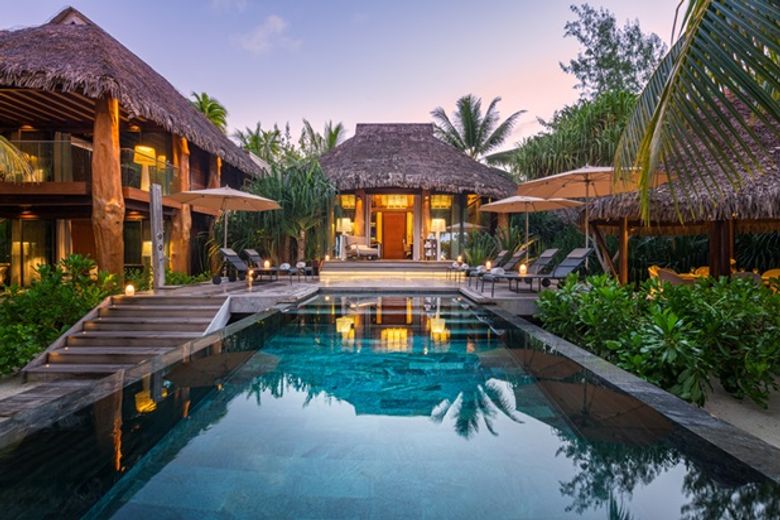
Three-bedroom villa at The Brando
Admittedly, his approach at The Brando is applicable to
small luxury eco-resorts in unique locations where environmental sensitivity is
high and there is some prospect of interest by the scientific
community. “Our model [at The Brando] includes a resort and a non-profit
conservation/research field station that work in hand in hand. This
separation gives the Field Station legitimacy and authority, while not placing
the burden of conservation on the for-profit resort,” Bailey explained.
But he also knows where there’s a will there’s a way for any
owner and operator who wants to invest as the ROI on sustainability initiatives
is reachable in a shorter timeframe every year.
Expanding the concept
Looking ahead, Bailey has explored expanding the brand but
to date has not found the right location with all the right traits, or the
right investment partner.
What he might consider is creating a collection with
like-minded owners and operators like his contemporary Mike Freed, founder of
the Post Ranch Inn in Big Sur, California. They are already cross-market and
if Bailey does expand, he sees working with Freed as a start.
I run a very profitable company, and my profitability depends on it. If I wasn’t running a sustainable operation and created a community around it, I wouldn’t have the things that they’re coming to see. It’s as simple as that.
Richard Bailey
“His [Freed’s] entire business model is based on some sacred
assets [like The Brando], which includes the California coast,” Bailey said.
“It’s about the resort, but it’s also about the location and what the resort is
doing to be a part of that community, which is very environmentally sensitive.
Everything that happens on that coast is carefully planned and Mike is fully on
board with that.”
But evidently, not every developer feels the same and, in
fact, Bailey thought for years that so many would jump on board his bandwagon
without him having to export his model. “It just seems so obvious to me, but I
haven’t really seen that happen,” he lamented. “I believe that there is a space
that has not been occupied brand wise. Six Senses comes to mind, but it is
mainly about wellness. Singita does amazing work on the African continent, but
there’s no brand that come to stand for exactly what we are doing. I think
there is potential demand there.”
Bailey thinks of places like the Red Sea, Galapagos and the
Coral Triangle – places with very high biodiversity, environmentally fragile,
susceptible to the dangers of overtourism and environmental degradation. “These
are the natural points of entry for our business model. Costa Rica comes to
mind where there is a higher level of sensitivity, and great things are
happening. But bigger picture, the concept needs to be organized under a brand.
So, yeah, I’ve been thinking about that.”
When asked about creating a collection with existing assets
that pass an intensive review process, Bailey nodded affirmatively, but added
he is not ready to discuss anything definitively.
Finding like-minded developers is his biggest challenge,
perhaps.
“A project like this would be bottom up rather than top
down. The people that do this kind of thing want to be part of a moral part of
a cooperative rather than then pay for a brand. They want to share insights.
They want to feel like they’re part of the part of the program, rather than
just subscribing to set of principles.”
Think twice
When asked why more hoteliers don’t have his mindset and
don’t as easily equate sustainability to profitability, Bailey said they have
to really lean into the mindset, even in a middle American business market.
Let’s talk about what matters to our guests, and what provides financial returns to our P&L. Guests come to our resort because we do this, and if we don’t do that, we have less occupancy, or we have a lower ADR, and we have degraded RevPAR.
Richard Bailey
“It starts with the spread of sustainable technologies and
innovation starts in places where there’s a clear benefit of protecting those
things which without we don’t have a business model,” Bailey said. “But then
there are so many advances in construction technology with new types of
concrete, cross laminated timber, and LEED quality construction has become
compelling from an economic standpoint.”
However, Bailey added that most developers are not educating
themselves about these technologies and frustratingly admitted it’s not trendy
right now. “It’s almost trendy to be anti-ESG. Even capital providers look
askance when you talk about things like that.”
But Bailey said developers should think twice because he is
a businessperson and also needs to know if green systems will help make money. “We’re
getting financially adequate returns on sustainable technologies,” he said.
“Granted, we’re doing it in a very remote location where the alternative cost
of energy is very high due to transportation and distance and isolation. But
the technologies are promising and definitely possible of being employed
elsewhere.”
“Everybody should do something,” Bailey said, and he suggest
not to use the words ‘sustainability’ or ‘ESG.’
“Let’s talk about what matters to our guests, and what
provides financial returns to our P&L,” he said. “Guests come to our resort because we do this,
and if we don’t do that, we have less occupancy, or we have a lower ADR, and we
have degraded RevPAR.”
For example, Bailey has worked diligently with a nonprofit
to develop a system to eradicate mosquitoes at The Brando and it is now being
explored in Singapore, Hawaii and Florida.
“Did we do this for the world? No. We did it for our guests,”
Bailey explained.
Also at The Brando, conservation measures have resulted in
increased nesting on the hotel’s island for sea turtles with some 1,400 laying
eggs today versus maybe a dozen when they started developing the hotel.
“Guests flock to the resort to see them. The two are
connected,” said Bailey, who added, “Travel, especially leisure travel, is the
most natural point of penetration for sustainable innovations because that’s
the only thing we have to sell.”