First-time
hotel investor Narit Chia-Apar shows a differentiated product can always win
the price. But exporting seafood may be easier.
PATTAYA, Thailand - A
Thai shrimp exporter developed his first hotel, the Andaz in Pattaya, Thailand,
and lo and behold, the hotel that Narit Chia-Apar built already appears to be a
rate leader within just a year of opening.
A
Google pricing search is an indicator. As of June 21, the Andaz Pattaya Jomtien
Beach charges on average 10,900 baht per night ($297), higher than 8,800 baht
at the all-suite wing of Pattaya's oldest 5-star hotel Royal Cliff. Another U.S.
brand, Hilton Pattaya, and homegrown Thai brand Centara Grand Mirage Beach,
follow at 7,500 baht and 7,400 baht, respectively.
Andaz
rate push is striking as Jomtien is not even in Pattaya City, which is four kilometers away. It points to a trend of travelers preferring less crowded Asian beach
destinations, as a recent survey of U.K. tour operators by the Pacific Asia Travel
Association shows, but also to the need for hotel investors to create unique
products, as the Andaz has done, to challenge established spots.
Not
that Chia-Apar became a hotel owner to take on entrenched resort destinations.
He just wants to build a “beautiful, handmade” hotel with no exit strategy as
it’s a “legacy” for his family, he told Hotel Investment Today. He spent $150
million on the 204-room hotel, excluding the cost of land he bought 20 years
ago. That’s nearly the revenue his listed company, Seafresh Industry, one of
Thailand's largest exporters of frozen shrimps to global markets, made last
year ($177 million), according to Reuters data.
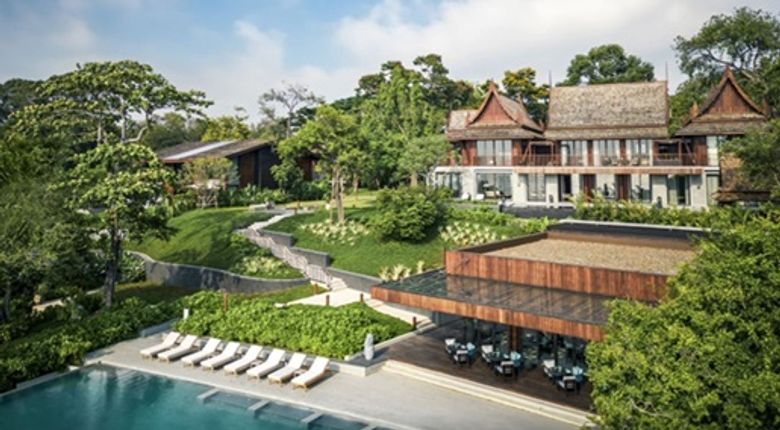
View of the Heritage House at Andaz Pattaya Jomtien Beach, a six-bedroom super-suite with a $10,000 room rate,
The
result is a hotel that’s fit for royalty. After all, when the place was his
family residence comprising three traditional Thai houses on a 15-acre land
enveloped by lofty trees, he had the honor of hosting royalty and distinguished
guests on various occasions. Why wouldn’t he spend royally on building his
first hotel?
Andaz
Pattaya turned out to be a heaven for tree huggers. Clusters of single-story to
three-story buildings were built around the existing trees – at a cost of a
bigger room count had he built a larger or high-story building, which the plot
allowed. Five of the trees were planted by royal guests, the source of
invaluable memories, said the architect, A49, on its website. Others include a
magnificent rain tree spanning 30m, and groves of Banyan trees. All these trees
inspired and influenced the design of the resort, A49 stated.
Natural
materials such as stone, timber and local woven crafts were used. Lawns, brooks
and ponds with koi fish were added, creating a green feast for the eye.
“The
biggest construction challenge was preserving the trees,” recounted Chia-Apar.
“It took us a lot of time and trouble because half way through the work, you
hit roots and if you continue building, a tree may die. So, we had to move here
and there [to accommodate trees].”
The
hotel took four years to build.
What’s
more, he insisted on quality. His son, Chintat Chia-Apar, vice president of
Chartered Square, the hotel developer, said with a laugh that his father met
the brand’s specifications many times over when choosing fixtures and
furnishings, be it the Grohe premium bathtubs or the most luxurious pillows
from Siam Feather.
They
also went to lengths in keeping to the Andaz promise, “Luxury lifestyle hotels
rooted in local art and culture.” For example, the ceilings of the main lobby,
restaurants and other areas were covered with exquisite rattan wickerwork,
which became the hotel's trademark.
“We
went to more than 10 villages to get the work done by the local artisans
because it couldn’t be done by one village alone,” the son said.
When
Hyatt offered them the Andaz brand instead of the initial plan to build a Grand
Hyatt, the Chia-Apar’s were delighted. “It’s quite a difficult brand to get;
they are picky about it,” the father said. “I prefer this new brand as it has
less limitations [than Grand Hyatt] and we can input our ideas rather than just
follow a set of criterion. What we wanted to create might not have been
possible as a Grand Hyatt.”
In
Asia, Andaz also operates in Bali, Delhi, Seoul, Macau, Nanjing, Shanghai,
Shenzhen, Singapore, Tokyo, and Xiamen. Pipeline is robust due to “increasing
demand for immersive, authentic experiences among luxury travelers,” said Sarah
Leow, vice president of Development & Owner Relations, Hyatt Asia-Pacific.
New Andaz hotels will debut in Bangkok, Taipei, Taichung, Hangzhou, Chengdu and
Hong Kong, while a second Andaz will open Shanghai.
Chia-Apar
picked Hyatt because for him hotels are “all about service and food” and Hyatt
is “famous for its F&B concepts,” said the owner who describes himself as a
foodie.

I prefer this new brand as it has less limitations [than Grand Hyatt] and we can input our ideas rather than just follow a set of criterion. What we wanted to create might not have been possible as a Grand Hyatt.
Narit Chia-Apar
He
also values the “family-like” culture of Hyatt, which is “similar to the way we
run our business.”
“If
you meet our GM, Ranjeet [Rajebhosale], you’ll find him a humble, warm and
caring family man kind of person. He fits our style of management,” he said.
Humbly
sharp
Beneath
a self-deprecating demeanor, and the emotional driver to create a legacy,
Chia-Apar is a sharp businessman at heart. He saw that the opportunity and
timing were right to develop the hotel as the eastern seaboard, which includes
the Chonburi province where Pattaya is located, is part of the government’s new
economic zone for the manufacture and export of high-value goods such as
automobiles.
“It’s
a waste if we don’t develop this land into a hotel because the Eastern Economic
Corridor [EEC] initiative is attracting a lot of investments from China, Japan
and elsewhere,” Chia-Apar said.
Added
Rajebhosale, “We are committed to showcase the charm of the Jomtien area as an
emerging luxury lifestyle destination within Thailand’s EEC development.”
Besides,
land costs have appreciated at least five times and Chia-Apar had, over time,
acquired several plots in the area. This includes his 229-acre, 18-hole
championship Chee Chan Golf Course located 10km away from the hotel.
But
one of his biggest worries about the hotel investment was not knowing what rate
the hotel could fetch, as there was no apple-to-apple comparison to reference,
given its location as well as high construction and operating costs.
At
the same time, he just kept spending. “There are three big swimming pools.
The operating cost is high. What if there’s no occupancy?” he said.
These
days, Chia-Apar’s less worried. The hotel is targeting slightly over 60%
occupancy this year. “So far, we are ahead of budget,” he added.
Chia-Apar
is pleased about the rate being twice what he guessed it would be, although he
declined to share the ADR. “Our rate is high because of a number of suites and
villas, which are twice or triple the rate of standard rooms. The villas
usually get booked first,” he said.
Chia-Apar’s
former oceanfront home is now a six-bedroom Heritage House charging over
$10,000 per night and selling quite well. Another room type that allows for
direct pool access also commands a high rate and occupancy. He credited his son
for thinking how to utilize the land effectively.
“The
hardest rooms to sell are the ones at the back,” Chintat said. “The
seafront rooms aren’t hard to sell. So, we wanted the designer to focus more on
these rooms.” There are 18 room types altogether at the hotel.
Asked
to rank his happiness index for the Andaz Pattaya on a scale of one to 10, 10
being most satisfied, the father said ‘8.5.’ That’s because service isn’t
perfect yet due to manpower shortage, while retaining staff is also hard these
days, he said.
Based
on the hotel’s performance to-date, Narit Chia-Apar expects an ROI timeframe
within 10 years. This time, he isn't guessing.