One of the internet’s original service providers now creates
authentic and hands-on experiences through Revolution Places.
WASHINGTON, D.C. – There’s some irony in the fact that AOL Co-founder
Steve Case, a man who helped start the internet and online communication
pre-social media with things like chat rooms that could keep people sheltered
from the real world, is now developing experiential hotels like the recently
launched Waldorf Astoria Costa Rica Punta Cacique. In fact, it seems he has
always known that the more time we spend online, the more we need real and
authentic experiences at hotels or multi-generational luxury vacation homes.
Case is very aware that his Washington, D.C.-based
Revolution Places, the hospitality and travel investment arm of his bigger
Revolution investment platform founded in 2005, is an extension of the things
he loved about the internet when he started AOL some 40 years ago. He leans
into that notion every chance he gets.
“The core of what we did in those early days of the internet
was trying to build a sense of place, a sense of community,” he told Hotel
Investment Today earlier this week. “Our most popular services were always the
community features, what people think of now as social media. That connectivity,
that community was always important... When I started making investments in
this [hospitality] space, which actually goes back almost 25 years when I first
stepped down as CEO of AOL, it was with [private, luxury vacation club] Exclusive
Resorts. I just liked the idea that it was a way to connect people, and connect people to places.”
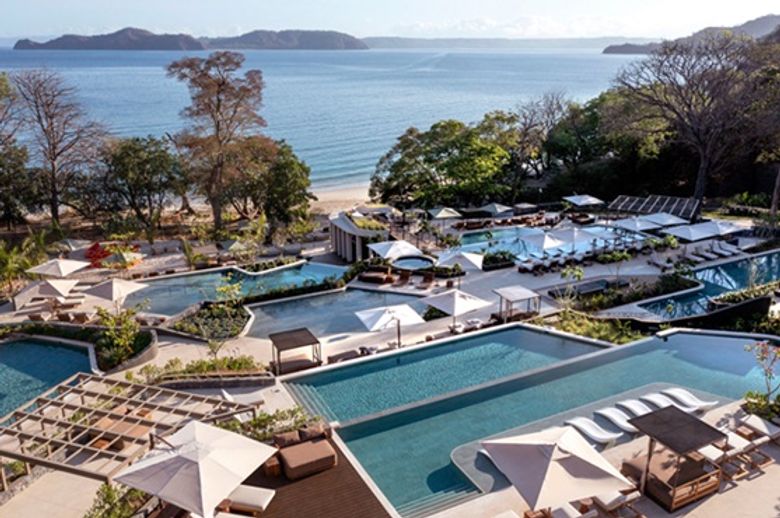
Waldorf Astoria Punta Cacique pools and beach
While Case is clearly still a fan of the internet, he also
understands there’s a role for getting people together in the real world and
have memorable experiences. That has led to hospitality-related investments in Hawaii
and Costa Rica.
Revolution Places has also invested in Miraval (now part of
Hyatt’s wellness portfolio), Twin Farms (Case has since exited one of the top
luxury inns in the U.S.), Exclusive Resorts, Maui Land & Pineapple, and
Grove Farm in Hawaii.
Revolution Places is also the majority owner of Punta
Cacique, a 600-acre oceanfront property in Costa Rica that Case purchased in
2006 and has spent nearly two decades developing with the right partners and
plans.
The Waldorf Astoria Costa Rica Punta Cacique—the first phase
of a larger wellness-oriented luxury community—opened this past spring with a
focus on authenticity. Its emphasis is on connecting to the surrounding region
and broader cultural and ecological richness of Costa Rica. Case said further
hotel development at Punta Cacique is going to be announced soon.
Case’s majority stake in Exclusive Resorts, a private
vacation club for ultra-high-net-worth individuals launched in 2002 that offers
access to a curated network of more than 400 luxury homes in 75 destinations
worldwide. It includes a $1 billion real estate portfolio and is evolving into
a fully integrated lifestyle platform. In July, Exclusive Resorts launched a
branded residential vertical with the first set of properties branded under
development at the Punta Cacique site.

I just liked the idea that it was a way to connect people, and connect people to places.
Steve Case
The company in June announced the acquisition of a
controlling interest from Accor in OneFineStay as a complement to Exclusive
Resorts. The strategic agreement gives Exclusive Resorts members access to a
curated selection of OneFineStay’s homes, while providing OneFineStay access to
a new, affluent member base.
Case is the majority shareholder in Maui Land &
Pineapple Co. (MLP), a publicly traded company and one of the largest private
landowners on Maui. MLP is returning to its agricultural roots, including a new
initiative around agave farming, which he said should produce a premium liquor
business opportunity and bring economic diversification and sustainable land
use to the island.
Case, born and raised in Honolulu with his father born on
Kauai, is also a legacy landowner on Kauai with deep commitments to sustainable
land stewardship and community-based agriculture. The Grove Farm company has
supported programs that empower local farmers and protect native ecosystems.
The internet pioneer has further interest in the hospitality
space and talked to Hotel Investment Today about a variety of timely topics.
Here are some of the highlights:
Hotel Investment Today (HIT): What’s next for Revolution
Place in the hospitality space?
Steve Case: We’ve been building Exclusive Resorts for over
two decades, and the club operates more than $1 billion of real estate, with more than $750 million owned by the company. This is supplemented with some long leases and hotel partnerships. We started a partnership a couple years ago with
Rosewood that they are pretty pleased with in terms of how many new customers Exclusive
Resorts was able to bring to them. We’re talking to a lot of other folks in
that space.
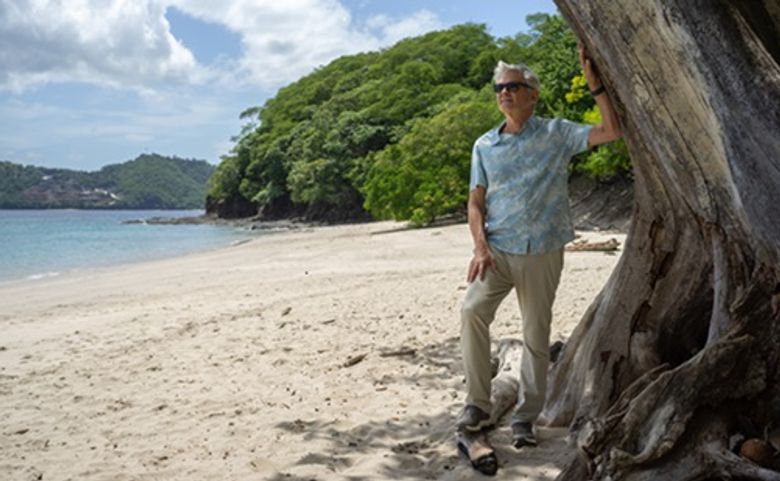
Revolution Founder Steve Case
Exclusive Resorts also acquired a controlling interest in OneFineStay from Accor
and believe that’s a nice complement to the core Exclusive Resorts club. OneFineStay is a luxury version of Airbnb, where there’s more curation of the properties,
more services built into what people are getting. We’re looking at other
opportunities in that space, including subscription products.
Exclusive Resorts also launched a branded residential business. We believe the company is uniquely positioned because we have nearly 5,000 High Net Worth
families that we have a good relationship with. As we launch in new places,
whether in Costa Rica or elsewhere, we can build small, boutique
residential communities that will be appealing for at least some of our members
to buy a home.
It was clear to us that Costa Rica was a market on the rise. When I first landed in Guanacaste, the airport was really only available for local prop planes.
Now, there are more than 20 international airlines and nearly 3 million
passengers. We've witnessed it transform from primarily an agricultural economy to one also heavily focused on tourism, much like Hawaii when
I was growing up there.
We have a lot of plans over the next decade to expand Punta
Cacique, including additional hotels, which we’ll be announcing shortly.
It was clear to us that Costa Rica was a market on the rise. When I first landed in Guanacaste, the airport was really only available for local prop planes. Now, there are more than 20 international airlines and nearly 3 million passengers. We've witnessed it transform from primarily an agricultural economy to one also heavily focused on tourism, much like Hawaii when I was growing up there.
Steve Case
In Hawaii, more than 20 years ago I bought 40,000
acres of land on the island of Kauai--Grove Farm--a former sugar plantation. We’ve
done a number of things with that land, including housing and retail development. We’re also rebuilding some of the main areas around the Lihue, the
main town on that island, with a business park, a town center, and in the next
few months we will announce a hotel near the airport there.
On Maui, via Maui Land and Pineapple, we also own the Kapalua resort, where there’s a
Ritz-Carlton and a Montage. We are talking about expanding that in several ways.
HIT: What’s your opinion on current macro conditions and how
it will impact the luxury hotel business in the next 18 months?
Case: There is still a lot of uncertainty in the
economy, related to tariffs and the possibility of a recession. That uncertainty impacts how some people view some potential investments.
But from most of the data we’re seeing, the high end of the luxury
travel market still seems quite strong.
Aggressive pricing surrounding ‘revenge travel’ is settling
down a bit, but overall, it still seems to be pretty strong, particularly when people are accessing authentic, immersive experiences. We are seeing that with Exclusive Resorts where we’re having a really good year in
terms of new memberships.
HIT: What were some of your biggest learns, takeaways from
developing the Waldorf Astoria Costa Rica Punta Cacique?
Case: It did take a little longer than we thought. The
construction cost was a little higher than we thought. So, there were some
tweaks and value engineering, but we recognized that the Waldorf was
anchoring Punta Cacique, and we really wanted to make sure it was done in a
first-class fashion.
I’ve been visiting there every six to eight weeks since it
opened this spring and it’s already off to a strong start in terms of the
initial reviews and interest from groups. I know it’s going to emerge as a market leader over the
next few years.
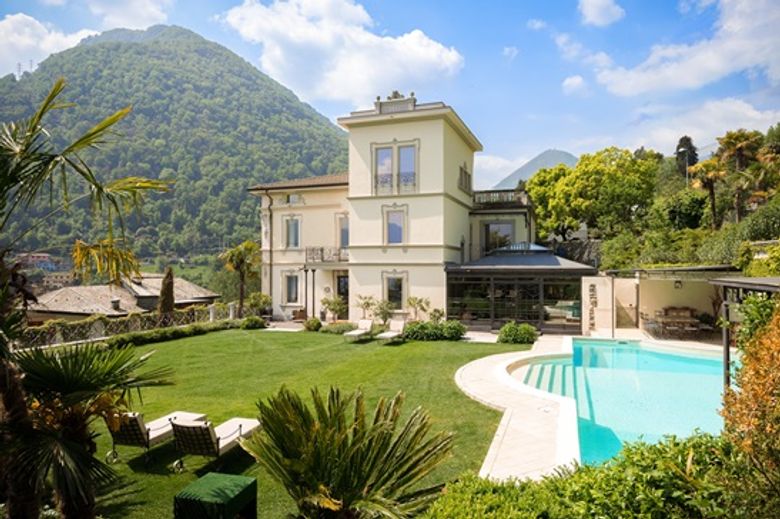
Exclusive Resorts' Lake Como Residence in Italy
One of the things that was really appealing to me about
Punta Cacique, which led me to purchase the land was a strong sense
that Costa Rica was a rising market for visitors and owners. As I said earlier, in many ways, it reminded me of growing up
in Hawaii going from agriculture to tourism, and you saw parts of the islands that
just developed into great resort markets.
I had a sense that was going to happen with Guanacaste in
Costa Rica, and what’s happened in the last five years exceeded my expectations.
The Ritz-Carlton Reserve had about $400 million in real estate associated with the hotel, completely sold out. Discovery Land is building a project about 45
minutes from Punta Cacique and already sold $900 million in just lots. Costa
Rica is really booming.
HIT: You are more of a developer. Would you consider buying
hotel assets?
Case: I wouldn’t rule it out, but that’s not really our plan
right now. I find it more interesting to take large parcels of land, and some would
say, ‘how do you master plan it?’ I think of it more as a canvas you’re able to
paint on and create something really special. Hotels are part of that canvas.
But it's more interesting to me to build the whole community of which hotels
are anchors, as opposed to just having the hotel.
HIT: How do you choose investment partners?
Case: I do have investors for core platforms. Then for particular
properties like the Waldorf, we did bring in some investors who had industry-specific
expertise, as well as local connectivity that we thought was important in terms
of entitlements, etc.
We take it very seriously. Maybe we bring more of an institutional mindset to this. At the same time, what’s different about it is we can afford to have a longer-term build and hold horizon.
Steve Case
It kind of varies depending on the business. It’s partly
accessing that capital to yield some of our growth and expansion, but mostly
bringing people who have unique expertise and value-add that can enable us to
do something that we wouldn’t necessarily be able to do just on our own.
We take it very seriously. We bring more of an
institutional mindset to this type of development work and
we can afford to have a longer-term build and hold horizon... Now, there may be
certain assets, like a particular hotel, where some investment partners will
want to look for an exit sooner than we might. So, obviously, there’s always
going to be an opportunity for that exit, or for us to increase our ownership,
or somebody else to come in as a potential partner.
Last year, we brought in a minority investment partner, Kemmons
Wilson Hospitality Partners, a private real estate firm and strategic investor,
into Exclusive Investments LLC, the newly established holding company of
Exclusive Resorts. They have broad platform experience in a lot of different sectors,
and we thought they would be additive. They have been super helpful.
HIT: What is your broader message about building hospitality
around community versus building community around hospitality?
Case: The best way to maximize the investment returns is to
build a differentiated offering that people really value, and community is
clearly a cornerstone of that. But it has to be real, authentic community – not
just pretty pictures on a website... Building those authentic, connected
communities are ways to maximize the differentiation and ultimately maximize
the returns on investment.