With
an insider’s approach to growth in Mexico, Murano Global Investment has tapped
the public market to help raise its profile, realize its vision.
LONDON – London-based but Mexico-born CEO of Murano Global
Investments Elias Sacal said he knows the dealmaking ropes in his homeland. Afterall,
his family has been developing in Mexico for years and for the past 20-plus
years he has deployed more than $2 billion in capital for the acquisition,
repositioning and development of real estate projects, more recently including
hotels.
“We speak the language, we understand the language, we know
how to get through the process of construction,” Sacal told Hotel Investment
Today. “We deal with the unions within the government and we know exactly how
to have good relations to develop things… We are like a good door for those who
want to come in and invest in Mexico.”
Sacal started in real estate by investing in and managing
some 1,500 rental and condominium units for wealthy Americans and Canadians looking
to retire or have a second homes in Mexico. He started in Puerto Vallarta and grew
in Ixtapa and Cancun.
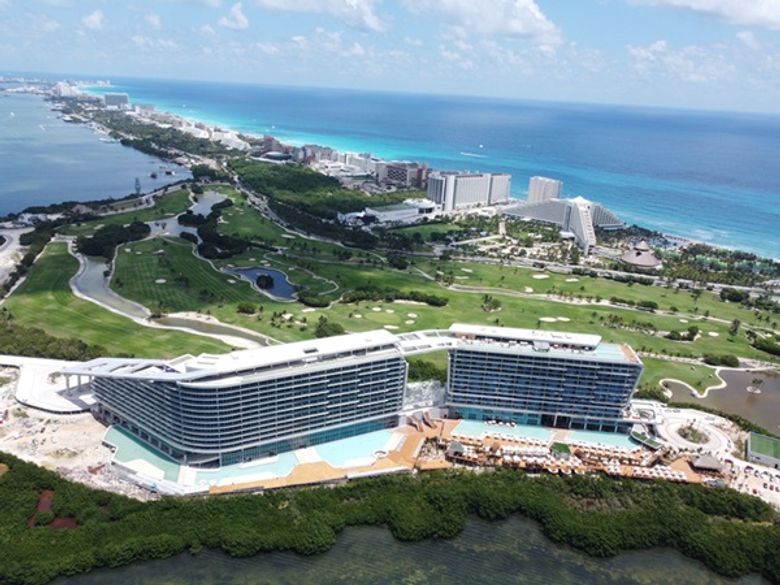
Murano Global Investments just opened the all-inclusive Hyatt Vivid in Cancun
In 2015, Sacal started investing in hotels and today, along
with his son Marcos, the COO, Murano’s portfolio includes the Hotel Andaz
(operated by Hyatt) and Hotel Mondrian (operated by Accor) in Mexico City as
well as luxury projects in Cancun, which include the 1,016 room Grand Island I
hotel with the first 400-room tower newly opened under Hyatt’s Vivid
all-inclusive brand. Another tower there will open under Hyatt’s Dreams brands.
He also has hospitality and hotel projects in Baja and more plans for Cancun.
To raise capital for development and further expansion, in
March Murano completed its business combination with HCM Acquisition Corp., a
special purpose acquisition company. The combined company operate as Murano
Global Investments and its common stock and warrants began trading on the
Nasdaq Capital Market under the ticker symbols “MRNO” and “MRNOW,”
respectively.
“Becoming a publicly listed company represents an important
milestone for our organization as it opens up a new source of capital and
significantly enhances the international profile of the company, which will
help to advance our growth plans,” Sacal said. “We are primed to steadily
expand our portfolio in top tourist destinations across Mexico.”
Shawn Matthews, CEO of HCM stated, “Murano Global
Investments is one of the very few entities that have the vision, experience
and professional network to succeed in Mexico’s nuanced real estate development
and hospitality market. It is these differentiators that initially drew us to
the company and having gotten to know the team better over the course of this
process. I’m confident it will succeed in executing its growth strategy.”
Big capital raise comes first
Since the public listing did not raise new funding, the
first priority is to raise capital to start up development plans, first in
Mexico. “We need to raise $1 billion to develop the portfolio that we have,” Sacal
said. “We have a very good pipeline with signed contracts. So, the next
challenge is to raise further capital, execute the bonds, get construction
loans from the banks and build our pipeline.”
Once capital starts to come in, the priority development will
be in Cancun, where Murano has the rights to the World Trade Center brand and
plans to create a big commercial center with convention facilities and multiple
hotels with up to 3,000 rooms.

We want to buy two or three portfolios in the next five years – maybe another 1,000 to 2,000 rooms – in strategic locations.
Elias Sacal
Over the next five to seven years in Mexico, Sacal said
Murano should have about 4,000 rooms in Cancun, as well as the new developments
in Baja to add to its holdings.
Murano is also planning two 400-room hotels for Baja, one
with Hyatt and another with another major U.S.-based operator, Sacal said.
Additional growth includes the exploration of a potential
entertainment village in Baja for cruise ship passengers departing California
who are now required to make a stop the first night out of American territory.
The plan is not yet fully realized, but the hope is to create docks for two
cruise ships, where Murano will offer day passes to their village.
What Murano will not do is invest in small business hotels
in Mexican markets that are in vogue due to ongoing nearshoring of production
by U.S. companies. The margins for those hotels aren’t big enough to suit
Murano’s purposes, Sacal said. But what he is considering, is building logistics
and industrial parks as he thinks warehouse space is at a premium.
Looking outside of Mexico, Sacal said Murano wants to buy
properties that need a new brand and/or management and an overall refresh to
increase their potential. He said they will likely look in Latin America, the
Caribbean and eventually in U.S. resort markets like Florida and Hawaii. “They are
tired because they are owned by big families or hedge funds and need a fresh
start,” he said. “We want to buy two or three portfolios in the next five years
– maybe another 1,000 to 2,000 rooms – in strategic locations.”
Even with a pipeline and new access to capital through the
SPAC, Sacal said Murano will walk before it runs, operating in what he calls
more of an incubation mode to show the public market it can deliver results
through strong asset management.
If all goes well, a second and third public offering could come
to market within 24 months, Sacal said. “But for now, I probably prefer to be
like a boutique company,” he said, adding that the stock remains in the $12 per
share range, the higher end of its original float.
Sacal
added that the company is likely to move its base to the U.S. within two to
three years and within 10 years reach a portfolio of 20 to 30 hotel properties.