With a background in architecture, this group has five
secondary market conversion projects on the books and a process they expect
will work.
NEW YORK CITY – Developers often suggest converting an office
to a hotel is fraught with peril and the general consensus has been
opportunities are limited. They must not know developer Jon Kully, managing
partner of Left Lane Development in New York City, who is an architect by
trade and seems to have the formula for office-to-hotel success.
Kully is responsible for Hotel Bardo Savannah in Georgia,
and Left Lane has office conversions projects in various stages of development
in Pittsburgh, Pennsylvania, Providence, Rhode Island, Memphis, Tennessee, Bozeman,
Montana, and Phoenix, as well as a second property in Savannah. All our scheduled
to open between 2026 and early 2028.
All projects will sit under the Bardo luxury brand or Recess
lifestyle brand, and Kully raises private equity and deploys capital from
limited partners, endowments, family office and foundations. Every deal is
financed with debt separately and hold times range from three to five years
with the stressed, exiting office owner taking a minority stake in the hotel projects.
Geolo Capital is Left Lane’s partner for Hotel Bardo in Savannah, and it raised
another vehicle for the other five office conversion projects.
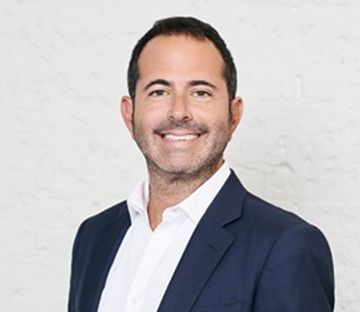
Left Lane Capital's Jon Kully
Pittsburgh, Providence and Phoenix will be a combination of
hotel and multi-family with shared amenities, and Memphis is multi-family only.
Kully said Left Lane is generally doing about 60% hotel keys and 40% multi-family.
“We also think that those two asset classes, which were once upon a time
disparate, are converging because they think that successful multi-family has a
very large hospitality component. So, really, it’s about duration of stay,” he
said.
Deals range from $80 million to $200 million in total costs.
Five historic office buildings totaling more than 1.2 million square feet in
high-growth secondary cities are acquired for $80 per square foot and a 75%
discount to replacement cost. Sourced off-market via a proprietary market and
asset selection process, Kully said for every renovation dollar spent, 20% is recouped
via historic tax credits.
Kully reinforced the fact that 98% of office buildings
around the country will not convert economically to hotels. But with 11 of his
22-person team architecturally trained, they set about this adventure, eyes
wide open, and found that the most distressed component of real estate, namely
Class B, historic office buildings, happen to be the easiest to purchase at the
cheapest price. They are the easiest to convert because they were built before
the advent of centralized air conditioning. They also have operable windows and
shallow floor plates. “They are literally conceived to convert to multifamily
or hospitality,” he said.
Kully and his team look for historic buildings that meet the
following criteria: constructed between 1900-1965 with the right light and air
dimensions. They are no greater than a 40 feet dimension from the center line
of the building to an exterior wall; 10,000-20,000 square feet floorplates; and
windows on most or all sides.
By converting distressed office buildings into their highest
and best use rather than developing ground up, Kully said Left Lane’s valuation
basis in the real estate is attractive. Assets acquired at 50% to 75% discounts, and “cumulative advantages”
result in 30% to 50% discounts to ground-up construction. Highly accretive state and federal historic tax credits equal ~$68 million across the portfolio or ~21% of hard costs (and other local incentives like tax abatements).
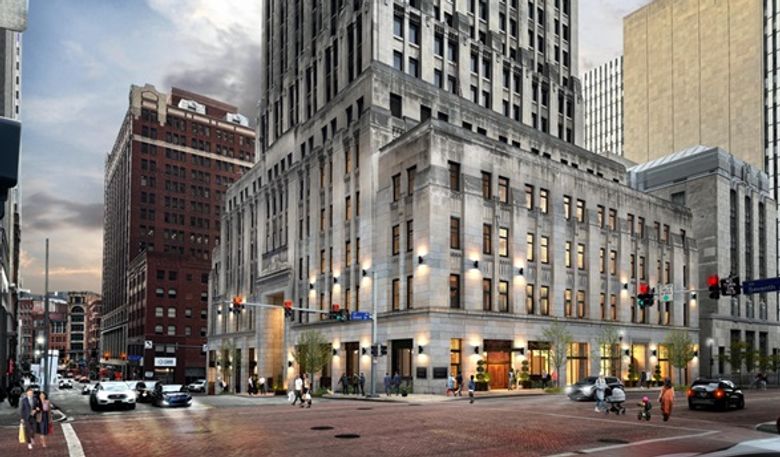
The Hotel Bardo Pittsburgh is supposed to open in 2027
“A lot of people in the real estate development might be financiers.
They might like to play in Excel. They might have good taste. But they’re not
thinking the way an architect thinks,” Kully explained. “Starting in the late
fall of 2020, we set about, like everyone sitting at home scratching their heads,
figuring out what the new world is going to look like. Where’s the opportunity?
So, we built it. We said we are obsessed with high-growth secondary markets,
even though I live in New York and have done half of my work in a gateway
markets. We think the future is about high-growth secondary markets because
they are very affluent. They’re well-educated people and well-traveled. They
have expectation, but unmet demand, and that’s the interesting cross section.
You have historic distress around Class B office, and you have unprecedented
government incentives to help defray costs.”
He further explained that ground up construction in their
markets cost $750 a square foot to build. Of that, $30 a foot is the land value;
$325 a foot is the core and shell. They bought the land and the core and shell
for $81 a square foot, which is a 75% discount replacement costs. They then
layer in historic tax credits to defray the redevelopment of the asset, which
has a value of $70 a foot. So, their discount to ground up basis is 36% or
their projects at $480 per square foot.

We think the future is about high-growth secondary markets because they are very affluent. They’re well-educated people and well-traveled. They have expectation, but unmet demand, and that’s the interesting cross section. You have historic distress around Class B office, and you have unprecedented government incentives to help defray costs.
Jon Kully
“By the way, building ground up – that’s not financeable. That
doesn’t pencil,” Kully said. “So, we’ve created a moat around our business
plan. Entree into market and these iconic historic Class B office buildings is
the only way. And oh, by the way, those old hotels that had been putting aside
4% of their top line revenue in an FF&E reserve for years planning the
renovation – unfortunately, they spent those dollars during COVID on interest
payments. So, now those assets remain tired and there’s no ground up
construction competitor. So, we’re the only shiny penny in market.”
Kully added that they identify good locations by using a
CMBS data feed from Morgan Stanley to understand the health and wellness of
borrowers in a given market. He cited the Gulf Tower in Pittsburgh that had a
loan maturity coming up and occupancy was way down. They cold call and suggest
a partnership where they infuse fresh capital and transform a tired asset to a
hospitality offering where the seller remain a minority interest holder, enjoying
quarterly distributions and upon disposition selling for maybe six to eight
times what they would have sold for as an office building.
But can secondary markets deliver the return? Kully responded
by saying they only go to markets with tremendous visitation, with lots of
affluency and with a real story behind them. Then, he said, they can deliver
breakaway rates because those affluent customers traveling to Savannah for a
weekend, for example, are used to paying a premium.
Citing the Bardo in Savannah, Kully said blended ADR is in
the $400s with transient in the $700 to $800 range on weekends.
To further differentiate, all hotels will have a private
membership club with Hotel Bardo already having 225 members and a planned
250-member cap.
Longer term, Kully said his aspiration is to become
Auberge-like (all Left Lane hotels are affiliated with The Leading Hotels of
the World) with an opportunity to reach maybe 25 assets doing five at a time
like he is doing now.
“It’s hard to find iconic buildings that lay out
appropriately. But I think people appreciate history. I think people appreciate
craftsmanship, and I think there’s so much about ground-up construction that’s
less appealing to people,” he said.