Level 8 takes up an entire floor of a dual-branded Moxy/AC hotel. We look at how the deal came together and what can make it pencil profitable.
LOS ANGELES — A unique and aggressive food and beverage play
in Los Angeles came from a desire to “crack the code” on an affordable
lifestyle hotel.
Level 8 is a 30,000-square-foot indoor and
outdoor space that takes up an entire floor of a dual-branded, 36-story and
727-key Moxy and AC Hotel in downtown Los Angeles. It is a collaboration between New
York City-based hotel developer Lightstone and Los Angeles-based Houston Hospitality.
“We came up with the idea that if we could
design a smaller hotel room and make it efficient, we could get a higher
density and charge a lower price,” said Lightstone President Mitchell Hochberg. But that concept came with a catch.
.jpg?tr=w-780%2Cfo-auto "Golden Hour is a rooftop pool deck and rotating carousel bar.")
Golden Hour is a rooftop pool deck and rotating carousel bar.
“We felt that the product needed to be
enhanced by food and beverage to compensate for the fact that the rooms were
smaller… If we gave them food and beverage options within the property, it
would make it more accommodating,” he said.
Lightstone first tried this approach with the
Moxy Times Square in New York. The company’s relationship with Marriott International encouraged the world’s largest hotel company to bring the Moxy brand from
Europe to the U.S. Four more locations from Lightstone in New York followed, along with one in
South Beach in Miami.
Los Angeles was always part of the plan, too,
but the city is notoriously difficult for development, Hochberg said, and it
took almost six years to complete the project. (The hotel opened in April, and
Level 8 started its sequential opening in September.)
Hochberg said Lightstone sought a food and
beverage play at a scale it had never attempted. The Level 8 concept wasn’t
just counting on hotel patrons to drive the revenue but drawing most of its
customers from Los Angeles.

Believe it or not, we do not depend on the hotel traffic to be profitable. We roughly expect 75% of the business to be generated outside the hotel.
Mitchell Hochberg
“Believe it or not, we do not depend on the
hotel traffic to be profitable. We roughly expect 75% of the business to be
generated outside the hotel.
“Our philosophy of this was driven by the fact
that we were building a large property in downtown Los Angeles, and we needed
to create a differentiating factor for people to stay at the hotel… and also
something that would draw people from Los Angeles to help support the food and
beverage as well,” he said.
Developing Level 8
Level 8 is a carve-out from the Marriott
agreement (the company is not involved) and is a joint venture between
Lightstone and Houston Hospitality. The percentage of the JV and the amount of
the investment were not disclosed.
Hochberg said Lightstone searched for years
for the right food and beverage partner. The company wanted someone based in
Los Angeles.
“We wanted somebody that shared our vision to
do a project that was experiential, that was not just a club or restaurant and
somebody that liked the idea doing multiple venues instead of one big
restaurant or the one big nightclub,” he said.
.jpg?tr=w-780%2Cfo-auto "Mother of Pearl is an al fresco oyster and ceviche bar.")
Mother of Pearl is an al fresco oyster and ceviche bar.
Level 8 includes:
- Mr
Wanderlust: A piano and jazz bar
- Golden
Hour: A rooftop pool deck and rotating carousel bar
- Sinner
y Santos: A nightclub disguised as a 19th-century cathedral
- Maison
Kasai: A French-Teppanyaki experience
- Mother
of Pearl: An al fresco oyster and ceviche bar
- Qué
Bárbaro: A South American live-fire grill
- The
Brown Sheep: A food truck serving Mexican street food
- Lucky
Mizu: A Japanese restaurant inspired by cooking with water
Hochberg said the process of creating Level 8
was unlike anything the company had done before.
“It was an interesting collaboration. The
Houston brothers (Mark and Jonnie of Houston Hospitality) themselves are
incredibly creative and talented. It was really a true collaboration with us and the two design firms that we brought in,” he said. “It was
not the typical design process, where you would work with a design firm, give
them a brief, and they would come back with drawings, and you would edit it. It
was really more workshops that we did over a period of two years. We would sit
in rooms for days at a time and work together.”
Another key draw is Level 8’s location across
the street from Crypto.com Arena (where the LA Lakers, Clippers and Kings play)
and the Los Angeles Convention Center.
How to make it profitable
But, make no mistake, Hochberg said Level 8 is
helping the hotel business, too.
“The early
indications are that it will be very significant and meaningful to both
our top line and bottom line. We did it because we thought it would be, and
we’re already seeing the results of it,” he said.
.jpg?tr=w-780%2Cfo-auto "Sinner y Santos is a nightclub disguised as a 19th-century cathedral")
Sinner y Santos is a nightclub disguised as a 19th-century cathedral
“The primary driver of food and beverage in
our hotels is for us to drive RevPAR. We didn’t do it to have a standalone food
and beverage experience. [We thought] how do we get more people to stay in the
hotel? And how do we get people willing to pay a higher rate by virtue of the
totality of experiences we’re going to give them?”
So how does this concept pencil profitable?
“So far, it’s only worked on paper… We had to
be a little crazy and daring to do it because it’s a first instance,” Hochberg
said. “But we’re not afraid of being a groundbreaker and doing something new,
nor are our partners (Houston Hospitality) because if you look at most of what they’ve
done throughout their career it has always been
something new and different.”
Hochberg said he expects the hotel and the
restaurant to be profitable in the first 12 months. “The issue is going to be how profitable and
how they ramp up,” he said.
Making F&B efficient
So far, there have been many early successes
and lots of group sales, including two big buyouts of the entire 8th
floor.
“That’s something that nobody else can do in
LA,” Hochberg said.
To make the concept work, they had to build
many efficiencies.
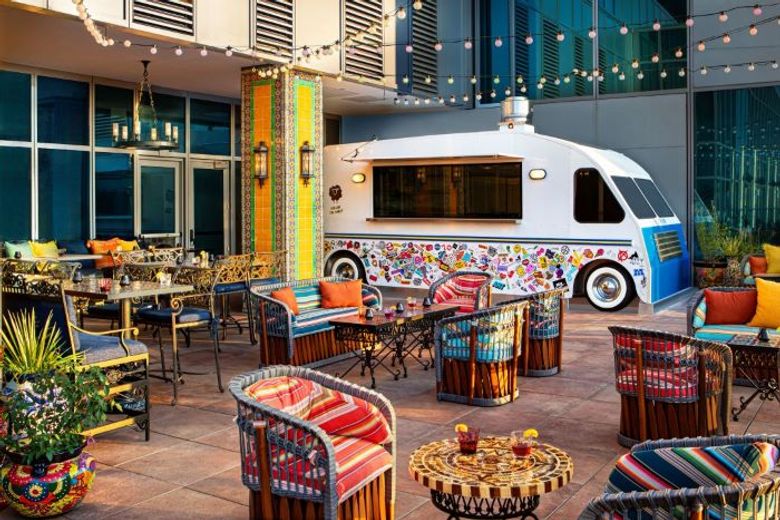
The Brown Sheep is a food truck serving Mexican street food.
“The critical part of this is how to
create unique destinations, but take advantage of the critical mass to have
efficiencies. If you run it as eight separate destinations, it would be
very difficult to be profitable,” Hochberg said. “We spent a lot of time
thinking about that. For example, we have one big kitchen, and most of the food
comes out of that single kitchen with an executive chef who works with the
chefs of each of the restaurants to prepare, create and purchase the food.
That’s done as if it’s one large restaurant.”
But because they were going for experiential,
most of the cooking is done at the restaurants. “We’ve tried to be very creative and efficient
in the operating model to take advantage of the scale while leaving the
individuality of the restaurants from the guest-facing perspective,” Hochberg added.
There’s also been a significant PR campaign. “I don’t have data yet. But clearly, part of
the marketing effort is to ensure we get the information to the guests,
particularly pre-arrival, so they know their options.
“One of the things that we have been challenged
with is making sure they know about it ahead of time so they can book a
reservation. The worst problem you could have (and this happens in New
York) is that the guest gets to the hotel and wants to go to the venues, and
they find out [they] are sold out.”
While food and beverage will be part of any
future hospitality expansion for Lightstone, Hochberg said he doesn’t think a
concept like Level 8 is necessarily transferrable to other markets.
“I don’t think there’ll be anything as
ambitious as LA because I don’t think there’s another city — other than New
York — that can absorb the scale,” he said. “And we have already saturated New
York.”
Hochberg said Level 8’s opening has
“exceeded our expectations.”
“But now we have to run it. And we’ll have to
see if all of the exposure and all the people coming continues,” he said.
“Because what we don’t want to be is just an occasion place, right? That’s the
worst thing that can happen to a restaurant. You want people — particularly the
locals — to come back.”