Dallas has led the nation in construction
pipeline for most of the year. We explore why the market is so hot and why the high-end segments are leading the way.
DALLAS — When exploring why
Dallas continues to lead the U.S. in hotel construction, the reasons are
almost as numerous as the 189 deals currently listed in its pipeline.
“Dallas
is seeing really strong GDP growth and is expected to continue to see really
strong growth over the next three to five years,” said Zach Demuth, global head of
hotels research at JLL. “Historically, GDP and hotel demand have a strong
correlation.”
“For the last three or four years, it’s been a hot market
because it remained open,” added Colin Sherman, CoStar's director of hospitality market
analytics, Texas & Tennessee. “When a lot of the U.S.
travel was restricted, it remained a very open market, and it was easy to get
there. The same elements that made it strong during the pre-COVID years
continue now."
The
Dallas market, which stretches in all four directions for dozens of miles past
the nation’s 9th largest city, has led the U.S. for the second and third
quarters of 2023 in hotel construction pipeline deals, according to Lodging
Econometrics. Through the third quarter, Dallas has 189 deals and 21,840 rooms in its pipeline. Those projects break down to 25 projects and 3,178 rooms under
construction, 80 projects and 9,021 rooms starting in the next year and 84
projects and 9,641 rooms in the early planning stages.
According
to CoStar data, Sherman said that in the near term, approximately 6,500 hotel
rooms are expected to be delivered in the Dallas area in the next 36 months.
Brian Nordahl, executive vice
president for CBRE Hotels, said developers like Dallas because of its
economically friendly conditions for taking risks.
Sam Tabani, founder and
managing director of Dallas-based brokerage Tabani Real Estate, said Austin is typically the preferred hospitality market in Texas.
However, the price and scarcity of land there have others looking for alternatives
and many investors “have come looking in Dallas.”
“I’ve been in Dallas for the
last 25 years, and we used to buy land for about $4-5 a square foot. That’s
turned into the mid-$20s,” Tabani said.
Demuth
said another factor setting the Dallas market apart is the migration shift
during COVID. While most markets have seen that shift slow down, the opposite
is happening in Dallas-Fort Worth.
“If anything, it’s actually
accelerating further. And you’re seeing particularly a population migration of
the upper upscale, luxury side of earners.
‘Luxury tier’
That
influx of top earners is important for the market because Dallas has one of the
lowest percentages of luxury hotels relative to all hotels for top U.S. markets.
According
to CoStar data, Dallas ranks third lowest across the top 25 U.S. hotel markets,
with only 3.3% of its hotel supply in the luxury segment. (For comparison, Las
Vegas is the top market at 28.1% and the average across the top 25 is 10.6%.)
That
creates a lot of opportunity for development in the upper upscale and luxury
segments, and developers are filling that need.
Big projects already announced in the luxury or upper upscale
space include a new Four Seasons Turtle Creek which is being developed by Boston-based
Carpenter & Co.; a J.W. Marriott
Dallas Arts District being developed by Plano, Texas-based Sam Moon Group; a
Hotel Swexan being developed by Dallas-based Harwood International; the already
complete Omni PGA Frisco Resort in the suburb of Frisco, which was
a public-private partnership; and, in Fort Worth, the Bowie House, Auberge Resorts
Collection developed by Jo Ellard and Fort Worth-based Bowie Place Properties; as
well as the Crescent Fort Worth hotels, developed by Fort Worth-based Crescent
Real Estate.
“These
are all well-known brands that have footprints in multiple other cities,”
Demuth said. “The fact that suddenly they’re all coming to Dallas is a
great indication that we are seeing this strong growth in demand for upper
upscale and luxury.”
The
string of high-profile projects also marks an important time in the market’s
hospitality development history.
“We’ve
never really had a luxury tier here in Dallas… Now we have the entrance of some
great high-end lifestyle hotels,” Nordahl said. “There is this band
of luxury that just didn’t exist here. Developers have taken the opportunity to
recognize from significant relocations on the corporate side, but also very
wealthy individuals relocating here from California and other places that will
patronize these properties, both for the food and beverage and everything else.”
Nordahl said the development
of The Knox, Auberge Resorts Collection in Dallas, which is a joint venture of MSD Partners, Trammell Crow Company, The Retail Connection and Highland Park Village Associates, could also be an important
milestone for the city.
“Auberge
is going to set the standard for ADR in Dallas, and it will certainly test the
limits of that,” he said. “The rub on Dallas is we’ve never been able to push
ADR to the levels of other major cities in the United States, and I think this
luxury stuff is going to make that happen."
Lower development costs
Demuth
said another strength of the Dallas market is that it’s relatively inexpensive to
build a hotel there compared to the rest of the country.

Dallas is one of the few primary markets in the U.S. where it’s still less expensive to develop a hotel than it is to acquire a new one, which isn’t the case anywhere else.
Zach Demuth
“Dallas
is one of the few primary markets in the U.S. where it’s still less expensive
to develop a hotel than it is to acquire a new one, which isn’t the case
anywhere else,” he said.
Demuth
compared Dallas to the New York City market, where it’s 30% less expensive to
acquire a hotel than build a new one, whereas Dallas is even.
“When
you think about it from an acquisition or investment perspective, if you can
develop a new hotel for roughly the same cost that you could acquire one, why
would you not develop [a new one], particularly given these migration
patterns,” he said.
That
has created many opportunities for growth in the select-service segment,
particularly north on the Dallas North Tollway, which connects the city to some
of its most prosperous suburbs.
“That’s
the new nexus of all this new development, and hotels will follow,” Nordahl
said.
Demuth
said the select-service growth speaks to the growth in business, particularly
construction, financial services and medical.
“Our
team continues to be increasingly involved in the select-service segments… and
that grows in the non-urban core,” Demuth said. “Those are typically more
inexpensive hotels to build, and there’s so much demand.”
Tabani
said the region benefits from diversification from many different types of
employers (unlike its counterpart in Houston, which has an economy more tied to
oil and gas.)
“Dallas
has properly planned this master diversification that we see from different
sectors, and it’s become a hub,” he said.
DFW’s submarket growth
Another
factor that makes the Dallas market unique is its expansive size (think of an
area the size of New England in North Texas).
“There is a lot of geographic diversity in the Dallas market,”
Sherman said. “There are a lot of submarkets that do provide an urban living
environment.”
Sherman
noted that while the Dallas Central Business District submarket leads the area
in 12-month ADR, ending in October ($188.57) and RevPAR ($121.14), there are a
host of submarkets doing impressive numbers as well, such as:
- Bedford/Grapevine
($157.07 ADR/$113.83 RevPAR)
-
Fort
Worth CDB/I-820 West ($152.25 ADR/$101.10 RevPAR)
-
West
Plano/Frisco ($135.97 ADR/$89.70 RevPAR)
-
Irving
North Area ($128.17 ADR/$88.72 RevPAR)
Demuth
said the Frisco and West Plano submarkets are interesting because they have
historically seen great demand in the select-service segments and are now
getting many more projects in the luxury and full-service segments.
Tabani
said the interest in the Frisco/Plano area is driving demand that can seem
irrational. He said if investors want to sell property in Frisco, “nobody wants
to take anything less than replacement value."
“We’re
involved in two deals in Frisco right now, and we’re trading at $130,000-150,000
a key,” Tabani said. “The numbers don’t make sense right now because things
have slowed down.”
This
begs the question of how many of these 189 deals in the pipeline will actually happen.
Tabani said interest rates will be the key factor.
“Because
if interest rates don’t start going down in the next 12 to 18 months, those
people will obviously not be able to build promptly. In some markets, if the
cost is too high to build, the ADR may not support it,” he said.
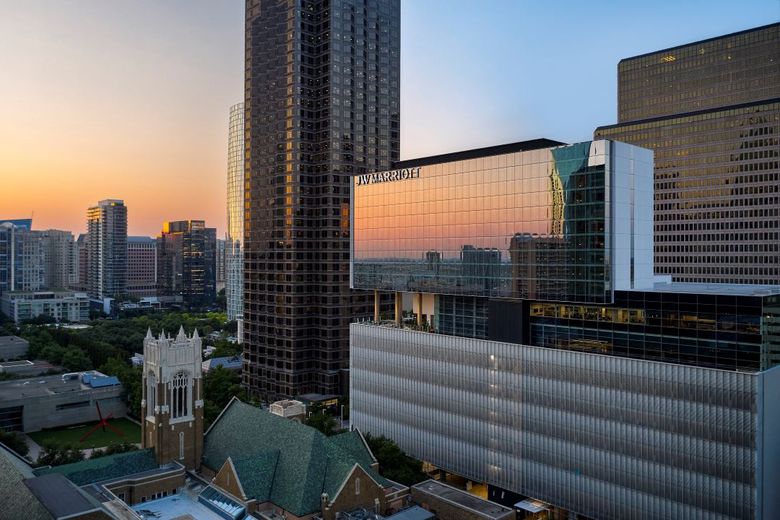
Dallas is getting its first JW Marriott hotel.
Opportunities in
Downtown Dallas
That’s
not to say there aren’t impressive development in Dallas’ urban core. Nordahl
noted DFW-based NewcrestImage purchasing the Magnolia in Dallas and announcing
hundreds of millions in renovations to the historic hotel.
“They
are probably the smartest investors in our business right now,” Nordahl said.
“Making that kind of commitment to downtown Dallas. It’s extraordinary. And it
shows where there was a need… and will test the market, regarding where ADR can
go.”
Dallas
voters last year approved extensive renovations to the city’s convention
center, which means the city won’t have one between 2024-28. Nordahl said it
will create hotel opportunities, especially the newer luxury/upper upscale
projects.
“It’s going to be an
interesting time for the hotel business because Austin’s convention center is
being rebuilt during that same time,” Nordahl said. “Many of these [luxury]
hotels will benefit because groups will still want to come to Dallas.”