Hotel101, a subsidiary of
Manila-based DoubleDragon, has micro-owners, one type of room and massive plans
to be in 25 countries in the next three years.
SINGAPORE — Sometimes, you walk into a
hotel room and look for an amazing view and top-tier service.
And
sometimes you just want to know where the light switch is.
A
Singapore-based hotel company is building an aggressive expansion plan for
guests seeking the latter — a “templated” consistency at a 3-star price.
Hotel101
is a subsidiary of Manila-based DoubleDragon, a publicly listed company with
approximately $3 billion in assets, founded by Tony Tan Caktiong and Edgar
“Injap” Sia II. Both founders have had incredible success in fast food in the
Philippines and internationally. The company has sizeable real estate holdings
in office and industrial and is the largest community mall developer in the
Philippines.
There are currently 11 Hotel101s in the Philippines (two are operational, with the rest under construction or in various stages of the pipelines). The company’s first location outside is in Niseko, Japan, which broke ground in August, and another is under construction in Madrid.
On November 14, the company announced its first U.S. property, with a 622-key Hotel101 being built in the Westlake North District of Los Angeles.
CEO Hannah Yulo-Luccini said the company makes money in two ways: first, from selling each individual hotel unit (the average hotel has around 500 keys) and then from their management of the hotel. Each owner gets a strata title when the hotel opens, and Hotel101 manages the hotel. The company has a 30-70 revenue split, with the unit owner getting 30% of the gross room revenue, distributed equally to all unit owners. Hotel101 gets 70% of the gross room revenue to cover maintenance and operating expenses.
Yulo-Luccini said the roots of DoubleDragon are important because
Hotel101 wants to “fast food-ize” the hotel space.
“We
aim to be like the Big Mac of hotel rooms,” she told Hotel Investment Today.
Hotel101
wants to open 500,000 rooms by 2040 and become one of the world’s top five
global hotel groups, operating in over 101 countries. That’s a lot of Big Macs.
The
company is aiming for “one SKU globally” (think economy airlines, Coca-Cola or
an iPhone) and 9 out of 10 consistency for its hotel rooms, which are all the
same size and layout (around 21 square meters of space with two beds and a
kitchenette.)
“We
believe that standardization in any market, like the budget airline market, for
example, exists because it delivers unbeatable value,” Yulo-Luccini said. “We
believe it’s the same for hotel rooms. Some people don’t care what view they
have outside their window. They just want a clean bed.
“It
smells nice and is consistent — they know where the light switches are. No
matter where they go, the light switches will be exactly where they are… Even
for a business traveler, we think it will be very attractive for them to feel
like they’re coming home to the same room no matter where they are.”

Hotel101 CEO Hannah Yulo-Luccini
Yulo-Luccini
said a templated approach could be exactly what someone staying in a 3-star
hotel can appreciate “because they just want a good value for a room. They can
stay longer for their budget.”
She
said many businesses that start in the Philippines only expand inside the
country. “Hotel101 is DoubleDragon’s first foray into the international
market. It’s the only part of our business that we feel has the substance to
truly become a global player,” Yulo-Luccini said.
While
Hotel101 is DoubleDragon’s first foray into global expansion, the company is
also the owner and developer of Ascott DD Meridian Park and a master franchisee
of Jinjiang Inn.
Jonathan
Ravelas, managing director at Manila-based consultancy firm eMBM, said
DoubleDragon has already shown an ability to take concepts successfully outside
the Philippines.
“When
you have a model that’s working in your country, and it works well in other
countries, you know you’ve arrived,” he said.
Ravelas
said it’s also a smart bet to rely on Asians to drive an international
hospitality expansion.
“Now
we’re starting to see this Asian wave. People in Asia want to see the rest of
the world. And the bigger populations are in Asia… If Asians want to feel
comfortable, people will try to patronize more of their products, because they
feel at home with the service.”
How Hotel101 works
Besides
the templated approach, the hotel chain prides itself on its simplicity (think
English 101) and its “micro-owner” approach.
“For
the recurring revenue, which is what we’re really after, we want to maintain at
least 25% operational margin in the long run, after giving our 30% to the unit
owners, because we only have one type of room and we don’t do F&B. All we
do is maintain the property and keep everything clean.”
Yulo-Luccini
said the idea is for the simple concept to keep everyone happy.
“It’s
easy to understand. [Individual room owners] won’t complain about our expenses
because they don’t participate. They only participate in the revenue. We’re a
listed company. It’s all very transparent.”
Inside the 'micro-owner'
The
micro-owners are typically kept at one owner and one unit per hotel. But the
idea is for them to own multiple units across properties and worldwide. They
each sign 50-year management contracts that they can’t sign out of.

We believe that standardization in any market, like the budget airline market, for example, exists because it delivers unbeatable value. We believe it’s the same for hotel rooms. Some people don’t care what view they have outside their window. They just want a clean bed.
Hannah Yulo-Luccini
“I’d
say 90% of our unit buyers are single-unit owners,” Yulo-Luccini said.
The
owners can sell the units, but Hotel101 has the right of first refusal.
Yulo-Luccini said there hasn’t been much activity on that end, but she
anticipates owners trading units, especially once the company opens in more
geographic locations.
The
fragmentizing of ownership creates revenue to fund Hotel101’s rapid expansion
plans.
“Every
time we sell a hotel, we take that margin and put it in another two hotels.”
Hotel101
can develop in three ways: through direct development, joint venture
partnerships (most properties are done that way in the Philippines) or
franchising.
Yulo-Luccini
said on the operations side, Hotel101 is aiming for a 25% margin, but it’s
often a delicate balance to keep everyone happy.
“We
always have to keep that balance so that the developer makes some money but
just enough so that the unit owners also are happy that their yields are good,
compared to rental yields in that market,” she said. “So, we ensure that the
developer is happy, the owner is happy, and the consumer is happy. And that the
hotel operator has just has the right amount of margin.”
Proof of concept
Yulo-Luccini
said the company opened its first property, the 518-key Hotel101 – Manila, over
five years ago. The hotel had 89.2% occupancy and 8.1% yield to unit owners in
2019. So far, for 2023, those numbers are 84.6% occupancy with a 7.4% yield.
She
said the 500-unit scale of the hotel is a differentiator (compared to the
100-unit scale of its competitors).
“This
gives us the scale and efficiency to price lower than the market and also
allows us to offer amenities that you would typically only find in a 4-star
hotel.”
Those
amenities include food and beverage options like all-day dining that a third
party runs. There is also retail space at each property that the company leases
to a 24-hour convenience store.
Yulo-Luccini
said the company has dynamic pricing but aims to price ADR at value.
She
said Hotel101 has made some changes over the last five years, with most aimed
at efficiency.
“We’ve
tweaked it a bit, in terms of having modular furniture to ensure that we can
repair and maintain rooms much faster,” she said. “We were traditional with our
build of bathrooms, and now we’re going moving to bathroom pods, so there’s
more consistency with that.”
Global expansion
Yulo-Luccini
said most of the hotels in the pipeline are already sold out, which not only
finances the build but also helps them recycle the capital by building more
hotels.
That
kind of model has Hotel101 thinking aggressively about expansion. It has around
8,000 hotel rooms in its pipeline (with just over 2,000 in operation). The
company wants to be in 25 countries by 2026, 140,000 rooms in 2030, and over
339,000 rooms by 2035.
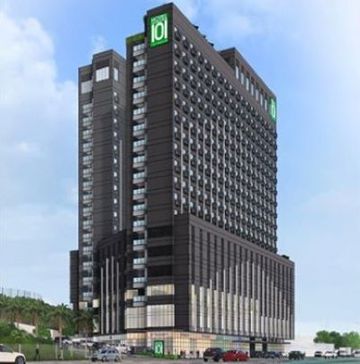
Hotel101 Los Angeles was announced on November 14.
For
those skeptical of whether this micro-owner concept will work for a global
audience, specifically the U.S., Yulo-Luccini said for the first few locations
outside of the Philippines, the buyers of those units are still primarily from
Asia.
“People
from all over the world want U.S. dollar exposure,” she said. “They buy in
Madrid because they want Europe exposure… We don’t depend on the domestic
market, particularly for the U.S. property (in Los Angeles).”
The
property in Madrid is also unique because it can qualify for Spain’s Golden
Visa investment, which can potentially provide a passport and citizenship.
Yulo-Luccini
said other than the 25 countries it has already named (she says there is a lot
of interest in Australia and New Zealand, for example), the company doesn’t
have a predetermined number of locations it needs in each place, with the U.S.
being it’s only exception.
“We
don’t have a preset thing, although we do want to have 10 in the U.S. in the
next few years,” she said. “There are so many 3-star hotels that are so
old… Not in the first-tier cities, but in the third-tier cities, when you
travel, you’re paying $250 for a not-so-great hotel. We feel that the U.S. has
a lot of opportunities and is primed for disruption.”
Funding the expansion
All
of this expansion is new construction, which can be challenging in today’s
capital market. Yulo-Luccini said Hotel101 can do it with the equity it has
built and the pre-selling of units.
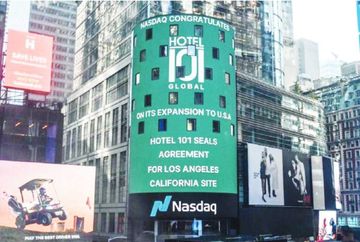
Hotel 101 is looking to list on the NASDAQ.
She
said the company is exploring a NASDAQ IPO, but the timing is
uncertain.
Yulo-Luccini
said putting Hotel101 in one specific segment is hard because she thinks they
have more amenities than a normal 3-star hotel.
“It’s interesting because it’s not
really select-service. We have all-day dining; we have a pool… It’s not
necessarily for those on a budget, but it could be for people that are looking
for good value.”