Vision Hospitality Group Founder
and CEO Mitch Patel talks about growth, strategic partnerships and the state of
the economy for hotels right now.
ATLANTA — Mitch Patel loves a
good analogy. As moderator of a panel discussion at the Hunter Conference in
Atlanta last week, he used an interesting one when comparing the quality of
assets and how long their shelf life is: Which hotels are beer and which are
wine?
“Sometimes these analogies help
simplify things,” said Patel, founder and CEO of owner-operator Vision Hospitality Group, Chattanooga, Tennessee. In
this analogy, consider beer as select-service hotels and wine as luxury or
full-service assets in high-barrier-to-entry markets.
“You have to have a strategy on what you want to do with these valuable assets,” he said. “We have assets that
are urban and high-barrier-to-entry and we feel like, even 10 to 20 years from
now, they will have a life.
“Beer has an expiration date. It
could get stale over time; a new exit could pop up with a new supply. Your
building may not be as relevant as much anymore. It requires a considerable
amount of capital.”

We think it’s a great idea for us to build those strategic partnerships with the right groups where our capital is going to go alongside their capital.
Mitch Patel
Vision Hospitality Group has been adding an interesting mix of “beer and wine”
to its portfolio of 40-plus hotels over the past few years. The company plans
to break ground on four new hotels and complete renovations on four others in
places like Colorado, Tennessee, Georgia and Florida.
“We are evaluating what’s beer
and what’s wine. With wine, you have flexibility. Let me add that it’s not like
you have to keep it forever. You can keep it for a long time, and you have to
be very strategic with it,” Patel said. “We’ve evaluated what hotels that we
would probably want to have a disposition with. There’s no point in putting
tons of capital in a hotel you’ve identified as having a disposition. Let the
new buyer do that. Why disrupt the operations of the hotel and diminish the
value of the NOI?”
Strategic
partnerships
Another part of Vision’s growth
is adding strategic partnerships into its mix, Patel said.
“We think it’s a great idea for
us to build those strategic partnerships with the right groups where our
capital is going to go alongside their capital,” he said.
As part of their growth plans, Vision also named Mary Beth
Cutshall as chief growth officer last week.
“I’m excited and thrilled to
have somebody that’s a true partner. That’s what I was looking for,” Patel
said. “As we look at our full potential of what we could do 10 to 15 years from
now, I don’t want to look back and say we could have done this.”
So, how big does Patel want
Vision to get, and what’s the mix of beer and wine assets? He said he’s never
had a specific number in mind and that growth could also mean continuing to
manage hotels it divests.
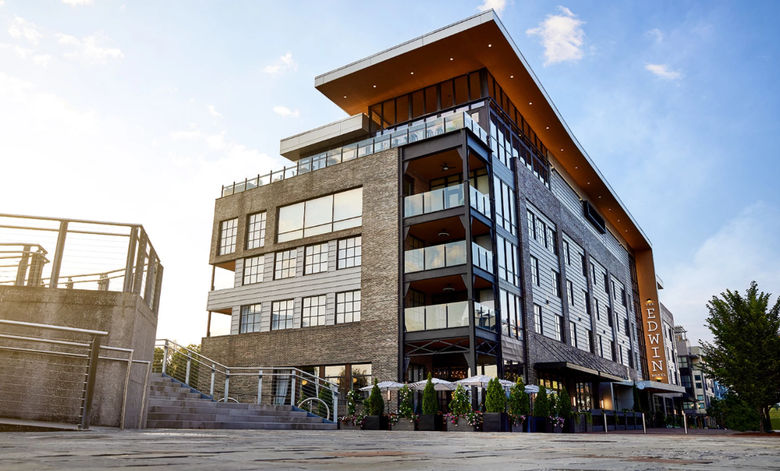
The Edwin Hotel in Chattanooga, Tennessee.
“I would love to keep management
and that’s also where the strategic partnership comes in because it keeps your
people and maybe I still keep an interest in the deal,” he said. “We operate
our hotels because we feel like no one else is going to care more than us. We
think that we have done a great job of operating our own hotels and that we
could do it for others, but in a strategic manner, in a true partnership, not
just as a commodity.”
So, what’s the ideal number for
Vision?
“We want to grow strategically.
How many hotels? I can’t tell you, but in five years, we’ll probably have
60-plus hotels,” Patel said. “It’s not going to be 150 hotels or something like
that. Quality is way more important to us.”
The economy and hotels
Another thing Patel said on
stage while moderating a Hunter panel was that his colleagues who own economy
hotels said they’ve already been in a recession these past few years.
“Let’s face it, if you don’t
have a lot of money, then you’re going to be more cautious about spending money
on travel,” he said. “So, for economy hotels, for the last couple of years, they
have absolutely been in a recession. They have declined in performance, and
many of those owners have been struggling because the costs have gone up and
the revenues have not even gone up.”
Patel said he’s seeing a softening of business over the past months and has even seen a slight slowdown because of the DOGE cuts that are currently happening.
We’ve seen [a slowdown] in IRS training business. We’ve seen it in government research grants that were frozen. It’s hyper-localized... It’s not a huge amount, but it could be 20% for somebody that’s next to a lot of government business.
Mitch Patel
“We’ve seen it in IRS training business. We’ve seen it in government research grants that were frozen. It’s hyper-localized, and for the overall pie, it’s only 3% to 4% of the total business,” he said. “It’s not a huge amount, but it could be 20% for somebody that’s next to a lot of government business.”
Patel said to pay attention to consumer confidence numbers because that can drive a lot of the softness.
“We saw a dip in consumer confidence in February over January,” he said. “People are a little concerned, and when they’re concerned, they tend to retreat.”
Patel also noted the bifurcation
of hotel assets where Vision Hospitality's higher-tier assets (like The Edwin
Hotel in Chattanooga) are still seeing ADR growth.
“That’s the big gap that we’re
seeing… People will pay a premium for that kind of experience, and that has
really driven this luxury development throughout the world,” he said.
“Everybody says that demand follows GDP. It's that demand is tapering away in a positive
way from the GDP because the experience economy is growing at a greater rate
than the goods economy.”
Patel also spoke about his personal travel experiences and how the memorable experience has now become the
commodity.
“Now, let’s translate into the
hotel world. It can’t just be a bed, and it can’t just be a shower; that’s just
shelter… At the Edwin, it’s way beyond that. You get this tremendous
experience. You’re immersed in a story,” he said. “There is no ceiling on [what
some hotels could charge in ADR]. If you want to charge $800, $900 or $1,000,
you could do it because people will pay for that unique experience. There’s no
other place you could get that unique experience… It’s that top, top tier, and
there’s just enough customers that are used to paying that they want the best
experience when they come into town.”