Regent
is back in Hong Kong after “lots of sweat and tears,” not to mention a $1.2 billion
price tag for Gaw Capital. At the grand opening, the owner urged IHG to expand its horizons with the luxury brand.
HONG KONG – After
an undertaking that cost more than $1.2 billion and stretched across eight
years, the grand opening of Regent Hong Kong on November 8 sashayed into a
top-quality hotel deserving of its status as the flagship of an iconic brand.
But now comes the job of ensuring all the hard work will bring in the
returns.
At a
black-tie event celebrating the milestone, a welcome speech by Goodwin Gaw,
chairman, managing principal and co-founder of Hong Kong-based Gaw Capital
Partners, started with the softer aspects of the hotel’s rebirth as a Regent,
but ended with a hint of accountability for IHG to take the brand forward. IHG
owns 51% of Regent since a 2018 joint venture with Formosa International’s
Steven Pan, who owns the remainder.
The
hotel was a Regent from 1980 to 2001, when it became InterContinental. In 2015,
Gaw Capital with other investors, including sovereign fund South Korea
Investment Corp., acquired the property. Goodwin Gaw then orchestrated the
IHG/Formosa joint venture, which paved the way for the hotel to be flagged
Regent once again.
Gaw
spoke about how Regent played a huge role in Hong Kong’s ascendency to become a
global financial hub and tourist destination, and how it “etched memories” for
people as the place of countless weddings, reunions and other milestones. He
shared the challenge of “re-igniting an icon” and creating an urban sanctuary
that is “fresh yet familiar,” and how the best and brightest creative minds in
Hong Kong were brought in for the process.
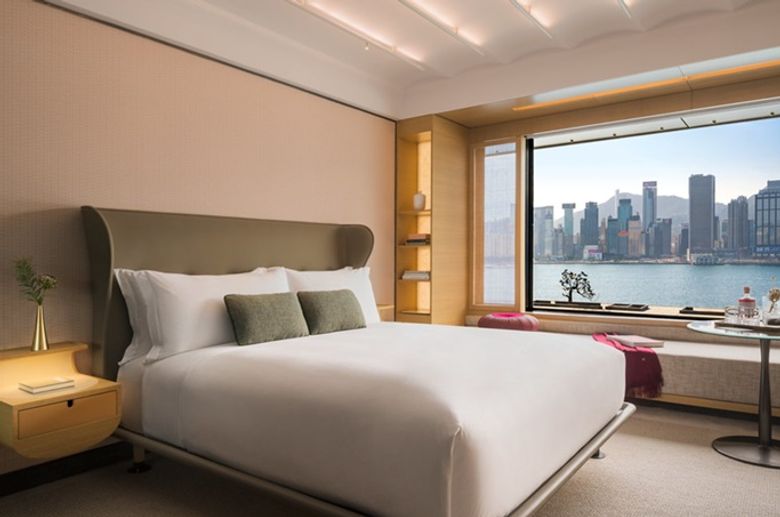
Classic Harbourview Room at Regent Hong Kong
The
result, he said, is the best of East and West, which is the essence of Hong
Kong and the brand. He thanked the Hong Kong-born international designer Chi
Wing Lo, the project management team and all colleagues for “jumping through
fire with COVID, cost escalation, inflation... So, lots of sweat and tears.”
“But
we have arrived, and I firmly believe what we as a group has created is a
polished diamond in the fragrant harbor, and the [hotel] once again will be the
place to etch new memories and rekindle old memories for visitors and locals
alike.
“And
now the job is passed to IHG as they take what we have relaunched in Hong
Kong... Take the Regent brand global and something that started from this hotel
in Hong Kong,” Gaw said.
Price
tag
The
price tag of Regent Hong Kong is $938 million, excluding a reported $300
million capex for renovations that were intended to start in 2017 for 18
months. Designer Lo was brought in 2019 when an earlier designer didn’t work
out. A big setback Lo faced in renovating the 43-year-old building was that
some structural changes required more time for approvals, while COVID caused
new uncertainties.
“They
[the owners] realized time was getting less, budget was getting higher. As a
result, 85% of the entire project had to be redesigned,” Lo said in a media
interview.
The
“cost escalation” that Gaw referred to, plus revenue loss due to the closure of
the hotel for renovations in 2020, must be hefty. And while the much-loved
Regent is back, Hong Kong isn’t. Latest Hong Kong Tourism Board figures show
arrivals of 20 million in the first eight months, or 84% of pre-COVID
levels.
The
tourist board blamed currency exchange rates, airline capacity and the global
economic outlook. But geopolitics may also prevent the full return of key
long-haul markets such as the U.S. The state government has a travel advisory
to “exercise increased caution when traveling to Hong Kong due to the arbitrary
enforcement of local laws.”
Regent
competes for the smaller pie with esteemed nearby neighbors, particularly The
Peninsula and the Rosewood Hong Kong.
Connecting
the dots
Owners
naturally want to see more new or renewed Regent hotels opening in great
locations across the globe as the critical mass will spread the word faster
about a legacy brand remade to modern tastes.
In
2018 when IHG became majority owner of Regent, there were just six operating
Regent hotels left in the world. Only three have been added in five years, in
Phu Quoc, Cannes and Hong Kong. COVID no doubt impacted openings.
Another
nine Regent hotels are in the pipeline, with expected opening next year in
Santa Monica, California, Shanghai, Bali and Jeddah.

The U.S. is one of the biggest feeder markets in the world and is a significant proportion of the business here in Hong Kong. So, having an iconic hotel in the U.S. is part of that strategy of mapping Regents around the world. Likewise, Asia is a massive feeder market into Los Angeles. So, you can see how we’re connecting the dots.
Tom Rowntree, IHG
To
owners like Formosa’s Pan, who owns Regent Taipei, the opening of Regent Hong
Kong is especially auspicious. “This will put a lot of momentum for Regent to
grow, although we [the brand] have grown well during the pandemic. IHG
added 10 contracts without the opening of Regent Hong Kong. Now, owners can
expect IHG to secure even more Regent deals,” Pan, who is also chairman of Regent Hotels & Resorts,
told Hotel Investment Today.
“I
did Regent Taipei because of Regent Hong Kong. Everybody did a Regent because of
the hotel. It was the world's best luxury hotel. It was ahead of its time with
the [porte-cochère], the five-fixture bathroom and lots of other innovations,”
Pan said. “I remember in the ‘80s it took forever to fill up a bathtub. Regent
Hong Kong made sure the tub would be filled in two minutes. Problem was,
everybody turned on the tap, did their thing and came back in 20 minutes
[laughs]. Today in the bathroom there's a sunken bath and a moat around it to
keep the floor dry.”
Tom
Rowntree, IHG's vice president of Global Luxury & Lifestyle Brands, said
the Regent is on track with its goal of 40 hotels with 10,000 rooms in the long
term. It is connecting the dots to ensure more feeder markets for Regent
properties.
“We're
excited about Regent Santa Monica, which is going through a major
refurbishment,” Rowntree said. “The U.S. is one of the biggest feeder markets
in the world and is a significant proportion of the business here in Hong Kong.
So, having an iconic hotel in the U.S. is part of that strategy of mapping
Regents around the world. Likewise, Asia is a massive feeder market into Los
Angeles. So, you can see how we’re connecting the dots.”
Rowntree
is also cognizant of the responsibility towards a legacy brand but also towards
returns for owners. “There’s a responsibility to nurture legacy brands and
ensure they will be enduring. And part of that is having healthy returns.
That’s why we’re here [in Hong Kong] creating a brand that our guests will love
more than any other. And key to that is understanding the customer, which is
the work we’ve been doing since acquiring Regent.”
IHG
also arranged for 50 international media to attend the grand opening, supported
by the Regent Hong Kong team.
The
chain is said to retain the management of the hotel for 37 years with three
10-year extension rights.
Hong
Kong strategy
Michel
Chertouh, managing director of Regent Hong Kong, said response to the hotel has
been “amazing” since it soft launched in March with most of the F&B venues
opened.
“Everyone
came back to reconnect with the hotel, and we established ourselves as a dining
destination again. Now it’s time to get to the rooms side of the business,”
Chertouh said.
Occupancy
in the second half of the year is inching towards mid-70%, while room rates are
on the same level as the other upper luxury competitors, he said. “We’re not
shy to be on par with them. We are proud of our legacy and what we have
achieved here,” Chertouh added.
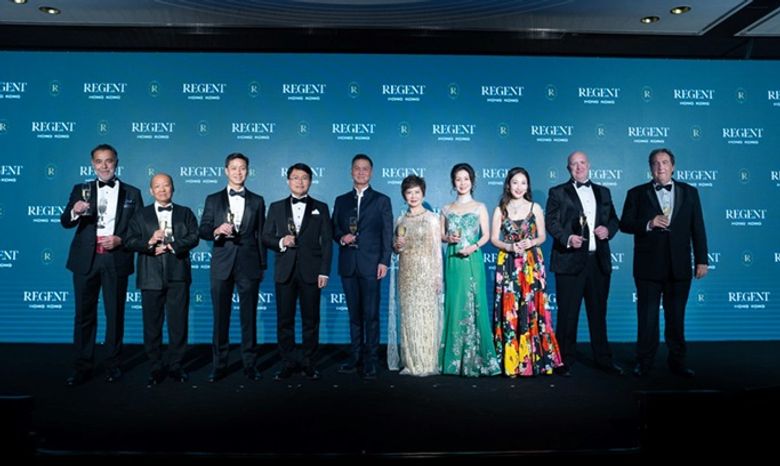
The key players of Regent Hong Kong at the grand opening
A
Classic Harbourview Room is currently at HK6,000 ($768) per night, excluding
10% service charge.
Chertouh
said once airlift is back, which he expects by the second half of 2024, big
events and international travelers will return in bigger numbers. “I’m French.
There were three flights a day from France, now only one,” he pointed
out.
“So,
in the short term, we are focusing on the luxury markets in the regional areas
– mainland China, North Asia and Southeast Asia. There’s a lot of growth in
places such as Vietnam, Thailand and Indonesia. So, Southeast Asia will play a
bigger role as a key feeder market.
“In
the long term, Hong Kong is resilient, and will no doubt get back to what it
was because of the nature of its people. And everyone who hasn’t been to Hong
Kong in the past few years will see that the part of Hong Kong that has changed
the most is Kowloon [where Regent is located], with new attractions such as M+,
Palace Museum, K11, new hotels opening and the Regent coming back,” Chertouh
said.
M+,
designed by Herzog & de Meuron, is one of the largest museums of contemporary
visual culture in the world. Hong Kong Palace Museum presents 900 priceless
treasures from the Palace Museum in Beijing, while K11 is a museum retail
development developed by Adrian Cheng, brother of Rosewood leader Sonia Cheng.
Former
IHG CEO Keith Barr, in an email interview, said it’s exciting to see the Regent
brand return to Hong Kong with such a transformative renovation. He said he’s
certain the hotel will continue to define luxury for decades to come “due the
commitment of the owners, the passionate service of our colleagues and the
support from the community.”
“I
love that hotel and the team there is truly special,” Barr said.