This Mexico City-based developer just acquired the Boston
Park Plaza and sees more opportunity in the U.S. while continuing to dominate upscale development at home.
Charles El-Mann Fasja’s strategy for Parks Hospitality
Holdings (PHH) is straight-forward and simple: continue to develop in Mexico
where he said yields are two to three times higher than what he can deliver in
the U.S., and buy hotel assets in the U.S., especially in ”sweet spot” urban
areas such as a Brooklyn, New York, versus a more complicated, union-heavy
Manhattan.
Founded in 2006 by El-Mann as a division of Parks
Holdings, PHH is Latin America’s largest full-service hotel
developer, with 11,000 rooms developed (43 hotels) and 3,000 rooms more in the
pipeline, including an emerging move into Cabos San Lucas with four branded
hotels. Since its founding in Mexico City, the vertically integrated firm with ability
to do everything from plan to asset manage (it does not yet property manage but
expects to move into the space) has developed more than 100 million square feet
of real estate, including mixed-use, high-rise office, high-rise residential,
commercial, industrial, and hotels.
“I started with hotels because we had some density left in
our mixed-use properties,” El-Mann said. “I realized that this was a really
good business and because we did a lot of developments, I had the ability to
choose the best locations for our hotels… That’s the key – the location is very
important and mixed-use gave us a lot of advantages.”
The privately owned company owns all the resort assets,
while the family’s FUNO REIT, the first and largest REIT in Mexico, owns the
urban hotel portfolio along with properties across multiple asset classes. Its
extensive network and access to deal flow across Mexican and U.S. channels
makes it a formidable yet low-profile player in the region.
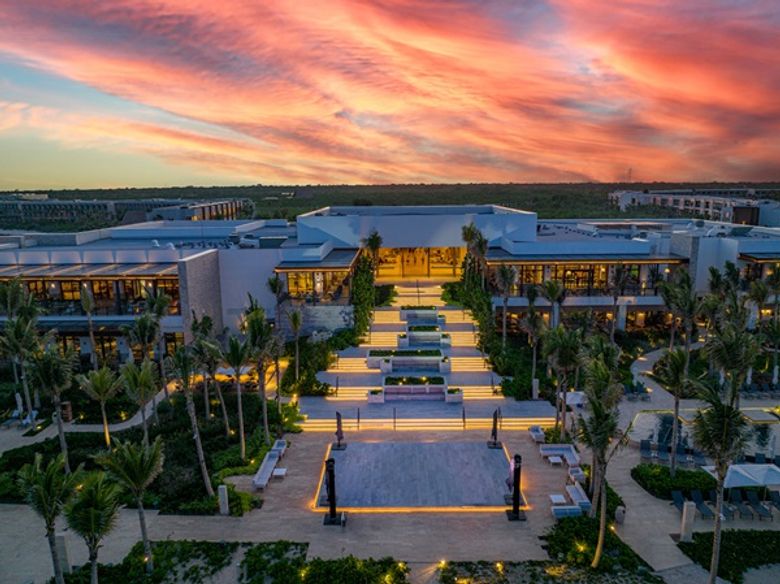
All-inclusive Hilton in Tulum, Mexico
What started as a general contractor shop with just six
people has swelled into a development organization of more than 6,000 people that
tends to work with Hilton, Marriott International and Hyatt Hotels Corp. In
fact, among its latest deals is a plan to develop four new properties with
Hyatt across key destinations in Mexico, including Mexico City, Los Cabos, and
Cancun.
At the end of October 2023, it also acquired for $370
million from Sunstone Hotel Investors the 1,060-room Boston Park Plaza with
plans to rebrand under the Hilton flag.
Parks moved into the mainstream about 15 years ago when it
signed a 20-hotel master development agreement with Hilton for Mexico that
El-Mann said acted more like a joint venture than an HMA with “very friendly
terms.”
Realizing big money could be made from making deals for
bigger hotels, from there the focus to develop, build and acquire hotels,
primarily in Mexico’s key gateway destinations and major tourism markets,
became a priority. PHH is currently focused on best-in-class resorts in Cancun,
Riviera Maya, and Los Cabos.
It currently has almost 2,000 keys in the luxury and
lifestyle spaces with Waldorf Astoria, Grand Hyatt, Park Hyatt, Conrad and
Canopy by Hilton. It has close to 3,000 keys in the all-inclusive segment,
working with Marriott and Hilton. PHH has another 3,000 keys with brands such
as Grand Hyatt and core Hilton. In the focused-service space, it has about
2,700 keys with City Express, Hampton, Hilton Garden Inn, Hyatt Place, Fiesta
Inn and others.
Among recently completed projects in Mexico are the 349-room
Conrad Tulum; the 178-room Waldorf Astoria Cancun; the 735-key, all-inclusive
Hilton Tulum; and the 715-key, all-inclusive Hilton Cancun.
In September 2022, it opened the mixed-use Mitikah, the
tallest building in Mexico City, while its industrial portfolio has a top tier
tenant base.
PHH and its affiliates have also been investing in
multifamily since 2012 through different ventures owning at its peak ~30,000
units.
The group’s U.S. portfolio includes 11,000 multi-family
units, the Grand Hyatt Vail and an office building leased to USAA in San
Antonio, Texas. It has partnered with some of the top multifamily players in
the world like Greystar, the largest operator of apartments in the United
States. Over the last decade, the group has transacted on over 50,000 units,
including large portfolio transactions, with a transaction value of ~US$10 billion.

We don’t build hotels for the brands, we build hotels for ourselves. We need to know what product is the right one for the market and the location. Then we put the brand on top of it and make some choices on the DNA. We can’t miss on the kind of product for the market. That’s kind of the way we see it.
Charles El-Mann
Additionally, PHH and Greystar have a development pipeline
of 1,817 units distributed in four development projects, as well as the recent
acquisitions of ~800 units in South Florida.
Today, El-Mann personally spends a lot of time focused on
the hotel design phase to make sure deals turn out as planned. “We don’t build
hotels for the brands, we build hotels for ourselves,” he exclaimed. “We need
to know what product is the right one for the market and the location. Then we
put the brand on top of it and make some choices on the DNA. We can’t miss on the
kind of product for the market. That’s kind of the way we see it.”
Hotel Investment Today recently interviewed El-Mann to
learn more about the group’s strategy and to get his take on the potential for
development and M&A in the year ahead – both in Mexico and the U.S.
Hotel Investment Today (HIT): Other than the REIT, do you
have any outside equity partners?
Charles El-Mann Fasja: Not yet. We are actively talking to a
lot of big private funds. They’re willing to come to Mexico, but nothing yet.
HIT: You acquired the Boston Park Plaza all by yourself, as
well?
El-Mann: Yes… Financing is an issue as the market has been
pretty dry. We had the ability to solve the financing of Boston, which was not
easy, but we have really good relationships. Apollo helped us with the
financing. Otherwise, it was going to be no-go for the transaction.
HIT: Talk more about your multi-family investments in the
U.S.
El-Mann: We have a lot of interest in the U.S. We have a big
multi-family platform, which we use to buy existing assets. So, we are starting
to develop now and have one project in Dallas/Fort Worth and another in
California. The Texas asset is starting construction this month and California
starts in February or March…
It’s kind of an experiment [with multi-family]. I think we’re
going to do it really well. We are also going to start development in Vail
[where PHH owns Hyatt a hotel].
HIT: What is your take on potential hotel investment and
M&A opportunities in the U.S.?
El-Mann: There will be a huge opportunity. Some of the big
funds – they just do what the market wants them to do. Sometimes it’s not the
right thing to do. Everybody’s trying to sell big urban hotels and buy luxury
resorts… But I feel a lot of strength in urban markets versus others. For
example, I like the Boston market because of the fundamentals. What made this
work was that Hilton needed that inventory in the market, and their engines
will be very powerful there.
That’s where we jump in, identifying strong markets and
opportunities. We don’t see ourselves as buyers of just any property – that’s maybe
more for a pension fund. But for us, if we can make any change, make
renovations, reflag – that’s where the opportunity comes in to make better
returns.
As longer-term holders, we’re first interested in the right
market. Second, it’s what makes more sense in terms of price. Right now, it’s
really hard – almost impossible – to buy luxury resorts. Prices are crazy.
I don’t mind buying big boxes if I think that those markets
are strong. That’s kind of our thesis.
I also don’t mind luxury, but I don’t like luxury union
hotels where it’s hard to make money… I will choose either a luxury asset that
is not union, or a really well located, union full-service or lifestyle hotels in
Top 10 or Top 20 markets. But I won’t, for example, go to Manhattan in New York
City, where it’s very complicated. I’d rather go to Brooklyn.
HIT: When will investment in Mexico pick up?
El-Mann: At some point, Mexico is going to be the natural
path for these institutional investors… There are 38 flights daily from New York to
Cancun. You’re going to stay in a much better property with much better service
for the price you pay... Airlift has been improving a lot. There’s a lot of
infrastructure being done by the government. There’s a new airport in Tulum and
a new airport coming to Riviera Nayarit. It makes it much easier to fly from
the U.S. In fact, I see more private jets at the Los Cabos airport than I do at
La Guardia in New York…
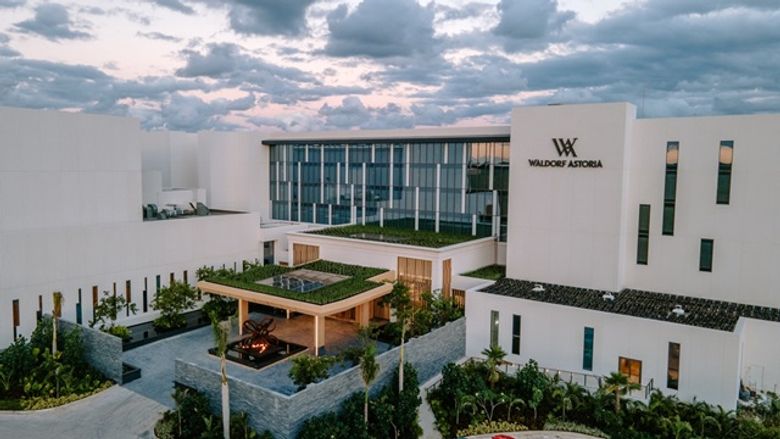
The Waldorf Astoria in Cancun, Mexico
Mexico is different in terms of acquisitions than the U.S. There
is much less institutional capital with big players that would like to buy and
sell a lot of the real estate. It’s only family companies, or hotel companies
that want to own the assets. So, our weakness is that it’s a less liquid
market.
HIT: How stable is Mexico for investment?
El-Mann: The government has not been so friendly with
investment. But on the other hand, it is under control and we don’t see any big
social movements… There are two big takeaways of this government: they respect
the U.S. and it has been a very healthy economy. We have a very deliberate
economy and leverage hasn’t increased in the last [few] years. If they keep
that healthy balance sheet, it gives us stability.
There’s a lot of growth in Mexico and it’s an ally of the U.S.
government. So, it’s very stable politically and I do think that institutional
investors in the U.S., sooner rather than later, are going to come to Mexico to
invest because yields are much better… And it’s a natural hedge of the peso. It’s
really nice to have revenues in dollars and expenses in pesos.
HIT: What’s the outlook on Parks Hospitality performance?
El-Mann: On the urban portfolio, we’re a little
bit better than 2019 and next year is looking good because there’s no new
supply in the main cities… On the resorts side, we have been pushing rates and
2023 has been good and next year looks fantastic as Mexico is in a great
position as, unfortunately, what’s happening globally will bring U.S travelers
closer to home. So, unfortunately, that benefits Mexico.