White knight investments and lending drive business, even as
the Miami-based real estate firm has $800 million in new development in the
works.
Note: This is Part 1 of a two-part interview. In the second installment on Monday, April 22, Driftwood
will address the acquisition cycle and controlling development costs.
MIAMI – Driftwood Capital is creatively rolling with the punches
coming from micro-market economic instability and what continues to be an
expensive debt market. The Miami-based father and son team of Carlos Rodriquez
Sr. and Jr. has pivoted to focus on providing even more rescue capital as well
as debt and is being more selective with development and acquisition.
Even as Driftwood remains conservative on the development
side and at a moment in time when getting new developments to pencil out is challenging
at best, the vertically integrated commercial real estate firm still exceeds $1
billion in projected value with $800 million worth of strategically pursued
projects either under construction or scheduled to break ground in 2024.
This pipeline includes the groundbreaking for the Riverside
Wharf property, which is the $267 million mixed-use development located on
downtown Miami's riverfront, featuring a Dream Hotel. In fact, several of their
new properties are in Florida, but growth is coming across the U.S.
Driftwood is also developing a $54 million Element by
Westin in Melbourne, Florida, due to open this June; a $74 million Element by
Westin Mission Valley San Diego, California, that is just underway with
completion projected in 2026; and the Westin Resort & Spa Cocoa Beach,
Florida, an approximately $410 million luxury resort development expected to
break ground in Q3 of 2024.
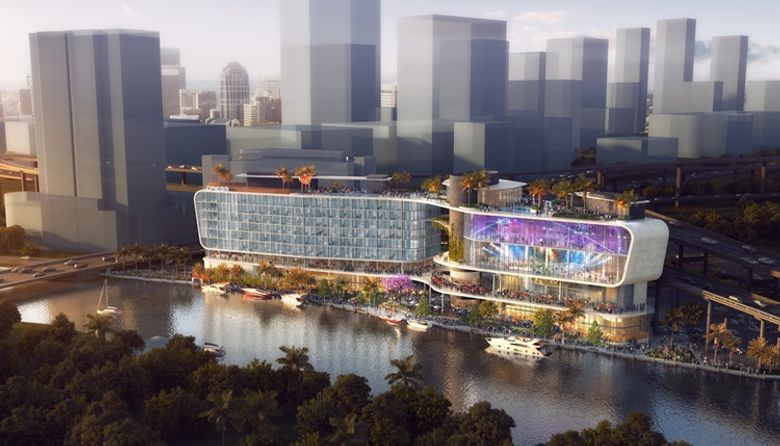
Rendering of Dream Hotel Riverside Wharf in Miami
Its $267 million Riverside Wharf Miami mixed-use development
is expected to break in the latter half of 2024. This project benefits from
Opportunity Zone advantages and EB-5 capital sourcing through Driftwood Capital’s
affiliate EB-5 Regional Center.
Carlos Sr. told Hotel Investment Today that Driftwood has two
more deals with term sheets – a bigger development in San Antonio and more of a
lifestyle deal in Boca Raton, Florida.
Multiple opportunities
Since 2015, Driftwood Capital and its principals and
affiliates have transacted on more than $5 billion in hospitality assets. They
have seen it all and can use that experience to navigate today’s uncertainties.
Today, it has 90 hotels in its portfolio, about half with varying degrees of
ownership.
Right now, Driftwood remains very active on the credit side,
having laid out $100 million in the first quarter of this year alone. They are
also doing “white knight” deals, coming in to take majority stakes on stalled
developments where a lot of the leg work is complete. In addition, to the
development described above, Driftwood is active in the acquisition market –
only not nearly at the level it was pre-COVID (one a year versus eight a year).
But father and son said they expect M&A to ramp up starting in the second
half of this year.
Rodriguez Sr. is often on the road working to attract more
capital investment and talked about how investor expectations are evolving.
On the lending side, where a lot of capital is sourced in
international markets, Rodriguez Sr. said their investors are pleased with their
returns and demand remains very strong. “The moment we put out the paper on
loans they sell in a day,” Rodriguez said. “Investors on the lending side are
very happy.”

It’s not easy, man. I’m telling you. We underwrite a ton of deals to achieve these deals. We used to get loans with banks for 70% to 75% of loan to value or loan to cost. Today, banks will offer 60% if you’re lucky but more likely 50% to 55%... So, not everything pencils; it is a difficult environment.”
Carlos Rodriguez Sr.
On the acquisition side, Rodriguez Sr. said expectations have
increased for higher returns because of higher interest rates. “Investors are
looking for 300 basis points more than they used to – in the high teens,” he
said.
And on the development side, Rodriguez Sr. said investors want
returns in the 20%-plus range to make deals appetizing. “It’s very difficult to
make these deals pencil with construction costs being higher, with interest
rates being higher, insurance and payroll being higher,” he said. “Then the project
won’t stabilize for six years, and you can’t sell it for seven to 10 years.
Whereas in an acquisition, you’re taking about selling the deal in three to
five years. And with loans for three-year terms – it’s a lot more liquid.”
So, when Driftwood does make a development deal, they are
very methodical and strict in their underwriting to deliver those 20%-plus
returns. “But it’s not easy, man. I’m telling you. We underwrite a ton of deals
to achieve these deals,” Rodriguez Sr. said. “We used to get loans with banks
for 70% to 75% of loan to value or loan to cost. Today, banks will offer 60% if
you’re lucky but more likely 50% to 55%... So, not everything pencils; it is a difficult
environment.”
But new deal flow will start to pick up, according to
Rodriguez Jr. “When banks start loosening up a little bit, when interest rates
go down, you’re going to see a spike in construction. There are a lot of deals
on hold right now because the numbers don’t work. But once you start seeing
interest rates coming down and banks loosening up the purse strings, you'll
start seeing new-deal flow. But it’s going to be a few years – it’s not going
to be right away.”
White knight approach
Absent more development and acquisition opportunities (they
acquired one hotel last year when they normally buy between five and eight),
Driftwood is playing “white knight,” jumping in on stalled deals and taking
advantage of all the planning and permitting work already done, which skips a
few years of work.
Driftwood will bring in the capital structure and take at
least 50% of the deal, and usually a majority stake. It brings its development
expertise and basically revives the project.
“The developer usually knows the market, the people, the
government officials. So, it’s a very helpful partnership and working very well
for us. That’s an approach we’re going to have for the next few years. We feel
good about doing these jvs nationwide.”
Looking ahead, Rodriguez Sr. said he expects that there is
going to be an opportunity on acquisition value-adds with so many PIPs coming
up that are no longer going to be extended. “In our acquisition fund, the last
five deals, with the exception of one, have all been heavy value-adds,” he said.
Watch for Part 2 of Hotel Investment Today's interview with the Driftwood Capital father-son team tomorrow.