The revived market’s
development fans approach the market differently with luxury leading the way.
DETROIT – What was
once, then wasn’t and now just might be?
The riddle whether Detroit
is a viable place for hospitality investors to lay their money down is
increasingly getting some answers from owners and developers leaning bullish
toward the Motor City.
“Those who know
Detroit understand it well and I would say those who really know Detroit have a
good opinion of it, but I think there’s always the education piece for the
people who don’t,” said Will Woodworth, senior vice president of investments
for Peachtree Group, which has been active in the market.
Atlanta-based Peachtree
is no stranger to the area. “We’ve been there in the thick of it of when it was
a little tougher,” Woodworth continued. “Over the past 10 years we started with
our lending business, got exposure to the market and then in recent years have
had increasing interest in equity positions and ownership there.”
Many might consider
things being “a little tougher” an understatement when recalling Detroit’s
recent past. Historically, thriving via the dominance of the labor- and
wealth-generating auto industry, over the past several decades, social,
political and economic turmoil characterized much of the city’s profile.
Indeed, a dozen years ago it declared Chapter 9 bankruptcy, although it
ultimately exited the process in December 2014.
Within the time
period, however, investors, notably Rocket Mortgage Founder billionaire Dan
Gilbert, who had earlier moved his business to Detroit, began seeing the market’s
potential, particularly in the Midtown/Downtown area. He started developing,
acquiring and managing a variety of properties in a concentrated—and ongoing—effort
to revitalize the area and stimulate interest, which has yielded positive
results. A variety of funding sources—city, state and private—also support
revitalization efforts.
Among his more than
100 business ventures, Gilbert’s real estate company, Bedrock Detroit, owns the
260-key Courtyard by Marriott Detroit Downtown in the Millender Center, along
with the high-profile, lifestyle Shinola-branded hotel.
“The Detroit
hospitality market has become very dynamic and has many more demand drivers
than just automotive companies,” said Adam Dahan, vice president of business
development for Azul Hospitality Group, which has been active in the market
since 2016. “In that time, we opened the Element Detroit at the Metropolitan
[Building], where we also operate the Monarch Club rooftop bar and The Lone
Goat pub on the ground floor, and then converted [an] Aloft to the Hotel David
Whitney, Autograph Collection (which opened last
year).”
Both properties are
housed in historic buildings.
Great bones
Dahan tagged Detroit
as a strong adaptive-reuse market, noting there is “incredible architecture,” with
many buildings still underutilized or sitting vacant.
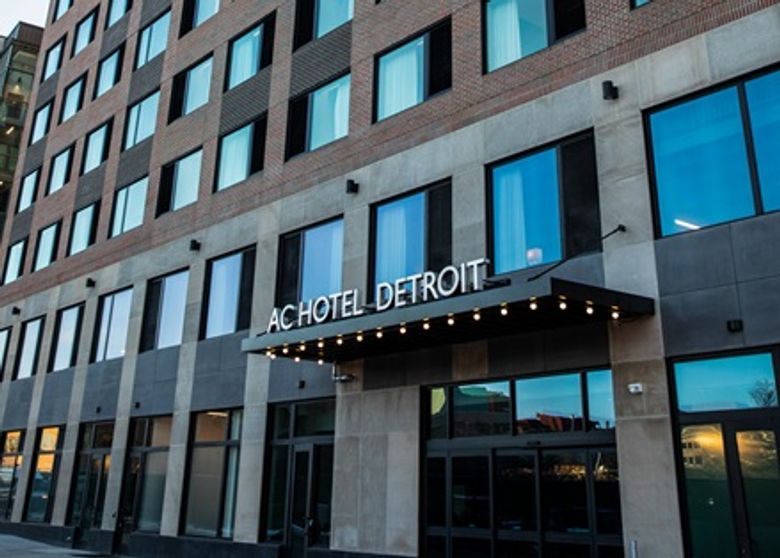
The 154-key new-build AC Hotel Detroit is managed by Azul Hospitality.
“Historically, the
state of Michigan has incentivized developers to take on these complicated
projects, which has been helpful to getting them done. With that being said, we
always caution adaptive reuse, especially in historic buildings because they
are often times more work than a new development but if executed right, can be
very successful,” he said.
In a hotel play that
included new construction, Peachtree Group jointly developed the AC Hotel
Detroit at the Bonstelle Theatre with local real estate development and
investment firm The Roxbury Group, which is led by principals David Di Rita and
Stacy Fox. Located at 10 Eliot St. in the Brush Park neighborhood, the
10-story, 154-key new-build hotel is managed by Azul Hospitality.
The project
additionally involved restoration of the early 20th century Bonstelle Theatre
(the former 1903 Temple Beth-El), which will host a variety of events,
including live performances. The venue is connected to the hotel via the
glass-enclosed Conservatory that includes a bar and private event space.
Active locally, The
Roxbury Group is a joint-venture partner with the Means Group in an LLC
(Metropolitan Hotel Partners) that developed and owns the Element Detroit. It
also owns the David Whitney building.

Peachtree Group's Will Woodworth
Woodworth said their focus on new construction through that
AC was really capitalizing on that Midtown/Downtown market. “You have the four
major sports franchises downtown… committed revitalization of the Downtown
neighborhood by the city with a lot of public support behind it. This made it a
pretty attractive place between corporate and leisure travelers; just a big hub
of demand,“ he said.
Peachtree also gained greater exposure in the market by
partnering with area-based Group 10 Management, bringing 14 hotels into its
managed portfolio.
“We like it when we have opportunities to have a critical
mass in a given region and being able to partner with Group 10—an experienced
owner within the Detroit/Midwest area,” Woodworth said. “It gave us a chance to
not only enter that market but enter it with a lot of exposure and the ability
to commit resources to it.”
Luxury leads
When it comes to construction, STR/CoStar data shows 50% of
the total rooms under construction in Detroit (by scale) are luxury, 22% are
upscale, 10% are upper midscale, 6% are midscale and 5% are upper upscale; 7%
are unaffiliated. Data on economy rooms is negligible.
Among the luxury properties expected by 2027 are the 600-key
JW Marriott Detroit Downtown, which is being developed by Sterling Group, and
will be connected to the Huntington Place Convention Center via a skybridge;
the 225-key Edition being developed by Bedrock Detroit as part of the Hudson’s
Detroit mixed-use development; and the 180-key NoMad Detroit, which will be
housed in the historic Michigan Central Station via a partnership between Ford
Motor Co. and Sydell Group.
While the significant
skew toward lodging’s upper tiers might give pause, luxury and upper-upscale
demand “has held up very well” post-pandemic, according to Jan Freitag, national director, hospitality analytics, for CoStar Group. “[This] has given owners/developers
faith in the higher-end performance. Most of the hotel stock is a bit dated and
developers feel they can provide more updated amenities and services to their
audience,” he said.
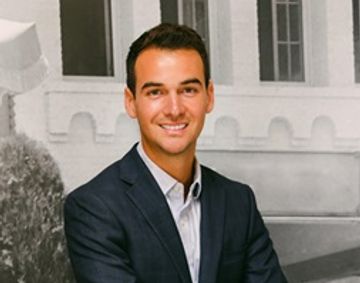
Azul Hospitality Group's Adam Dahan
Commenting on the
dearth of projects at the opposite development end, Freitag noted, “Economy-class
projects are hard to pencil given the high interest rates and the relatively
small ADR that they achieve.”
He added: “Given the
price per key to develop, midscale properties might be an easier product type
to underwrite” in the market.
“We continue to
remain bullish on Detroit and are working on more projects with our local
partners, The Roxbury Group. Detroit has done a very good job stimulating
development, while also keeping downtown very clean and safe,” Dahan observed.
As to making more
inroads in the market, Woodworth said while Peachtree currently is not under a
fresh contract for land or for a property, “every day we’re continuing to
evaluate opportunities and certainly are fans of the market.”