At Wyndham's annual conference, CEO Geoff Ballotti discussed outperforming
the industry during previous recessions, mitigating tariffs and still betting
big on infrastructure.
LAS VEGAS — The hotel industry
has seen plenty of times of economic uncertainty, or worse, and Geoff Ballotti
said the last three cycles of recessions give him cautious optimism about how
Wyndham will fare.
Ballotti, president and CEO of
Wyndham Hotels & Resorts, spoke to the media as part of the company’s 2025
global conference in Las Vegas and was asked whether his company was “recession
proof” because of how well it had outperformed its competitors after 9/11,
during the Great Recession and during COVID.
“You never want to say you are recession-proof
because you’re always thinking about your franchisees and owners,” he said. “If
we think about COVID… our small business owners were uncertain. Many were
hurting… because of everything they were dealing with. It was the biggest drop
of occupancy that… nobody had ever imagined.”
But Ballotti noted that most of
Wyndham’s hotels didn’t have to close.
“If we look back over the three
downturns (9/11, Great Recession and COVID)… [After 9/11], we outperformed the
rest of the industry in terms of RevPAR decline. So, it’s not recession-proof,
but our brands outperformed the overall industry by 300 basis points,” he said.
“If you fast forward, we’re getting bigger. We’re getting stronger. Our systems
are getting more powerful. By the [Great Recession], our brands outperformed
the industry by 500 basis points. Fast forward another 10 years, after the
longest-running positive cycle we’ve ever seen… [during COVID] suddenly RevPAR
is falling at three, four times the rate it was falling during the last
downturn.”
But Ballotti said during COVID,
Wyndham went from outperforming the market by 300 or 500 basis points to 2,500
basis points.
“Think about that. We were 25
occupancy points better than the industry,” he said. “Our hotels were not
having to close and were remaining open. They were operating at 30% occupancy
levels, which allowed them to stay open and maybe not make money, but stay
open… It was our job then to lean in and see how we could support them
financially.”
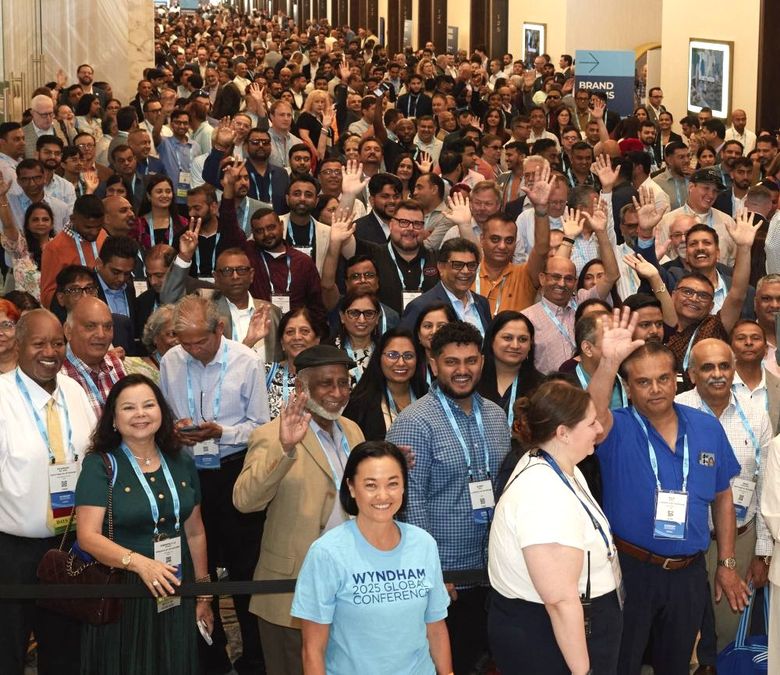
Over 6,000 attended the Wyndham 2025 Global Conference in Las Vegas.
Ballotti made historical
references to Wyndham’s performance during those economic downturns to explain
his optimism for how the company would perform, even if the dreaded R-word
happened.
“Nobody’s thinking or wishing or
ideating that we’re going to have another downturn like COVID, but if there was
a recession, historically select-service [will outperform the industry], which
is why I think there’s so much interest in it right now. All of the smart money
in this country, when it comes to development, if you look at all of the
private equity and look at all the people that call us up, the institutional
money that are building Echo Suites by Wyndham today, they’re all looking at
select-service in a different light than they were pre-COVID.”
Ballotti said he’s also
cautiously optimistic about how Wyndham will fare even with international
inbound numbers trending down.
“Three percent of our check-ins
domestically are coming in from overseas and the bulk of that is Canada,” he
said. “So, where it’s impacting us right now the most, if you were to walk and
talk to franchisees from Maine, New Hampshire, Vermont, Massachusetts, people
who would get in their car and drive down [from Canada] for the summer months.
That is certainly showing up... You’ll see that the softest states compared to
the prior year are those Canadian inbound states. But we are not as
concentrated in those states. Our heaviest states are Florida, which is still
doing very well… Texas, where we have 700 hotels… and California. Those are
holding up. Certainly, the trend is our friend right now.”
Ballotti said another reason for
his optimism is that drive-to-demand, which is 90% of Wyndham’s travelers, is
still showing positive trends for Memorial Day weekend and this summer.
Another reason is that Wyndham
is a dramatically different company than when it first went public in 2018,
Ballotti said.
“Our growth is coming in the
mid-scale and above segments, so that’s been really exciting and the reason for
that is how well our brands are performing from a market share standpoint,” he
said. “We’re a much different company than we were seven years ago when
we went public. Nobody really knew who Wyndham was. We owned hotels… We managed
hotels… And we franchised hotels. We’ve sold our owned hotels and sold our
management business. We’re an entirely pure-play franchisor. We’re the largest
franchisor of economy, mid-scale, and now increasingly upscale lodging.”
Mitigating tariff
costs
So far, Ballotti said Wyndham
has been able to mitigate any increased tariff costs by sourcing and supplying
as much as it can in the U.S. or through countries with lower tariffs than
China (like Korea). He also mentioned that the company’s Days Inn Dawn package
is now sourced entirely out of North Carolina, though some of the components
still come from China.
“Tariffs are obviously on
everybody’s mind, and what I think about every day is whether there’s something
we can do to mitigate it,” he added.
Ballotti said many of Wyndham’s
suppliers are helping mitigate the impact of those costs.
“It’s still very early days, but
I’d say that aside from onshoring where it’s possible, working with our
suppliers where it’s always possible, in terms of sharing that cost increase,
the sentiment of our small business owners is that it’s hopefully, and hope is
not a business strategy, but hopefully temporary.”
He’s also optimistic that the
labor costs are mitigating too, especially in key construction markets like
Texas.
“They’re finding the cost of
construction labor in markets like Texas to be lower than it was a year or two
ago,” Ballotti said.
Betting big on
infrastructure
Wyndham has also been betting big on
the $3-billion-plus in infrastructure legislation that passed a few years ago in
Congress will turn into big business for the company’s brands.
Ballotti said, despite a new
presidential administration and the much-discussed DOGE cuts, he’s still very
bullish that most, if not all, of that proposed spending will still happen.
“Only a fraction of that
[funding] has been spent in terms of shovels in the ground,” he said. “There’s
the difference between allocation and spending. Think about any of the big
projects around New York City, such as bridges and tunnels. You could allocate
it to the state from the federal, but it doesn’t actually translate into
project starting because of how big and complex these projects are.”
Ballotti said the company has
spent a lot of time talking with the administration, including Secretary of
Transportation Sean Duffy.
“[He] believes that the
administration is still very interested in big, beautiful highways and big,
beautiful bridges, and assured us all that [they] will keep spending and it
will keep happening.”
Editor's note: Wyndham paid for some of the expenses for the reporter's trip to this conference, but it did not influence coverage of this event or future coverage about the company.