Anthony Capuano was interviewed to lead off the second day of the 33rd
annual Hotel Investment Conference Asia Pacific (HICAP). He talked about
M&A, the role of AI and chasing conversions.
It’s been seven years since
Marriott International completed its $13.6 billion merger with Starwood Hotels & Resorts.
And with the hotel industry currently abuzz regarding Choice Hotel
International’s hostile bid to try and acquire Wyndham Hotels & Resorts, Marriott President and CEO Anthony Capuano said he understands why the big players in
the industry will always evaluate consolidation.
“I
think our merger and other big transactions have borne out the fact that scale
matters,” Capuano said. “There
are significant benefits to scale.”
While
Capuano said the larger transactions are challenging and less frequent, he does
think the hotel industry will continue to see more small- and medium-sized
transactions.
“Our
Starwood deal tended to dominate the headlines, but if you move beyond the
Starwood transaction, we had a fairly steady cadence of what we term ‘bolt-on’
acquisitions. We were doing one or two a year,” he said.
Capuano,
who was named CEO of the Bethesda, Maryland-based hotel giant in 2021, said the opportunity for acquisitions for these
sizes of companies happens when they reach an inflection point.
“They
had reached a point in their growth evolution where they had to decide if they
had the appetite and the capital resources to invest in two areas: loyalty and
technology,” he said. “And if they didn’t have the appetite and the capital to
invest in those areas, often that led them to consider strategic alternatives.
We’re going to continue to see those sorts of transactions.”
When asked about 2023 being the year of the conversion, Capuano said he expects that trend to continue next year.

The only thing that has really evolved over the last year or two is that we’ll continue to be very aggressive in our pursuit of single-asset conversions. But we’ve also ramped up our efforts on portfolio conversions.
Anthony Capuano
“The only thing that has really evolved over the last year or two is that we’ll continue to be very aggressive in our pursuit of single-asset conversions,” he said. “But we’ve also ramped up our efforts on portfolio conversions… Even for owners who historically have been fiercely independent, the pandemic has been a profound reminder of the power of being connected to strong global revenue engines and loyalty platforms.”
This summer, Marriott bolstered a partnership with MGM Resorts International, adding nearly 40,000 rooms to its system.
Capuano said the deal is a good example of continuing to grow in a challenging capital market.
“That transaction is also interesting because, in a climate where in big chunks of the world the debt markets are constricted, we’ve got to find more creative ways to continue to grow,” he said.
Capuano
was interviewed by Jeff Higley, president of The BHN Group, to lead off the
second day of the 33rd annual Hotel Investment Conference Asia Pacific (HICAP)
event in Singapore, produced by Northstar Travel Group in association with BHN.
This event continues through October 25 and is being held at the Fairmont
Singapore and Swissotel The Stamford hotels.
Capuano said he will spend 200 nights on the road this year, and this is already his
seventh trip to Asia in 2023.
He said Marriott
has a challenging and complicated business
model, which Capuano likens to having an unsolved Rubik’s cube sitting on his
desk every morning. He said trying to solve it is a reminder of the different
principles and constituents the company has to serve.
“Every
decision we make, we have to evaluate it through the lens of each of those
four constituents. And often their wants and needs are at odds,” he said. “You
won’t be perfect, but we try to strike the right balance… We can’t be too high
or low because you’ll rarely be able to satisfy all of them.“
So,
how often is he solving the Rubik’s Cube?
“The
short answer is ‘never,’” he said. “We constantly try to strive to improve. We make
decisions, monitor how each of those constituents reacts to those decisions,
and strive to be better the next time we’re faced with a complex set.”
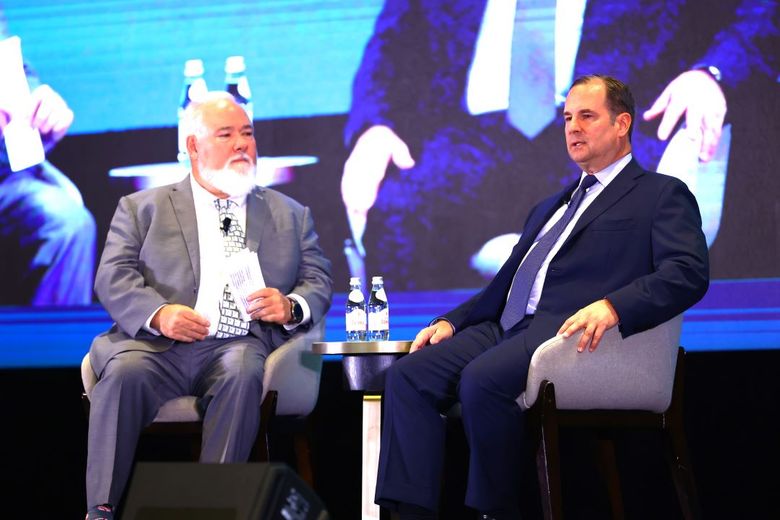
Marriott CEO Anthony Capuano (right) was interviewed by Jeff Higley, president of The BHN Group, to kick off Day 2 of HICAP.
Capuano admits he’s an optimist at
heart. So, it’s not surprising when he was asked about the role of AI that he found reasons to be excited.
“At the property level, I think about AI as an enabler of
creating capacity for our people,” he said. “If AI can create some capacity for
a front desk agent, where they can better engage with guests, learn more about
the reasons for their trip, and how they can enhance their stay, it’s a win.”
As
an example of the potential for AI, Capuano said he recently visited one of the
company’s customer engagement centers and listened to a couple of hours of
incoming calls.
“You
can hear how sophisticated many of our guests are,” he said. “The call sounds
something like this: 'I’m interested in a beach resort with Italian and Japanese
restaurants, allows pets, has a spa and two pools and is within 15 minutes of
an airport.'
“Absent
advances like AI, that is quite a challenge for an agent to try and navigate…
[It gives us] the capacity and the ability with a couple of keystrokes to help
plan the trip and help navigate through our nearly 9,000-hotel portfolio and
understand the full breadth of options that our portfolio offers.”