Armed with proof of concept, CapitaLand’s co-living brand
lyf is starting to live it up.
SINGAPORE – In a landscape where the lines between lodging
and living are increasingly blurred, Singapore-based CapitaLand Investment’s
(CLI) bet on its co-living brand lyf (pronounced as “life”) is well placed.
What began as a bold experiment in 2016 is now a rapidly expanding global
network, fueled by CLI’s investment management capability and its Ascott
lodging management expertise.
Since the first lyf Funan Singapore debuted in 2019, the
portfolio has blossomed to 35 properties with more than 6,500 units across 24
cities in 13 countries. These include operating properties in Penang,
Melbourne, Bangkok, Frankfurt, Tokyo and Shanghai, and new lyf openings in
Paris and Sydney by 2Q25. In the pipeline are also properties in London,
Glasgow and Manchester.
Although the brand's target of 150 properties with 30,000
units by 2030, announced in 2022, looks ambitious – that requires at least two
dozen lyf openings a year for the next five years – it’s not necessarily
unattainable. Ascott’s Chief Growth Officer Serena Lim pointed out that there's
now “proof of concept” for the product, and its adaptability across
geographical boundaries and in cities or resorts.
The acquisition of lyf Ginza Tokyo by Singapore-based
Invictus Developments in October last year, barely a year after its opening in
November 2023, also proves that the product is “tradable,” Lim said.
Invictus, the Singapore-based family office of Indonesian
tycoon Bachtiar Karim, paid CLI’s Ascott Serviced Residence Global Fund JPY10.5
billion ($93 million at the time) for the 140-room property which, according to
CLI, “exceeded its target ADR and occupancy rate within three months.” The
private fund is a 50:50 joint venture between Ascott and Qatar Investment
Authority. Ascott continues to manage the hotel.
Further underscoring investor confidence in the brand, CLI’s
second private fund dedicated to serviced residences and co-living assets,
CLARA II, established in February last year, acquired two seed assets upon its
first close, a 50% stake in the 308-unit lyf Bugis Singapore and a 100% stake
in the 200-unit lyf Shibuya Tokyo. The fund is 20% sponsored by CLI and among
partners in the first close were global institutional investors in Europe and
Asia.
Full value chain
But CLI’s aim is by no means to build or seed to sell, but
to solidify its position as a full value chain, from deal-sourcing, investment,
asset and fund management to development, design, construction, operation and
management to generate returns to investors. “It’s a whole project life cycle,”
Lim said. “We’re still managing the properties that we sold, which means our
owners trust that we will continue to add value to their assets.”
She believes the time has come for Asian chains to spread
their wings globally with brands that are scalable. “For us, we have the whole
infrastructure behind us to push through this ambition, and our roots as an
owner/operator sets us apart in efforts to optimize returns for our investors,”
Lim said.
However, the optimism is not without its challenges. For
one, Ascott, with a portfolio of nearly 1,000 properties across 230 cities in
40 countries, is still seen as mainly a serviced apartments player. This is
despite its internal data showing that just over 50% of Ascott's revenue from
direct bookings comes from extended-stays of seven nights and more. The other
half is from short stays, indicating its ambition to grow as a hospitality
company with strong transient and leisure stay segments is progressing well.
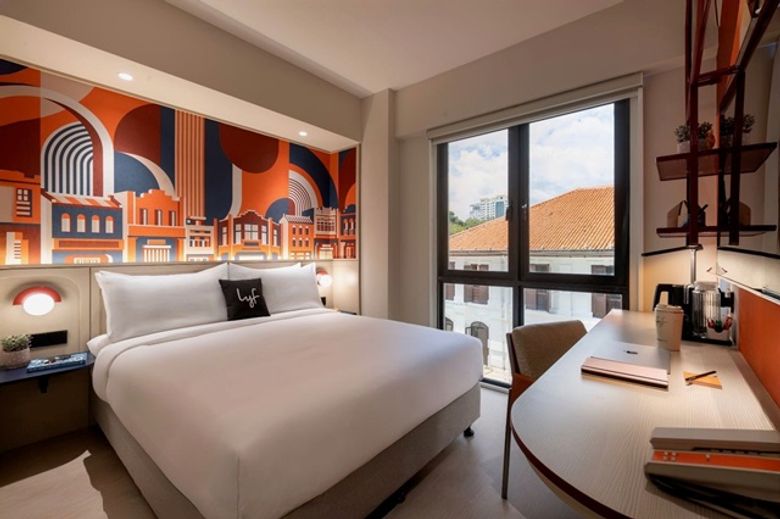
lyf Georgetown Penang two-bedroom
Competition in the co-living sector is also rising, with
major chains like Accor investing in “blended living.” Accor says 50% of its
guests now plan a stay extension, saying that integrating co-working spaces
results in a 10% boost in RevPAR. Smaller co-living groups like Ruby Hotels,
Habyt/Hmlet and Dash Living, meanwhile, are doubling down.
Certain institutional investors and private equity fund
manager in Asia Pacific are tuning in, according to a CBRE research released in
September 2024, which cited factors such as growing market acceptance and
demand for such properties, long-term stable cashflows, and lenders willingness
to provide construction and/or permanent debt capital for the projects.
Defining the space
But the challenge might not be so much about a lack of
awareness of co-living among investors as an evolving segment where many
co-living operators are struggling to define their niche. “The terminology of
co-living bugs me,” Lim admitted, “because I spend so much time [with partners]
just trying to talk about co-living and everyone has a different idea.”
She believes lyf is defining the space, which isn’t just
matter of adding co-working facilities and services but creating a new lodging
product altogether. At launch, Kevin Goh, CLI’s CEO for Lodging, said lyf
“combines the best of serviced residences, hotels and co-living apartments.”
In brief, it’s a model that breaks the walls of conventional
room sizes and configurations and does away with traditional hotel connecting
rooms. This enables a lyf property “flex” quickly from short-term to long-term
demand.
The first lyf Funan Singapore, for example, has eight room
categories, from a room for a single traveler to an apartment with six
bedrooms.
In unlocking new revenue streams is a key purpose of
co-living for investors, and lyf's dedicated brand guardian, Adeline Phua, said
the brand adopts a “retail” mindset for its social spaces, prioritizing revenue
and profit per square meter.
Public areas are designed for versatility and available for
rent and various activities by guests or external parties. The modular design
enables spaces to transform for diverse events, beyond traditional hotel
revenue streams. These spaces host everything from hackathons to yoga classes.
Reception areas are converted into bars and meeting nooks are reimagined as
flexible beverage spaces. Phua said this multi-functional approach, driven by
creative space utilization and talented staff, generates diverse revenue
streams.
Lyf operates with a lean staff structure, maximizing
efficiency through multi-functional roles. “lyf crews” embody this, with roles
like “ambassador of buzz” fostering guest connections and conversations. The “lyf
guard,” on duty after 8 p.m., is trained to handle various situations,
including basic maintenance tasks. The general manager serves as a “lyf
champion.” This lean staffing model, combined with Ascott’s cluster shared
service model, further delivers enhanced returns for property owners, Phua said.
And finally, lyf‘s “secret sauce” is emphasizing
“experience-led social living,” a philosophy driven by flexible spaces and
dynamic programming.
Beyond physical design, lyf properties focus on “deeper
activation” through specific themes. Individual lyf teams can select themes
like wellness, F&B, sustainability and technology, arts, culture and
entertainment, and fashion and design, influencing the property’s event
calendar. For example, lyf one-north, situated in a technology and R&D hub,
emphasizes sustainability and technology activations, reflecting its location’s
green and innovative environment.
As Bon Jovi's famous song ‘It’s My Life’ goes, it’s now or
never for lyf.