Branded residential is
rapidly expanding with standalone properties, expansion into
brands below luxury and even through third parties. What used to
be a North American story is now global.
Branded residential along a luxury hotel has become a global phenomenon and now it is starting to evolve into something new: standalone developments.
Until recently and certainly ongoing, new residential developments are sold off-plan before the end of construction. Then developers
cross-fund the hotel component of the mixed-use property, said Riyan Itani, director and founder
of London-based Global Branded Residences. Now, said Itani, the inevitable is happening as he is doing more work with standalone branded residences.
“You started with hotel [companies] that had some
residential. Now you have pretty much all luxury hotels with residential, and
you’re starting to see residential that doesn’t have a hotel,” Itani said.
“So, it’s evolving and forming back to, in theory, what it should be, which is a
residential concept uncompromised by a hotel.”
Bethesda, Maryland-based Marriott International has 127 open branded
residential developments, over 17 brands, operating globally, and 15% are
standalone (its first was a Ritz-Carlton Residences in Baltimore in 2008). Dana
Jacobsohn, chief development officer, North America luxury brands and global
mixed-use, U.S. & Canada for Marriott, said 27% of its current branded
residential pipeline is standalone. So, while it’s not the majority of its
pipeline, it is growing.
Jacobsohn said the growth in branded residential for
Marriott has come from customer demand. Massive international projects in
Dubai, London and Vietnam punctuate the growth in standalone branded residences.
“It started in the U.S., for sure. And now it’s an
international phenomenon, and it’s across all of our brands,” she said.
“Why is standalone so popular? The reason, at least for
Marriott, is that customers love our brands. They love to travel in our brands
and realize now that they can 'live with our brands.' They can have the same
services and amenities every day… Even though you’re not co-located with
hotels, you have a pool, fitness, food and beverage, spa, and all kinds of
programming. So you have the luxury hotel service.”
Barriers for branded
Itani said one of the biggest barriers to breaking into
branded residential is philosophical.

It takes a particular type of developer to do branded residences, and that tends to be either somebody who’s driven by finance (like private equity)… or a developer who is visionary and forward thinking and is not scared to do something different.
Riyan Itani
“It takes a particular type of developer to do branded
residences, and that tends to be either somebody who’s driven by finance (like
private equity)... or a developer who is visionary and forward thinking and is
not scared to do something different.”
Itani said he often finds the biggest challenge in new
markets: getting developers out of “let’s just churn and burn and build what we
know.”
“[The hardest thing] is getting developers to realize that
there’s a huge opportunity here, which is why the market is growing like
wildfire,” he added.
But Itani said it’s become a lot easier to sell for a simple
reason — which can be addictive.
“It’s because developers have realized that it works. And
so, they’re doing it, and then they’re doing it again, and they’re doing it
again.”
Itani started Global Branded Residences in December 2022.
The company focuses on a mix of services between market and feasibility studies
for developers, investors and hotelier and non-hotelier brands.
International growth
Branded residences, which have been in the U.S. since 1927
but didn’t start to expand until the 1980s, were primarily in North America.
But in the last 10 years, its biggest growth is international.
“It is a great model, which is why it’s being adopted by
huge institutional bodies and sovereign wealth funds,” Itani said. “Pretty much
the whole of the development of the bigger projects in Saudi Arabia is
predicated on branded residences.”
And that international growth is now continuing all over the
globe, even in huge countries like China, which proportionally
have almost no branded residences compared to their population and size, to
places like Australia that have very few branded residential projects, according to Itani. “It’s commonplace in the U.S. to have branded residences, whereas the
rest of the world is just catching up,” he said.
Michael Shindler, president of Chicago-based Four Corners Advisors, said
the branded residential is a no-brainer in the U.S. and is quickly becoming
that way in many foreign markets.
“I don’t think you will see a luxury hotel built, in the
U.S. anyway, that doesn’t have branded residences with it. It’s just too
expensive. I think for emerging markets and discovery resort markets the
residential program has a lot of benefits from a cost perspective and helps to
decrease the size of the hotel you’re trying to sell,” he said. “I don’t think
you’ll see too many upper upscale or luxury resorts built anywhere in the
United States, the Caribbean, Central America, maybe South America, and
perhaps even more broadly, without having some residential component.”
Moving down brand?
Another branded residential trend is moving down from luxury
to upper upscale.
Itani said that expansion also felt inevitable and has
several upsides, mainly a chance for branded residential to move into new
geographic areas.
“Statistically speaking, it’s happening in the next five
years because the luxury element of the market is due to drop,” he said.
“What’s interesting is it’s deployable in many locations.
“It’s great for the brands because they can deploy in many
different places and grow their pipeline. It’s great for the buyer because
those upper upscale developments are often more driven towards investment. They
are for people looking for yield — second home locations and investment
locations — so the buyer is happy because the entry cost is lower. And
relatively speaking, the yield is more interesting."
Jacobsohn said there was skepticism about moving below the
luxury tier, but the demand is there.
“There are many people out there who want to buy branded
residences… They’re very expensive. I think developers have realized that
there’s a market that’s one notch below. And we’ve just seen tremendous
growth,” she said. “For example, our Autograph Collection residences have grown
tremendously.
“We signed one or two, and people weren’t sure if those
projects would drive price premiums for the developers and a higher velocity of
sales. But… just like when we started Ritz-Carlton Residences 20 years ago…
proof is in performance. And now that’s one of our fastest growing areas.”
Shindler said expanding into upper upscale brands can also
change how developers approach a project.
“From an accounting perspective, it’s not cheaper. From a
tax aspect, it’s not cheaper. But [it is] from how developers look at cost,
investment, and capital at-risk,” he said. “If you can sell some of the
residences, and instead of building a 600-room hotel, it’s 300 rooms, and
you’ve got a couple 100,000 square feet of residences that you can sell at a
premium, you will benefit from that by having less money at stake in the
operation of the hotel.”
Jacobsohn said brands below the Autograph Collection are
available for branded residences, and Marriott is seeing some traction. But
going below that, into what the company calls its Marriott select brands, hasn’t
been viable yet. “We’ve seen more demand in the other segments right
now,” she said. “And I’m not sure yet that the business model works for the
developers.”
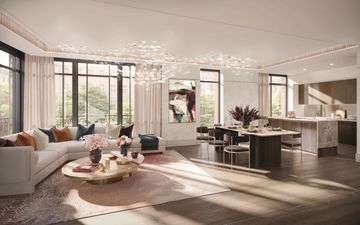
Marriott's standalone The Lucan, Autograph Collection Residences in London
Jacobsohn said that when the price point gets lower, the
math becomes more difficult for developers.
“It’s not that it’s not a good deal for us. I don’t think
it’s compelling for the developer… They have to pay us to use the brand… When
they do the analysis, they have to determine if they brand with Marriott, what
is the potential price premium?” she said. “You might have to do things a
little differently for us. If you’re a certain brand, you’ll need to do some
signage, and you have to do some decor in certain ways. We have requirements,
which we should… When the prices are lower, everything is tighter.”
Third-party branded residential
Itani says another huge area of growth for branded
residential is for non-hotelier brands (think brands like Armani, Missoni,
Aston Martin or Lamborghini.) This has been especially popular in overly
saturated markets where most of the hotel brands are tied up in territorial
relationships. So, developers “run out of
hotel brands and start to look at what’s different and interesting.”
“I get a lot of trouble from the hotels about why [I am]
doing non-hotel branded residences. It’s not me pushing my clients. My clients
are saying to me, either, ‘We already are residential operators, and we know
how to manage buildings. We’re looking for a brand to add value. We’re not
looking for a brand to operate.’ Or they’re saying, ‘I can’t get a hotel brand
because everyone else already has them. So, we need to look at a different type
of brand to come into the market.’”
Dubai is already the world's leading spot for branded residences with 51 operating currently. Accord to Savills, that number is scheduled to double by the end of 2030. Many of those projects are coming from third-parties in the automotive and fashion space.