Macau’s dream for more non-gaming
revenue finally has teeth, putting the destination in a stronger position to
compete for higher-yield tourists seeking attractions other than casinos.
The six gaming companies in Macau are now falling all over
themselves to create non-gaming attractions. Their new 10-year gaming
concessions, which started this year, are tied to their pledge to spend
billions of dollars – to be exact, a staggering $13.6 billion (MOP109 billion)
on non-gaming attractions over the course of their licenses.
Las Vegas Sands alone said it would invest nearly $4 billion
on non-gaming over the next decade. This has started with the reshaping of its
integrated resort Sands Cotai Central into a new theme, The Londoner Macao. The
$2 billion redevelopment replicates London landmarks, just like its Venetian
and Parisian on the Las Vegas Strip boast a life-size Grand Canal and Eiffel
Tower.
All six companies – Sands China, Wynn Macau, MGM China,
Galaxy Entertainment Group, Melco Resorts & Entertainment and SJM Resorts –
are singing the same tune that they are excited to support Macau’s vision to
develop a highly diversified tourism industry.
The measures could include capital costs to upgrade or
rebuild their resort complexes; sponsoring big events such as the recent Macau
Grand Prix; bringing in hugely-popular concerts, as Galaxy did in May with
Korean girl band Blackpink, or Sands with the just-concluded Irish pop band Westlife
tour. In September, each of the companies also dutifully agreed with
authorities to pick one of six old districts in Macau and revitalize it.
Macau’s wish for more non-gaming revenue, part of Beijing's
morality drive in 2021, finally has teeth, thanks to the chance to include such
new conditions when the previous 20-year gaming concessions expired in 2022.
This does not mean gaming will thin out. Macau is the only
place in China where gaming is legal and throngs of Chinese from the mainland,
Hong Kong and Taiwan love to gamble. That resulted in gaming revenues of $36
billion in 2019 – nearly six times that of Las Vegas Strip. No one would want
to give up on that kind of pie.
In 2019, the six companies collectively earned close to $10
billion in profit, several times higher than other jurisdictions, according to
Alidad Tash, managing director of 2nt8, in his ongoing opinion series on Macao
News. The firm advises developers on international casinos and integrated
resorts.
What it means is a correction, especially when non-gaming is
only 5% of Macau's revenue, compared with 30% in Singapore and 50% in Vegas,
experts said.
How to spend a jackpot
A $13.6 billion non-gaming budget is a windfall that other
destinations can only dream of.
“Building infrastructure such as convention centers and
other non-gaming buildings such as sports and events arenas cost a lot of
money,” Tash told Hotel Investment Today when asked how one spends an average
of $1.36 billion a year for 10 years on non-gaming.

Most people doubt if the returns would justify the overall investment on non-gaming because it’s 'notoriously difficult to persuade the bulk of visitors to Macau [i.e., neighboring Chinese] to spend on non-gaming as they would on gaming.'
Ben Lee, IGamiX Management & Consulting
Another consultant, Ben Lee, managing partner of IGamiX
Management & Consulting, said most people doubt if the returns would
justify the overall investment on non-gaming. That’s because it’s “notoriously
difficult to persuade the bulk of visitors to Macau [i.e., neighboring Chinese]
to spend on non-gaming as they would on gaming,” he said. Moreover, Macau lacks
a variety of labor that is needed to implement non-gaming successfully, as
shown by Singapore, Manila and even Australia, Lee added.
One solution, of course, is to diversify the market mix and
attract higher-spending tourists for whom casinos are just one attraction, if
at all. It’s also classic chicken-and-egg: these travelers go to Paris for the
real Eiffel Tower and competition for them is ever more about authentic
experiences. Macau’s foundation, on the other hand, was built on gaming, with
shopping and meetings forming the chunk of non-gaming.
To Kris Kaminsky, Sands China’s SVP of Hotel Operations, it’s
a question of going deeper into non-gaming.
“Our founder, the late Mr. Sheldon Adelson, was the first
one who said let’s build resorts around MICE,” Kaminsky said. “Our room revenue
was always 50% gaming and 50% customers who came for other reasons whether
MICE, cultural experiences or entertainment. So, for us it’s putting a bit more
oil on the fire as we see that the market is shifting towards people wanting to
pay for a great experience.”
One way Sands does this is by offering exclusivity, such as
a by-invitation-only stay at the first-ever suites in the world designed by
soccer star David Beckham. The 14 suites, ranging from 113sqm to 298sqm, are
located on the top two floors of The Londoner Hotel.
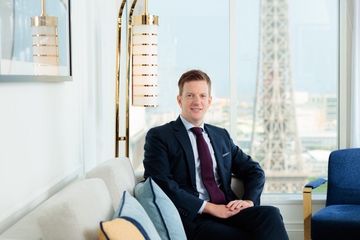
Kris Kaminsky, Sands China
The 600-suite hotel, refashioned from the former 1,200-room
Holiday Inn in the complex, also boasts a private club called The Residence,
which supersizes the industry’s Executive Floor many times over. Open only to
the hotel’s guests, it spans 1,100sqm, with different ultra-luxurious rooms
inspired by homes of famous British personalities for guests to relax in and
enjoy premium F&B 24 hours daily.
“As we develop these new properties, it’s more about
developing new experiences,” Kaminsky said. “Another aspect is creating a
deeper connection to the cultural side of Macau. We see our guests visiting the
Ruins of St. Paul, but they also want to go to the cool coffee shop around
there. So, our concierges become really important.
“Plus, there’s amazing talent in Macau, be it the local
fashion designer who was featured in London Fashion Week, or the guys who
played around and came up with a great gin made in Macau. It’s on all of us to
shine the light on these talents to our visitors.”
Motivated Macau
According to Macau Government Tourist Office (MGTO), a
gradually diversifying Macau is helping to bring back visitors
post-pandemic.
In the first nine months, there were nearly 20 million
arrivals, an increase of more than 356% YOY. More than half (51%) were
overnighters staying on average 2.3 days; the rest were same-day
visitors.
The success of Hong Kong and Macau can be mutual and spotlight the Greater Bay area. Maybe on some weekends we compete with a live concert here or a convention there, but that’s natural; besides, we’ve always had people going to Hong Kong then tack on to Macau and vice versa, and that won’t go away.
Kris Kaminsky
While more than 90% were from Greater China (mainland, Hong
Kong and Taiwan), regional markets such as the Philippines, South Korea and
Indonesia also showed healthy returns, likewise longhaul markets, including the
U.S., Canada, Australia, UK and France.
Hotels enjoyed an average occupancy of 80.6% from January to
September, a 43% increase YOY, and an average rate of US$163, a 79% rise YOY.
As of 2022, Macau had 142 hotels with 47,000 rooms, of which 28,000 rooms are
five stars.
It isn’t clear if MGTO has more marketing dollars as part of
the non-gaming deal, but what is clear is the tourist board has been
aggressively promoting Macau to international markets since borders reopened
last year.
Among efforts, it worked with airlines that operate direct
flights to Macau to offer discounted air tickets, such as Air Macau’s buy one,
get one free for roundtrips from Singapore, South Korea, Japan, Thailand and
Vietnam. The carrier also started direct flights between Macau and Jakarta in
October.
Together with the six companies, MGTO held trade roadshows
in Portugal, Thailand and South Korea. It also participated in consumer travel
fairs in Singapore and Malaysia. And its hundreds of media and industry
partners have been invited on fam trips to rediscover Macau.
Some media reports even suggest that Macau could sweep Hong Kong under the rug, particularly in the live concerts and conventions
arena. In early November, Macau hosted Kentucky-based Yum! Brands convention, a
gathering of 12,000 delegates, including franchisees of its fast-food brands
such as KFC and Pizza Hut in Greater China.
“I’d say Macau and Hong Kong compete with and complement
each other,” Kaminsky said. “It’s not good for either of us to be overtaking
the other. The success of Hong Kong and Macau can be mutual and spotlight the
Greater Bay area. Maybe on some weekends we compete with a live concert here or
a convention there, but that’s natural; besides, we’ve always had people going
to Hong Kong then tack on to Macau and vice versa, and that won’t go away.”
Kaminsky added that Hong Kong is like Macau’s second airport
[after Macau international airport]. The majority of international customers
fly into Hong Kong and now the experience of traveling on the [Hong
Kong-Zhuhai-Macau] sea-crossing bridge is even more seamless. “You can be in
your hotel in Macau in 45 minutes. And flights are returning quickly to Hong Kong
International Airport,” he added.
Meanwhile, Mayur Patel, head of Asia, OAG Aviation, said
Hong Kong’s strategic position will never go away. “Hong Kong International
Airport serves a larger catchment [i.e., the Greater Bay Area] which provides
new intermodal transport opportunities to travel by road, rail and sea. The
airport’s Masterplan 2030 will see investments in terminal development and
facilities that will increase capacity growth as part of a three-runway
project.”