The company that introduced residential style Bode and lifestyle
brand Drift has its strategy in place and plans for further regional development.
Note: This story first appeared in Travel Weekly
IRVINE, California – TMC Hospitality, which launched in 2016
as an offshoot of Irvine, California-based real estate powerhouse TMC Group,
has carved out a niche within the boutique hotel space. The company introduced
its residential style Bode concept in 2018, then unveiled lifestyle brand Drift
in 2021. Drift originated in San Jose del Cabo, Mexico, and has since added two
locations in California and, most recently, a fourth outpost in Nashville.
Travel Weekly Hotels Editor Christina Jelski spoke with TMC Hospitality
co-founder and CEO Philip Bates about the latest news on the company's expanding
portfolio.
Q: How are Bode and Drift differentiated?
A: I'd say Drift is about a half a star higher than
Bode, with Drift being upper-upscale and Bode upper-midscale. Drift really
caters more to that traditional traveler segment of one or two people, or maybe
three to four. Bode, meanwhile, is really focused on what we call the social
group traveler, which the Airbnb market largely targets. Bode is looking to be
the lifestyle hotel in that space, offering multibedroom units.
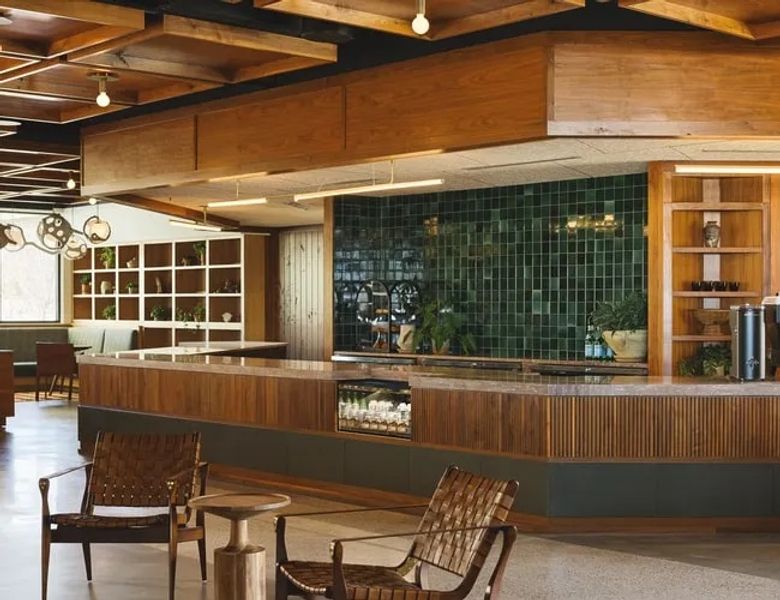
Cafe at the Drift hotel in Nashville
Q: You now have both a Bode and a Drift in Nashville.
Any concerns about the competitive environment there?
A: Yes, that was a big concern for us. There is a lot
of supply in that market, and it's been increasing for years. But we saw some
white space. I consider Drift a "lifestyle light" concept, in that
we're in the lifestyle space, but we are light -- we're a little more
tech-forward, and we don't necessarily always have full-service restaurants,
for example. And that enables us to come in at a more competitive price point.
When we looked at Nashville, we saw a gap emerging where you have these
high-end hotel brands coming into the market, like Four Seasons, 1 Hotels, JW
Marriott, Ritz-Carlton, and you also have a lot of lower end, midtier chains.
And then you do have a few boutique hotels, but some guests who want that
boutique experience might not be able to stretch their budget for those hotels.
And so, we put Drift on Nashville's East Bank, where the next wave of the
city's growth is going to be. We feel that between our brand positioning and
pricing as well as our location and the long-term trajectory of the city, we
can be very competitive in that market.
Q: What's your approach to incorporating local culture
into each Drift hotel?
A: One big focus with Drift is to make it a kind of
pillar within the community, with a strong social element for locals. For
example, in Baja California Sur, every Thursday we do a tacos and mezcal night,
and all the locals come out. And that's something we want to create everywhere
we go. From a food and beverage perspective, we look at it like our main
customer is the local. We know that if we get that right, it's going to be what
the guest wants, too. Because our guests want to know what the locals want.
Q: What's next when it comes to expansion?
A: We just signed a new project in Fulton Market in
Chicago, and that's going to be a renovation of a former Schwinn Bicycle
factory. That one's about two years away from delivery. And then we're actively
looking again in the Southeast as well as looking in the San Francisco area,
kind of around wine country. Philosophically, as a company, we're big believers
in that when you move into a region, it then makes expanding further within
that region much simpler. So, for example, we already have hotels in Baja and
in Palm Springs and Santa Barbara, California, so we'll continue to expand
there. We have two more projects in Southern California, though I can't
announce the locations for those yet; we'll be delivering those within the next
two to four years.