Group business accounts for an increasing piece of business
for the nature-focused brand who has taken on a partner to grow the platform.
CHICAGO – An unexpected opportunity has emerged for Outbound
Hotels, the nature-first brand with properties adjacent to outdoor destinations
open in Jackson Hole, Wyoming; Mammoth Lakes, California; and Stowe, Vermont:
groups now accounts for about 30% of its business. When you stop and think about
bigger trends, it really shouldn’t come as a surprise and it is delighting Matthew
Mering, Outbound co-founder and executive vice president of Hospitality at
Waterton, the brand’s ownership group that has a newly announced minority investment
partner in Lowe Enterprises’ CoralTree Hospitality.
“When we started the first Outbound in Jackson, we didn’t
really think through meeting and group business much. We were focused on F&B,
rooms and traditional rooms department operations,” Mering explained. “But it’s
been eye opening how much group business is in these markets, and it’s been an
evolution pivoting towards group business. It really helps in the shoulder
season and mid-week.”

Outbound Hotels Co-founder Matt Mering
Mering said group is a nice mix of leisure and corporate business.
“The nice thing about group is it obviously creates a base of demand. So, we
can yield really high transient rates, which helps if you’re shrinking your box
from 150 to 100 rooms.”
Five years in, Mering added that the existing assets are performing
well, “Getting at least our fair share of RevPAR index.”
Two more Outbounds are opening in the first half of next
year, including the only new-build, Outbound Yosemite in California, and
Outbound Sedona in Arizona, with an additional project under contract.
Opening Q1 2026, Outbound Yosemite is a 17-acre retreat just
15 miles from Yosemite’s South Gate, with 104 park-model cabins, 12 lodge
rooms, a pool and hot tub, and 5,000 square feet of indoor-outdoor meeting
space. Outbound Sedona, debuting Q2 2026, introduces 138 rooms with
Pueblo-inspired architecture, layered interiors, and Moonwater, a pool complex
designed for golden-hour lounging and stargazing. Bookings open November 3 for
both properties, with stays beginning April 1 at Yosemite and May 1 in Sedona.
Outbound is also getting creative with its existing assets,
building 20 condo-like units at Mammoth and just starting to sell them as
branded residences. In Jackson Hole, they have a half-acre parcel being
developed into 32 studio-type units to potentially use for employee housing and
to rent at very healthy market rates.
Mering see approximately 50 markets in the U.S. that Outbound
wants to be in and would like to start franchising the concept after maybe 12
to 15 are open.
He also sees the opportunity to take the brand overseas in
markets like Mexico, Costa Rica, South America and Asia. “There are national
parks all over the world. There are ski towns all over the world. There are
outdoor focused markets throughout the world,” Mering said. “The sky’s the
limit long term for the brand and the concept.”
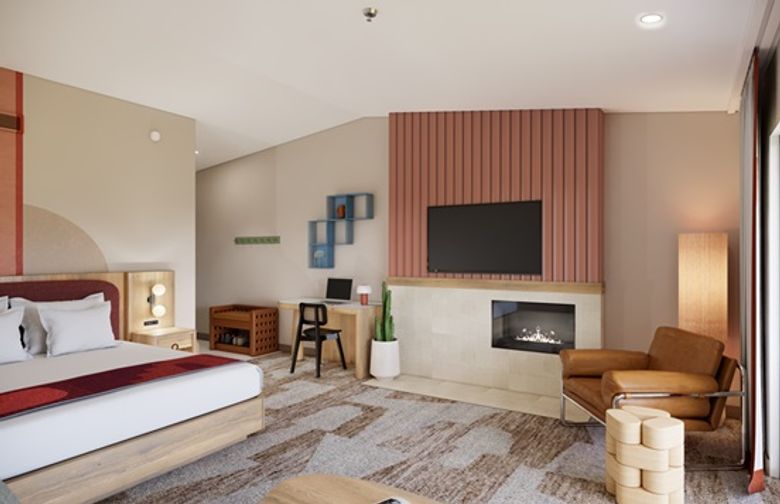
Rendering of an Outbound Sedona guest room
Who actually takes the concept outside the U.S. could be
another story as Mering eluded that it could be “the next owner.”
That said, he said brand owner Waterton is patient. “It’s not
like we need to be out in three years,” Mering continued. “We were deliberate
with our capital, especially in the first few projects where we tried to
curate. It takes a while to build a brand. It takes a while to execute on these
specific assets. So, we didn’t want to have a gun to our head and we’re taking
a long-term view of the strategy and the platform.”
CoralTree steps up
The group also has a new investment partner with CoralTree
Hospitality stepping up to the plate, investing minority stakes at both the
brand and asset level.
“For us, it's more about alignment of interest,” Mering said.
“We’re a well-capitalized company. We’re very selective about who we bring in
as partners. It’s making sure that everyone has an owner’s mindset when we’re
approaching projects, developing and managing them.”
The other big investment CoralTree is making is in building
out a dedicated Outbound team, focusing exclusively on the Outbound portfolio.

It’s so challenging to develop and operate in these markets. You have to have a big balance sheet. You have to know the lodging business inside and out because there’s a lot of nuances to working in these types of environments. No, I don’t think it’s getting overdone by any means at this point.
Matt Mering
“They have a great track record, both in the independent
resort lifestyle space, but also in building brands,” Mering added. “And
because they’ve been around for 50-ish years, they have a really deep bench of
talent. One thing we saw immediately out of the gates when they took over some
of our properties is their ability to build a seasoned team really focused on
these outdoor-type markets. That’s a real challenge as these markets don’t have
super deep labor pools.”
Challenges, opportunities
As with any emerging concept, there are challenges on the
development side. Within the outdoor-related space, Mering pointed to entitlements
that can take six to 18 months and permitting, adding that they have to manage
a lot of nimbyism in these markets.
“There are strict environmental regulations and lengthy
entitlement processes because of that kind of ‘nimby’ sentiment that emanates
through these markets,” he said. “We typically like to steer clear of any
scopes of work that will trigger lengthy design review processes with the local
municipalities. That being said, if there is a scope of work that’s really
vital the success of the property, we’ll take that on.”
The other big challenge Outbound has faced revolves around
construction labor as most local contractors are custom home builders without
deep subcontractor bases.
To get around this, Outbound has a handful of contractors
across the country that parent company Waterton has been partnering with for 30
years. Outbound mobilizes them, sends them to development sites, and houses
them along with subcontractors since the projects are generally conversions.
Mering added that construction costs are starting to flatten
out, but they are bracing for the impact of pending tariffs.
“We haven’t seen a meaningful impact yet,” he said. “We’ve
seen maybe a 5% to 10% increase in certain materials or furniture and fixtures
that are coming from Asia, but nothing as catastrophic as you might see in the
headlines.”
Then there is the growing competition in the space from
major brands like Marriott International and Hilton.
“I think it’s great,” Mering said. “It’s a vote of
confidence and validates our thesis... There’s a lot of opportunity, and at
different price points. There’s plenty of room.”
Mering isn’t too worried about overbuilding either. “It’s so
challenging to develop and operate in these markets. You have to have a big
balance sheet,” he said. “You have to know the lodging business inside and out because
there’s a lot of nuances to working in these types of environments. No, I don’t
think it’s getting overdone by any means at this point.”