Amid
the nighttime din of a chi-chi Manhattan restaurant, CEO Dillip Rajakarier of
Bangkok-based Minor Hotels dished about what’s on his plate.
NEW
YORK CITY — In New York City recently for business and a conference, Minor
Hotels CEO Dillip Rajakarier readily acknowledged it’s been an active year on
many fronts, from adding a quartet of new brands and creating a guest-facing
master-brand strategy to being opportunistic about expanding Minor’s
distribution footprint globally. It’s a pace, he said, that finds him sleeping
only four hours a night.
“Our
focus is on growth and how we’re growing our brands in the different regions
and in some of the new markets as well, where we have to compete with some of
the larger brands. It’s not easy but I think we’ve done a pretty good job the
past few years,” Rajakarier said. “The brand has really gained a lot of scale
and we’ve also been able to rebrand from the other brands, which shows owners
trust us and they are confident about that brand delivery and the performance,
as well.”
With
the launch this past summer of four new brands—The Wolseley Hotels and Minor
Reserve Collection in the luxury tier, premium soft brand Colbert Collection
and select-service iStay Hotels—Minor Hotels currently has a dozen brands for
owners and developers to consider, which the CEO viewed as an advantage.
“The
good thing is we only have 12 brands,” Rajakarier continued. “Each of the
brands is in very specific market segments from ultra-luxury to luxury to
upper-upscale to midscale to select. We do have some soft brands, as well, to
cater to the demands of hotel owners who want to keep their own hotel brand but
[want] to be part of a larger distribution platform.”

Minor Hotels is launching four new brands, from luxury to soft brands and select-service.
In
addition to the recently launched brands, Minor’s brand portfolio includes luxury
Anantara Hotels & Resorts, elewana Collection, Tivoli Hotels & Resorts;
premium nH Collection Hotels & Resorts, nhow Hotels & Resorts, Avani
Hotels & Resort; and select nH Hotels & Resorts and Oaks Hotels,
Resorts & Suites.
With
more than 560 hotels, resorts and branded residences, the company has a
relatively near-term goal of adding some 300 properties by year-end 2027.
Within
that timeframe, Rajakarier expects to see the debut of both its Anantara and
Wolseley hotel brands in the United States, where currently it’s solely
represented by the 288-room Hotel nH Collection New York Madison Ave.
“We
should be able to get something in New York for Wolseley because the brand is
so well accepted and so well-known by the American travelers into London (The
Wolseley is a renowned café/restaurant in Mayfair on Piccadilly). Therefore,
the brand will resonate really well with this market as a hotel brand also,”
Rajakarier said.
With
the wealth of architecture in Manhattan, the CEO was asked if Minor would look
to do a conversion/ adaptive reuse of some iconic building.
“I
think for the Wolseley, a conversion in an historic location or an historic
building, yes, will fit with the Wolseley theme, as well,” he said.
And
as might expected, a Wolseley Hotel will have a Wolseley restaurant as a
premier draw.
Rajakarier
noted London and the Middle East also are on the company’s radar to debut the
brand.
Minor
also is eager to bring the Anantara brand to the U.S. ”We’re quite strong [with
the market]; 15% of our total revenues [for the brand] are generated by the U.S.
Therefore, the U.S. segment is very important for us because they are seeking
lifestyle, luxury and experiences, which will help us launch the Anantara brand
successfully here,” he said.
“I’m
fairly confident that both [U.S. brand introductions] will happen by next
year,” he added.
Meeting
challenges
Among
the challenges in having its expansion plans gain traction, said Rajakarier, is
to “ensure the brand consistency, the brand promise and the brand delivery is
there. The good thing with us is we are segmented by regions. So, we have
offices in the big hotel areas, for example, Australia, Africa, Europe, Asia
and China. They carry out the delivery of the brand promise, including the
guest experience and ensuring they deliver that consistent customer experience
all the time.”
That
dedicated approach also resonates with owners considering switching brands, he
said.
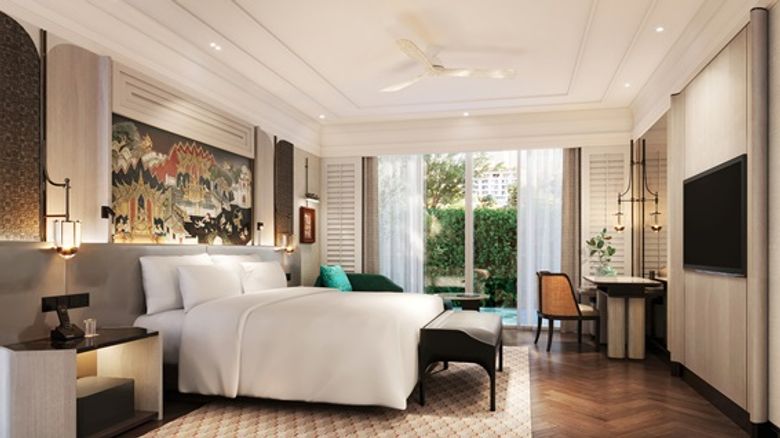
Anantara Siam Bangkok is undergoing a$50 million renovation, including this Garden Terrace Villa.
“We
have seen movement from the larger global brands to us, for sure. I think today
owners want to ensure their asset is not just another brand. They want to make
sure they are part of a brand where there’s performance, where there’s the
owner relationship.
“There’s
also the link between the owners and us. We are owners,” he continued. “Today,
we own two-thirds of our portfolio. So, we understand the owner mindset, which
is really important for us. We can relate to the challenges the owners have
with some of the larger brands because we also own some of the larger brands as
well… We own three Four Seasons, a St. Regis, a JW Marriott, and a Radisson in
Africa.”
In
Thailand, for example, these include the Four Seasons Resort Chiang Mai, Four
Seasons Resort Koh Samui, Four Seasons Tented Camp Golden Triangle and the JW
Marriott Phuket Resort & Spa.
“I
think it helps a lot to have that owner mindset instead of just having a
management company mindset [because] we can benchmark and see how they do
versus how we do,” Rajakarier said.
So,
how are the KPIs?
“From
what we see in terms of expansion, scaling up we’re doing quite well,”
Rajakarier said. “We’re getting a lot of owners who want that brand niche
experience. They don’t want just another Marriott or IHG or something; they
want something special. So, some of the owners, if they are willing to create
that experience and that brand standard, we have a good fit.”
The
executive suggested the pace of expansion is not likely to slow any time soon.
If anything, he indicated that Minor was open to a variety of ways to continue
whetting its appetite for growth.
“We’re
always looking – either on an asset-by-asset basis or for portfolio deals which
would fit any of our brands and [have us] expanding into new markets,” he said.
He
added that Minor’s strategy is not about being asset light or asset heavy. “We
call it being asset right. [That’s] to ensure some of the locations where we
go, for example, a Tier One city, it fits the brand,” Rajakarier said. “We will
look at investments as well. The pipeline we have today, the majority of the
pipeline is… asset-light.”

We’re looking at restructuring our balance sheet from a financial perspective and trying to reduce debt, also releasing some capital for expansion in the future. The REIT fits in really well.
Dillip Rajakarier
Exploring
a franchise model for its non-luxury brands also is a consideration, Rajakarier
said, as well as continuing to form joint ventures, such as its parent company,
Bangkok-based Minor International Public Co. Ltd.Ja’s deal with Japan’s Royal
Holdings Co. to develop and operate some two dozen hotels over the next 10
years under Minor’s Anantara, Avani and Tivoli brands.
And
as recently as last week, Minor Hotels inked an agreement with Egypt-based
Sunrise Resorts and Cruises to—among other goals—open and manage 50 hotels in
the country over the next 10 years via a JV entity.
“We’re
looking at asset-light expansion or JVs in different ways—whether we take
majority, whether we take minority [stakes]—or even working with some of the
white label [operators] to expand our brands here in the U.S.,” Rajakarier said.
“Then we have the Minor Reserve Collection, which is soft brands. We have quite
a few of our owners who would like to keep the name of their hotel, but they
want to be part of our brand. So, they can be part of the Minor Reserve
Collection.”
REIT
in view?
And
while it was talked about last year, with the possibility of it happening this
year, it’s next year that Minor now plans to launch a real estate investment
trust, according to Rajakarier.
“We’re
looking at restructuring our balance sheet from a financial perspective and
trying to reduce debt, also releasing some capital for expansion in the future.
The REIT fits in really well,” Rajakarier said. “The REIT we’re planning is
going to be next year and we’re hoping to list [it] in Singapore, which has a
fairly strong investor following for the REIT segment. Also, in the future,
when we’re acquiring assets, we’ll be able to inject them quite successfully
into the REIT as well, which will allow us to expand much faster.”