Hyatt
CEO Mark Hoplamazian was interviewed at HICAP about whether he prefers JVs or
collaborations, the company’s current business model and what he would change
about the industry.
SINGAPORE — Fresh off the news
of a joint venture and strategic partnership with China Resources Land to
expand Hyatt’s presence across China, Hyatt Hotels Corp. President and CEO Mark Hoplamazian was
asked which kind of deal he preferred.
“It’s interesting because I
haven’t commented on this publicly… We’ve done both. We’ve tried some
collaborations, and we’ve done JVs. Collaborations are great, but they’re not
durable and they tend to morph in one direction or the other. You either get
closer and it becomes part of a unified effort, or you drift apart and it
changes,” Hoplamazian said during the second day of the Hotel Investment
Conference Asia Pacific (HICAP), which is run by Northstar Travel Group’s The
BHN Group. “I’d prefer if it’s a brand that we’re talking about co-ownership.”
Hoplamazian, who was interviewed
by The BHN Group President Jeff Higley, mentioned a few recent examples of JVs
or M&A that he thinks have worked well (another JV in China for the UrCove
by Hyatt brand and the acquisition of London-based Mr & Mrs Smith, which
added a million potential guests to the company’s loyalty program).
“We used to have, by way of an
example, a collaboration with Small Luxury Hotels and we now own Mr & Mrs
Smith. Why did we make that transition? Well, it didn’t make sense to us for us
to be continuously building the brand equity of someone else’s portfolio
without having a stake in it,” he said.
Regarding the deal this week
with CR Land, Hoplamazian said the companies have been working together for
over 15 years already.
“We’ve done a lot with CR Land
already, and we’ve been through a very great history with that,” he said. “We
started these conversations, I don’t know, more than five years ago, about
creating a joint venture (Yuen Kai Holdings Ltd.) together where we co-own a
JV for both brands (Mumiam and Kapok), which would be staffed largely by CR Land people, but also by Hyatt.”
In addition, Hoplamazian said
Hyatt and CR Land signed a strategic collaboration agreement to develop more
Hyatt-branded hotels across China and have signed agreements for the Park Hyatt
Xi’an and Andaz Dongguan.
“They think that we can
superpower, supercharge those brands and grow with this partnership, and
they’re going to continue to develop standalone hotels that we will manage,” he
said.
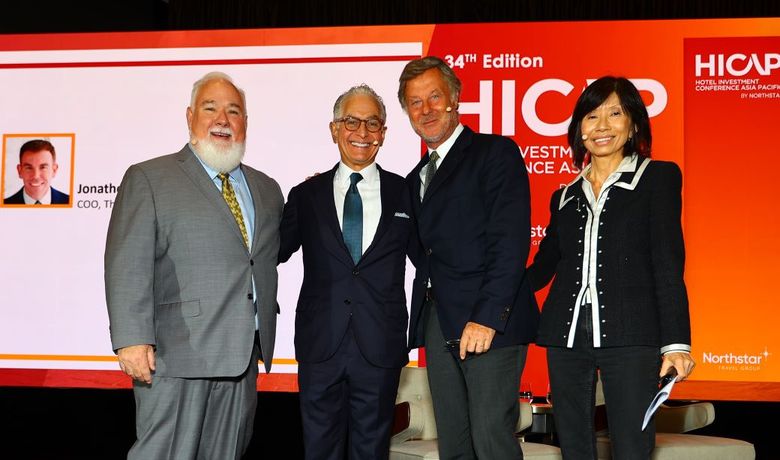
Hyatt CEO Mark Hoplamazian with Accor CEO Sébastien Bazin (along with Jeff Higley and Raini Hamdi) in between their sessions.
Hoplamazian talked about several
subjects in his wide-ranging interview at HICAP.
On Hyatt’s current
business model…
“First and foremost, we’re
staying more true to and getting to know our customers and guests by brand much
more intensively. We’re using many technology platforms to do that and
human-to-human interaction that translates into a brand portfolio approach…. because
ultimately, we’re selling brands and brand performance with respect to
management versus franchising. We are still primarily managing the company.
Seventy percent of all the hotel rooms around the world will be managed
directly. We have expanded our franchise base a lot, and we will franchise in
places and in circumstances where it really matters and makes sense. So, we’re
not averse to it and at the same time, if it doesn’t make sense, we won’t go
there just for the sake of adding another flag on the map.”
On what he would
change…
“A lot of time is spent on the
embedded conflict between owners and brands, or between operators or
third-party operators and brands and owners, or between satisfying the guest or
customer and satisfying the owner. These are all false choices. The framing is
managing conflict across the different players… If you don’t design your
business so that one serves the other… then you have the wrong business model.”
On why he stopped
scenario planning for recessions…
“We stopped it because I can’t
tell if it’s going to happen or not. By the way, most of the experts [in the U.S.] were
completely wrong most of [last] year, and it never happened. We never ended up
in a recession… The thing I spent my time on all last year, and all year this
year, has been building the muscles to be able to be responsive, to adapt, to
recognize change and to be able to pivot quickly. That agility, if you build
that into the company, then you’re resilient. Running scenarios doesn’t improve
your resiliency at all.”