The original Waldorf Astoria in New York City is expected to
reopen this spring after seven-plus years. Hilton’s head of luxury brands talks
about the meticulous process.
NEW YORK CITY – In Spring 2025, the phrase “meet me at the
clock” will have true meaning once again as the Waldorf Astoria New York
reopens after more than seven years of ownership tumult and extensive and
expensive renovations. In fact, just this week, the famed and now refurbished
lobby clock was reinstalled in the very same spot loyal guests know.
Hilton signed a 100-year contract in 2014 to manage one of
Manhattan’s most storied hotels just before China’s Anbang Insurance bought it
for $1.95 billion. In 2017, Anbang closed the hotel to reconfigure the condos
and hotel rooms, which at the reopening will stand at 375 spaces for each. By
2018, Anbang was seized by the Chinese government for improprieties and created
another holding company, Dajai Insurance, to take stewardship of the Waldorf. By
2022, reports surfaced that the $1 billion price tag to restore the grande dame
had ballooned extensively.
But Hilton and the owners are about to put those headlines
behind them with the recent news that reservations are open.
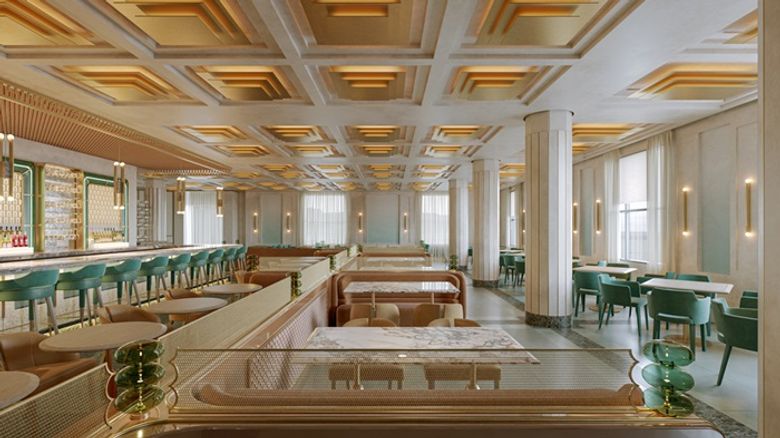
Rendering of downstairs at Lex Yard
Highlights of the transformed property will include:
- 375 luxury rooms and suites, some of the largest
in Manhattan starting at 570 sq. ft., with interiors designed by Pierre-Yves
Rochon
- 375 residences, ranging from studios to four
bedrooms, with interiors designed by Jean-Louis Deniot.
- Dining, including signature restaurant Lex Yard
by former Grammercy Tavern Chef Michael Anthony, and the return of Peacock
Alley (there’s also a surprise coming for the Park Avenue terraces)
- 43,000 square feet of reimagined event space,
including the restored Grand Ballroom and Jade Room
- A 30,000 sq. ft. spa and fitness center with an outdoor
terrace (operator to be named by Spring)
Hilton would not offer any projections for ADR and
occupancy, nor would they comment on how residences are selling other than to
say the owners are happy with the pace.
Yes, it has been a long, arduous road back, but this opening
is highly anticipated and very important to not only to the halo of the Waldorf
brand but to the halo of Hilton Worldwide. Since closing Waldorf Astoria New
York for renovation in 2017, the Waldorf Astoria Hotels & Resorts portfolio
has doubled in size to now 34 properties in 18 countries with a pipeline of
nearly 30 properties set to open in the coming years.
“The reopening means so much on so many levels,” Dino
Michael, senior vice president and global head, Hilton Luxury Brands, told
Hotel Investment Today. “It means a lot to our CEO Chris Nassetta who said this
is something that’s really important to him. For us as a brand, to have the
hotel reopen after a restoration is amazing. There’s something poetic about it
coming back to take its place amidst this wonderful collection of amazing
properties that have grown during its absence.”
Michael said it is also a very poignant moment. “Everybody I
talk to has a story about the hotel and everybody says, ‘don’t mess it up.’ So,
I take that obligation quite seriously to give it back to New York.”
Doing the right thing
So, how do you bring back an asset closed for more than
seven years – long enough to almost be forgotten?
Michael said the property is too transcendent to be
overlooked.
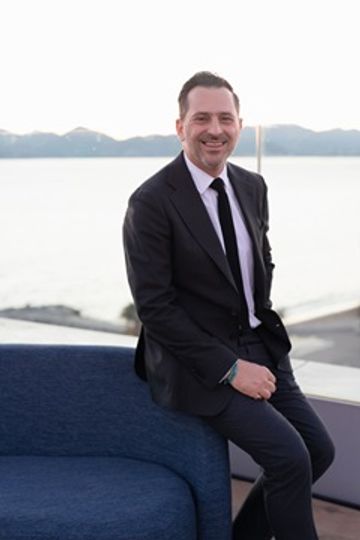
Dino Michael, Hilton Luxury Brands
“The amount of passion and emotion for this hotel surprised
me – maybe because I’m a Brit,” Michael said. “But the number of guests,
owners, developers and everybody else have such a positive, emotional pull to
the hotel. They are so curious, wanting to get in there to see it… They all
have stories about the hotel, and they inspire us to do the right thing.”
Michael waxed about how the team would peel back wallpaper
to find beautiful marble column and detailing hidden under decades of paint.
“You start to see the emblems and the motifs and the detail…
You think about Peacock Alley and then you start to see these peacock
references all around the building,” he said. “You see the meticulous nature of
the detail and you understand why it took so long.”
Yes, the clock in the lobby has been fully restored and it
was just returned to its original space, which throughout the renovation has
been used as an artisan studio where craftsmen restore and hand-create moldings,
cornices and the like.
The front desk has been completely reimagined. It’s smaller
and more elegant, according to Michael, and for the first time, daylight now
comes into the lobby from that side of the building.
“We’ve gone from what was 1,400-plus rooms – a behemoth of a
grand hotel – down to 375 rooms with another 375 private residences. So, we’ve gone
back to the concrete, reconfigured, reengineered and put all the efficiencies
back in… We’ve created two new curb cuts on the side street for residences and
guests. You might remember you have two minutes until someone was honking at
you to get out of the way while you rush to get your bags in on Park Avenue.
Now we have a much more elegant arrival.”
Hilton and the developers have also partnered with the
Landmark Association of New York, which Michael said most people would see as
something scary. “For us, it was a real privilege to have such expertise working
with us to make sure that we were doing the right thing. We are preserving it.”
Again, he talked about peeling back certain elements of the
hotel and finding colorings that they didn’t know were there. For example,
there were beautiful columns of jade covered up by huge curtains.
“You pull that down and you let the building reveal itself.
So, it feels sharp, it feels cleaner,” Michael said. “We really thought about how
the space feels when guests enter and didn’t want to lose that sense of
majesty. The moment you walk in, look up, take a slight inhale. We didn’t want
to lose that.”
The tone and look of the hotel will remain Art Deco,
according to Michael, but reimagined with a balance of contemporary to
modernize the property.
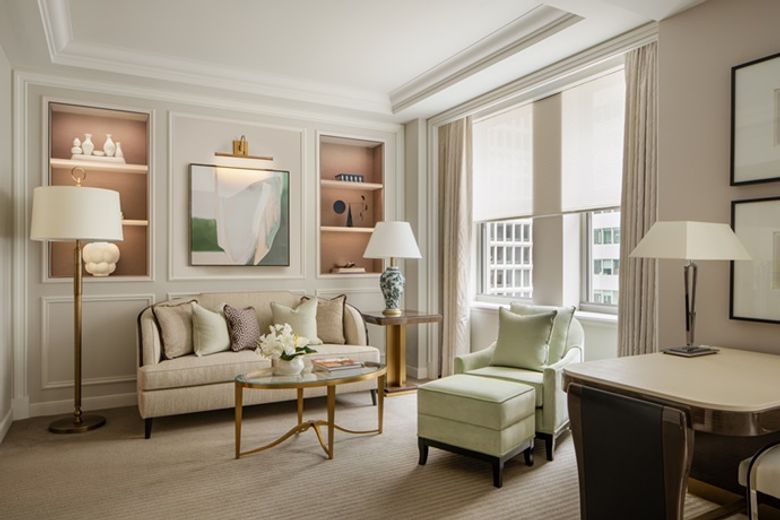
Rendering from a junior suite
“For me, the reimagining of Peacock Alley was probably the
most emotional,” Michael continued. “We wanted to preserve the space and its
intent. If you remember, Peacock Alley got its name because that was where the
ladies of the day would walk through and showcase the latest fashions… I’ve
joked, it is the original catwalk. You’re a little bit on show, you’re coming through,
and you feel like you’ve arrived. And that’s something that was really special
for us – not to lose that grandeur and that feeling of elegance.”
Michael cited a real trend and desire for nostalgia, which he said will help the hotel rise again. “People are really harking back to certain age
of glamor. We want to dress up and feel great. We want to feel like we’re going
out. We want to feel special. I believe the Waldorf really delivers on that.
It’ll take you back to an age where it meant something to dress up, to be out,
to walk through somewhere that special, and feel as though you arrived.”
Planning the comeback
Among the challenges during the renovation, Michael said,
was making sure they got the right balance of residential and hotel. “New York’s
amazing in that you have a very strong domestic meetings market, along with events
and galas. So, getting that right and making sure we’d fully modernize the
building without losing its integrity and history was important... For example,
we have a fully equipped Grand Ballroom, but it hasn’t lost that nostalgic
appeal.”
The other challenge will be bringing back guests after such
a long time. But Michael called that the easiest job in the world considering
the property’s history.
“Our sales and marketing team really understand how to bring
the power of the history to life, whether it’s Marilyn [Monroe] or Queen
Elizabeth or the countless ambassadors and world leaders we’ve had at the
hotel. So, the storytelling is important. Secondly, this real draw right now
for nostalgia is really strong, and nothing is as nostalgic as this. You walk
in and the mosaics, the majesty, the renovated clock, the ballroom, and all
that is grandeur – and we can back that all up with a modern sensibility, a
modern service style, and all the technology you’d need.”
Michael said a soft opening sometime during the Spring will
serve to pressure test the new operation and a big grand opening should happen
by Fall.
“The proof is in the
pudding,” Michael concluded. “Once we open and owners and investors come in,
that will speak for itself. I go there all the time and you just can’t
articulate the work that’s gone into it. Every time I go on site, I see
something different, and I get excited all over again.”