Discover the uncommon: a new management company with twice
the passion and no more compromises.
BANGKOK – Former Six Senses President Bernhard “BB” Bohnenberger
has created a hotel management company whose ideals have already won over
several owners to build authentic niche resorts in unique locations bearing the
company’s name, Discover Collection.
A dozen Discover Collection hotels are now in
conceptualization, design or construction stages. The first to open, in October
2025, will be Discover Collection R'as Amud, located on a stunning cape in
Musandam, Oman. The rest are in diverse destinations, including Ireland, Kenya,
Botswana, Mexico, Albania, Thailand, Bhutan and Zambia.
Generally, the cost per key of each project is on par with
the likes of Aman, Four Seasons and Six Senses, which typically is around $1
million to $2 million, excluding land. Bohnenberger is targeting an IRR
(internal rate of return) of at least 20%.
The portfolio is aimed at affluent guests who seek
extraordinary settings and are mindful about the need to protect them. They
must sign up as members of Discover Collection, but the company won’t be
charging a one-time annual membership fee as of yet. It will only do so when
more of its hotels are open. Registration is open on its website, and it
expects 10,000 to 20,000 members to join in the initial stages.

Rendering of the pool at the Discover Collection Amboseli in Kenya (Michaelis Boyd, designer)
The company is a joint venture between Bohnenberger and Mike
Meldman, founder of U.S.-based Discovery Land, a real estate developer and
operator of private residential communities whose 37,000 members include A-List
celebrities. Both entrepreneurs share the passion of being sensitive to
environments, and to create private and exclusive havens for family and friends
to enjoy special moments together.
“I started my journey with Six Senses, and Discover
Collection is the culmination of everything I believe in,” Bohnenberger told
Hotel Investment Today in an exclusive interview about his new venture.
No compromises
Bohnenberger was with Six Senses for nearly three decades
and was its president from 2011 until his resignation in 2019.
“I’ve told myself that for this new brand, there is no
compromise anymore. I only want to work with people I enjoy working with, and
who hopefully enjoy working with me and the team. I only want to hire really
passionate people. We only pick places that are remote yet reachable, with a
lot of culture and meaningful local community [interaction]. Meeting a Maasai
person and hearing the story of his land and his people from him is so much
more wonderful than having a Maasai tribe jumping around in front of cameras,
which is sad.”
BB also won’t compromise on exclusiveness. Guests won’t see
any neighboring hotels whether their Discover Collection hotel is on a beach,
island or in a mountain valley, he said.
Nor would Discover Collection invite other properties
managed by another operator into the portfolio.
Nor would he rebrand existing independent hotels into
Discover Collection for expansion’s sake. “Currently all our projects are new builds.
We have a strong opinion on location, look-and-feel, and concept, that few
properties globally would be a perfect fit. If we come across one that fits, we
will certainly do some renovations or improvements,” he said.
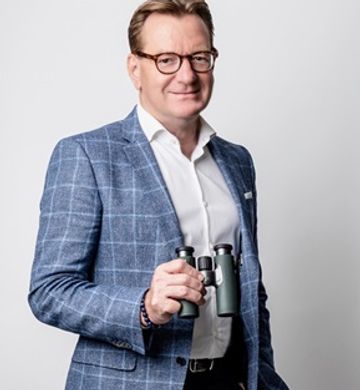
Discover Collection's Bernhard Bohnenberger
Among the investors who are building Discover Collection
projects are Six Senses hotel owners who worked with him previously, such as
the owner of Six Senses Zighy Bay in Oman, or the family in Bhutan that
owns Six Senses Bhutan.
“We will have a new interpretation. I believe we will put
something together that is even better than what we’ve done in the past – more
intimate, more exclusive, more private, more away from it all.”
Other owners include American actor and angel investor
Edward Norton, who will channel 100% of the net profit from his two resorts in
Kenya, Discover Collection Amboseli and Discover Collection II Ngwesi, into
conservation efforts for the region.
Every property, along with Discover Collection itself, puts
a percentage of revenue aside for local causes. The company is a for-profit
enterprise with a strong conscience, Bohnenberger added.
Projects have no more 60 keys. The hotel in Oman, for
instance, has 31 villas, but can house 100 members as villas have one to four
rooms. The two properties in Kenya, which are the next ones to open, have nine
keys each, and five owners’ villas between them which are managed by the
lodges.
Discover Collection hotels are fully all-inclusive. As a
gauge of room rates, the Oman property will be charging at least $3,000 a night
per couple for an entry-level room. Rates could go as high as $3,000 per person
for properties that provide high infrastructure cost activities and excursions
such as safari trips.
As Discover Collection gains traction, Bohnenberger aims to
be the rate leader in each location, hoping this will enable the hotels to make
even more contribution to local causes. His own cause is to fund
underprivileged locals to go to a university or learn a craft. In future, he
would also like to see the GM of every Discover Collection hotel to be a
local.
“The typical safari hotel brochure looks colonial. Imagine
how wonderful it would be if a local leader tells you about his or her
surroundings with pride, rather than somebody who's thrown in from Paris or
London and most probably has the nose a bit up in the air,” he said.
“Creative conceptualization”
Discover Collection is “extremely involved” in the
conceptualization, design and construction of the projects, although the
company does not invest in the assets.
An aspect of Bohnenberger’s “no compromise” ideal is
creating a “true” owner-operator partnership. “I don’t anymore use ‘owner’ and ‘operator’
in the management contract, but ‘capital partner’ and ‘operating partner,’
which [reflect] a true partnership. The capital partner brings in the capital
to build the hotel, and typically has fantastic insights into the country, area
and community, and can do things that we couldn’t do,” Bohnenberger said.
The contract also comes with a “creative conceptualization
and technical service agreement,” not just the usual letter where “typically,
the hospitality company will just pass on the folders and photos of standards
and let the owner build the hotel.”
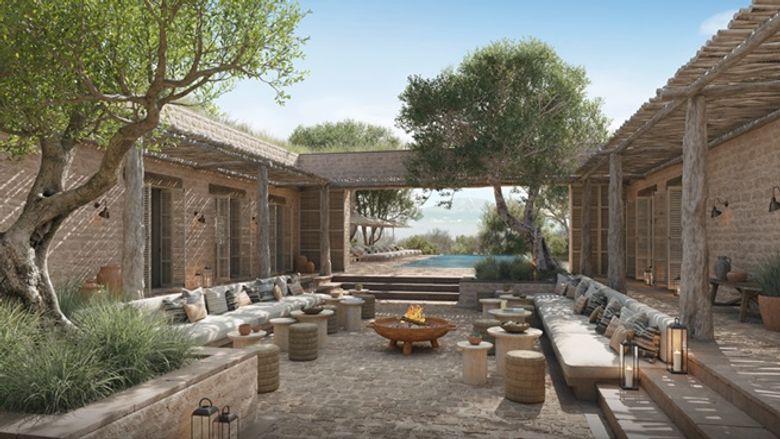
Rendering of the courtyard at the Discover Collection Amboseli in Kenya (Michaelis Boyd, designer)
BB said he is grateful to be working with like-minded
capital partners with whom he has had “wonderful” relationships or being
recommended to other partners by them.
“If you understand and trust each other, it’s much easier to
work together. A fund that sits somewhere in London or New York acquires
properties but isn’t intimately involved in them; the properties tend to be a
bit like stepchildren,” Bohnenberger said. “These funds also look to flip the
assets. So, I’m looking for individuals who really care about creating assets
that make a difference and who are in it for the long term. We have to have a
purpose, otherwise it won’t work for me personally anymore.”
As a result, contracts are at least 40 years, with extension
up to 60 years, subject to performance clauses.
The company currently has a team of 21 staff in the
corporate office in Bangkok. They include Chief Creative Officer Apiwat
Anukularmphai; Chief Operating Officer Anne-Marie Houston; Corporate Director
of Development and Wellbeing Chunxia Gao; and Director of Business and Legal Strategy
Ludovic Tendron. There are also two ‘experiential analysts’ looking at events
planning and creative F&B, and an ‘environmental designer.’ The list
reflects the company’s emphasis on design and architecture, sustainability,
content programing, culinary and wellbeing.
So, what is the ideal number of Discover Colleciton hotels
in the portfolio? Said Bohnenberger, “If the partner fits and they can commit
to the kind of budget we need, and if we have the bandwidth, we’ll take the
project. We’re not doing gold taps and such stuff, but there are costs because
we want the highest quality. I think we can’t open more than three to five a
year.”
He added, “Fortunately, Mike Meldman and I don’t have any
pressure to produce [numbers]. We are not a public company that has to report
every quarter how many contracts it has signed and what it has achieved.
“I also need to look at my age and it matters to me if some
of the things we do will hopefully drive the industry to think differently and
will trickle down for the next generation to take it forward.”