Accor’s
Maud Bailly discusses branding refreshes, pipeline pushes for four brands under
her guidance.
NEW YORK CITY – Basking in the success of the recent reveal
of the multimillion-dollar renovation of the Sofitel New York, Maud Bailly, CEO
for Accor’s Sofitel, Sofitel Legend, MGallery Collection and Emblems
Collection, is set on U.S. and global growth as she pushes to limelight the
four luxury brands on her watch.
At the reintroduction of the 398-key Midtown Manhattan Sofitel
as the brand’s U.S. flagship, now rife with Art Deco inspiration and carefully
curated design, Bailly shared with Hotel Investment Today how she has
been strategizing and what’s ahead.
Tapped three years ago to steer the futures of the brands,
including the recent rollout of Emblems Collection, the executive took a hard
look at the brands’ status worldwide in terms of meeting not only guest
expectations, but those of investors as well.

The last thing I want to do is to be opportunistic—saying yes and giving Sofitel brand to every new lead. I would have a wonderful net unit growth performance but within two or three years I would look silly.
Maud Bailly
The core of her game plan became revamping Sofitel’s
branding, leaning heavily into its French heritage, investing significantly
with renovations to existing properties—notably its six North American hotels—and
growing its portfolio.
“We started by assessing the network positioning,
understanding which products were not up to the standards anymore and then we
questioned ourselves about what we were standing for,” Bailly said. “It was a huge trip all around the
world to assess our products’ quality, and understand the deep need for
renovation, like in New York, which was obvious. Having a discussion with each
owner, convincing them about the need for renovation. The good news is that it
worked because after three years as of today one-third of Sofitel network (of
some 120 hotels) is currently undergoing renovations,” she said.
This effort, quite literally designed to elevate the brand,
is one Bailly sees resonating with investors. “We are going to open 39 new
Sofitels by 2030,” she said, stressing she is leaning strategic rather than
opportunistic when considering properties to bring into the fold.
“Now that we’ve managed to craft a very clear, distinctive
identity the last thing I want to do is dilute it,” she said. “To me, luxury is
all about consistency: consistency of the product, consistency of the culture.
Owners are coming to us with assets or they are launching RFPs. In the case of
RFPs, we’re looking at the destination, we’re looking at the product, we’re
looking at the inventory, we’re looking at the investment capacity of the
ownership. If we do believe it’s a real 5-star product, the designer is a good
one, it’s a good destination or a very nice venue because it has something
specific around heritage or history, then we can compete.
“The last thing I want to do is to be opportunistic—saying
yes and giving Sofitel brand to every new lead. I would have a wonderful net
unit growth performance but within two or three years I would look silly.
Because people do expect consistency in the promise,” she said, adding, “I do
say ‘no’ more often than I do say ‘yes.’”
Investor profiles
Bailly said she’s been being approached by a mix of
potential investors, including “hospitality families” who have been working in
the industry for generations, and noted one of her “favorite” inquiries is when
other Accor brand owners/developers reach out.
“I do love it when I have existing owners willing to extend
their network with us,” she said. “It’s been the case of owners of MGallery in
Athens [the 177-key Athens Capital Hotel and Athens Suites Hotel]. They are
entrusting us again with two new assets, which are actually going to be [among]
the very first Emblems, my new boutique hotel collection luxury brand.”
Lampsa Hellenic Hotels reportedly will redevelop the Elatos
Resort on Mount Parnassus into the first Elatos Resort, Emblems Collection in
Greece. The renovated resort
is slated to open in second-half 2026.
The first flagship Emblems Collection hotel,
the Lucknam Park Hotel & Spa in
Wiltshire, England, opened last month.
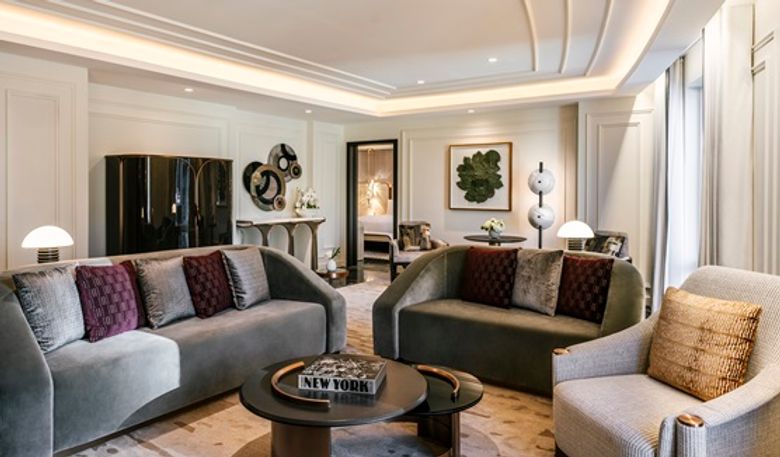
The penthouse suite at the redesigned flagship Softiel in New York City
“I’m also going to have two new MGallerys with existing
owners of [the brand] near La Rochelle in France and open with them another
MGallery in Valmorel and in Île d'Oléron on the ocean. I like the idea to keep growing with
the same owners because those owners have been so happy with our performance,
where we deliver the promise,” Bailly said.
Additionally, she wants to grow Sofitel Legend from its
existing half-dozen hotels housed in iconic structures with locations in
Amsterdam, Aswan, Cartagena, Hanoi, Panama City and Xi’an. Current plans call
for a Sofitel Legend to be developed by Sukhani Ventures in Jaipur, a first for
the brand in India, and slated to open in 2028, as well as The Mozart Prague,
owned by the Courbet Group, expected to open in 2027 following an extensive
renovation.
The CEO also is entertaining new owners and investors. “I
was in South America and Mexico two months ago. We had a very nice brand
activation between Sofitel and [Parisian restaurant] La Tour d’Argent In
Sofitel Mexico City; it was a wonderful gala dinner. We invited new investors
interested in the Sofitel brand, [but] who had some prejudice about the brand.
So, I spent a lot of time with them, showing them the new brand positioning,
how the network was getting cleaned, how the network was growing. The
day after, I received an MOU [Memorandum of Understanding] for 108 Sofitel
branded residences,” said Bailly.
Traditional funds are buying assets, as well. “It’s a more
short-term approach. I must confess that sometimes it’s easier for us to work
on a more long-term approach because you know you are going to invest in the
relationship for many, many, many years with the same families and I believe
time is value.”
Bailly noted there also are some “very nice funds” that are
investing into the assets for four or five years. “They are helping us to
renovate the product to enhance the business performance of the hotel, and then
they are going to sell it again.
“And then you have some individuals who have been extremely
successful in their previous career, and during their 50s or 60s they just want
to have a passion and buy a hotel… They come to us and say: ‘Hey, I don’t know
anything about hospitality, but I want a luxury brand and I need you to take
care of it for me.’”
How the brand will grow physically will mostly be via
conversion, Bailly continued. “Also, because there are a lot of constraints
about new buildings. You’re looking for land and space, there’s not that much,
especially in mature luxury markets… I would say maybe two-thirds conversions
and maybe a third new buildings, but mostly in Asia and in new markets. In
major luxury markets, it’s mostly conversions,” she said.
Brand distinctions
While each of the four brands under her watch are cloaked
with the luxury mantle, Bailly sees clear lines of distinction. “Sofitel and
Sofitel Legend are what we call hard brands. It’s mostly managed hotels and
they do have very strong criteria. If you want to open a Sofitel or a Sofitel
Legend, you must comply with them.”
All of a sudden it [multi-gen leisure travel] had major impact, even on our development strategy. We started being approached by owners and investors offering us branded residences, very often attached to existing hotels but even sometimes standalone branded residences.
Maud Bailly
The executive stressed the refreshed four pillars that
support the brand: French Zest, i.e., bringing a bit of France worldwide via
the hotels; consistency and a heartfelt service culture; a reinvigoration of
its logo as a cultural link to reflect its significance as “standing for the
beauty of encounter between cultures, ideas and people”; and a commitment to
luxury.
She also cited new partnerships, such as it has with Air
France in providing custom bed toppers in business class and with Bernardaud in
crafting logo-inspired candleholders.
Other signature aspects include the brands’ well-known
daily candle ritual, the introduction of a croissanterie that produces
localized versions of the pastry, e.g., a New York cheesecake croissant, and a
new 45-piece staff wardrobe that will debut in 2026.
“We need to stick to this identity because it is very much
the core DNA of the brand,” Bailly said.
In contrast, with the Collection brands, Bailly said there
is “a spirit” where each hotel is becoming a destination in itself. “It’s more
flexible; you don’t have [all] those hard-brand standards. There’s no ballroom,
no big meeting spaces. You have some pillars, you have some expectations to be
met. Nevertheless, those places are unique. Of course, the product quality, the
way we train the staff, the way we protect the Collection brand culture is
going to be the same everywhere.”
The CEO is confident there’s “a huge playing field” in the
Americas—North, Central and South—and would like “to really push the awareness
and the growth for the Collection brands” in these regions.
The Rimrock Banff, Emblems Collection, will be the brand’s
first property in North America when it debuts next year.
Asked if snagging appropriate hotel portfolios could help
expedite growth, Bailly’s response was positive. “I would love that, especially
in the U.S. In the U.S., I would like to accelerate the growth because I
believe there is huge potential for MGallery. If we start working one by one,
it’s going to take ages. So, I would love to partner with a third party already
having a network of five, six beautiful boutique hotels and integrate them into
the portfolio, and increase immediately our footprint and the awareness of the
brand in the market,” she said.
Bailly added MGallery Collection is half-franchised,
half-managed, and anticipates the same model for Emblems Collection.
There’s also robust interest in developing Sofitels with
residences. “It’s very strong, more than I expected,” said Bailly, who saw the
trend coming mostly from the Middle East with multi-generational groups
traveling together and looking first for bigger hospitality spaces and then
residences, apartments with up to two, three, four, five bedrooms, as well as
villas.

The Rimrock Banff will be the first Emblems Collection property in North America.
Bailly noted post-COVID, she’s observed the exponential
growth of multi-generational leisure groups traveling together.
“All of a sudden it had major impact, even on our
development strategy. We started being approached by owners and investors
offering us branded residences, very often attached to existing hotels but even
sometimes standalone branded residences,” she said, noting recently signed
branded residences in Argentina, Dubai, Mexico and Vietnam.
“Branded residences are definitely booming,” she said.
What’s next
With five domestic Sofitels open—Chicago, Los Angeles, New
York, Philadelphia and Washington, D.C.—Bailly has a wish list of U.S. cities
where she wants to plant brand flags, including in Miami and Boston.
“I want to have flagships everywhere, which is why the
renovation of the existing network is so important because [we’re] setting the
tone. People curious about the brand are going to look at what we have today,
so ensuring we have beautiful flagships is our greatest credibility lever,” she
said. “Once they see the new Sofitel New York I hope they will better
understand the brand promise and then they will trust us more by giving us some
key cities.
The CEO noted 55% of rooms revenue from its North American
hotels is coming from American travelers.
“The journey is not over yet,” Bailly concluded.