Founder Roman Pedan talks about the flexible model’s timely problem-solving
capabilities and Kasa’s current pipeline.
NEW YORK CITY – When Roman Pedan was at KKR in his mid-20s
building out a real estate portfolio, his team bought quite a few hotels and
recognized there was a great opportunity to make them operate more efficiently.
At the same time, Pedan wasn’t excited about the hotels service
delivery compared to other consumer products. For him and his contemporary
consumers, digitally friendly would be more relatable and familiar.
Four years later in 2016, Kasa Living was formed in San
Francisco – a tech-powered, flexible accommodations brand and operator that
partners with real estate owners to transform investor-owned multifamily
apartments, boutique hotels, and single-family homes into professionally
managed accommodations. It leverages advanced technology and deep industry
experience with a team from Airbnb, KKR, and Apollo to “improve property profitability
by >50%.”
Pedan said the average GOP across the Kasa portfolio for the trailing 12 months is
in the mid-50s with apartment-style properties outperforming hotels.
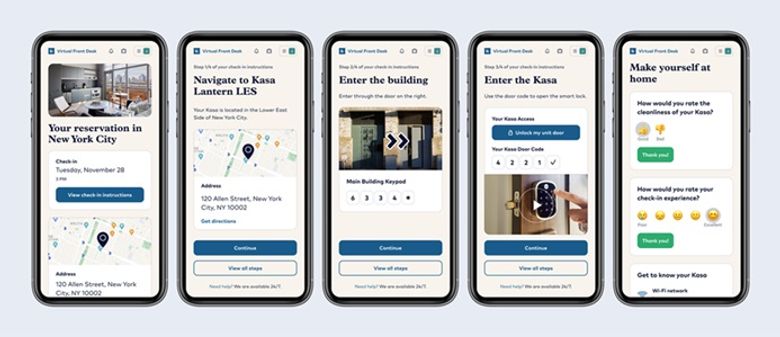
Kasa virtual front desk screenshots
“The problem we’re solving for owners is the tyranny of
costs that have gotten out of hand for a lot of them,” Kasa Living Founder and
CEO Pedan said. “It’s a combination of taxes that are growing because
municipalities are underwater, insurance costs that have been growing across
the country, debt service that has ballooned in the last few years, and then
the labor costs have really increased. We solve labor costs for them in a
meaningful way. We also solve with the digital delivery of a guest experience.”
He added that buying into the model requires a leap of faith
by owners having to lean into digital and a self-guided guest experience. “It requires
a little bit of capex investment. It’s not a lot, but it requires a bit of capex,”
Pedan added.
Pedan, now 36, said his learnings at KKR resulted in understanding
the need to do one of three things to every property-level line item – either
automate it, centralize it or eliminate it.
For example, on-site accounting costs are often quite high,
especially at smaller properties and still meaningfully impacts margins at
bigger hotels. Kasa has centralized accounting at all properties. There are no
night auditors, and by centralizing the data and functions, it started to
automate as much of the reconciliation process as possible, systematically
making accounting more efficient.

Kasa Living Founder, CEO Roman Pedan
They also removed the need for a 24/7-staffed front desk.
The staff that is there is focused overnights on what Pedan calls “proactive
hospitality.” They even share front desk staff across multiple properties.
As for housekeeping, Kasa typically cleans once per stay.
For example, at a 75-key hotel with between 15 and 20 staff
members, the Kasa model reduces FTEs closer to eight, according to Pedan, some
full-time and others part-time. “We can scale that down even further, and that
would be without compromising on service,” he said. “In fact, in some ways we
are enhancing it because we have people more proactively handling customer,
guest experience, and obviously halving the labor costs greatly improves the
bottom line.”
Kasa to-date
So far, Kasa Living has raised $125 million through three capital
raises and has a mix of almost 80 hotels and apartment-style products open. In
2024, Kasa opened 33 properties and Pedan expects to pace similarly in 2025.
The Series C fundraise closed in October 2023, adding $70
million with Citi Ventures and FirstMark Capital leading the all-equity round
with participation from new investors New York Life Ventures and Fireside
Investments. All major existing investors, including RET Ventures, Zigg Capital
and Ribbit Capital, participated in the twice upsized and oversubscribed C round.
The model is not unlike Sonder, but Kasa Living operates
only with hotel management agreements and does not take master leases on the
properties.
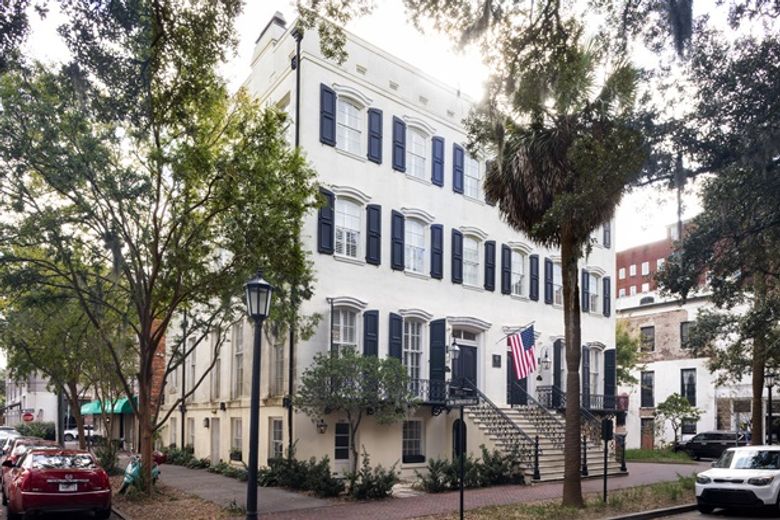
Kasa Jules is located in the heart of Savannah, Georgia's Historic District
Kasa has three inventory types – apartment, apartment style
and hotel style. Within apartment style, Kasa sometimes runs the entire
building or a portion of the spaces – usually on dedicated floors that are
zoned and licensed as hotels. Pedan said today about 60% of their inventory is apartment
style (about one-third are full buildings) and 40% hotel style at 10- to 250-room
boutique hotels in major urban markets.
Kasa has 20-some hotel-style properties in high labor
cost-markets such as San Francisco, Los Angeles, San Diego, Miami Beach, New
Orleans and New York City. “The value we drive for the owner, fundamentally, is
lowering the cost of operating the properties while delivering a compelling
guest experience,” Pedan said. “We soft brand those properties, for the most
part. So, they retain their local identity. We just opened at the Frenchman in
New Orleans as the Frenchman by Kasa.”
Among 2024 openings, about six were new development projects
in markets ranging from San Diego to Athens, Georgia, and Austin, Texas.

We’re solving an acute problem for owners whose costs have gotten too high. We have clear data demonstrating improved margins and reduced cost structures. That’s a need I don’t expect goes away in the next few years.
Roman Pedan
Systemwide,
Pedan said Kasa currently has around 2,400 keys open and another 350 signed. He
added that they roughly doubled their inventory in 2024 and have an even
stronger pipeline going into 2025.
While most all deals are strict management contracts, Pedan
said he is excited about another iteration of the brand called Powered by Kasa,
which is more like a franchise for owners building their own brand or a unique
boutique-style asset with a specific vision on the site experience who also
understand how costly it is to build a management business. Powered by Kasa is
a white label brand that includes all Kasa infrastructure technology and
services.
Pedan said Powered by Kasa started when Starwood Capital had
a vision for a brand in the furnished apartment rental sector and started
operating it themselves using off-the-shelf systems. “They’re obviously
extremely good at operating hotels,” Pedan said. “Apartment hotels are a little
bit of a unique beast. We took over operating those under their brand and
improved the revenue and review performance by a significant amount. We have
since launched Powered by Kasa with four other properties or brands. It started
with three properties and we’re opening three more in January.”
Looking further ahead, Pedan said the apartment hotel side
of the business will be the most dominant force for growth. “There’s not
enough of the product, and consumers really want it,” he said.
In the near term, however, he expects growth to be more evenly
split and perhaps slightly more in favor of hotels. “And the reason? We’re
solving an acute problem for owners whose costs have gotten too high,” Pedan
said. “We have clear data demonstrating improved margins and reduced cost
structures. That’s a need I don’t expect goes away in the next few years.”
Bottom line, Pedan said Kasa Living is close to
profitability and would be profitable if R&D was excluded. But for the moment,
he said, R&D remains crucial to their growth and success.
“We’re excited about the opportunity to lean into artificial
intelligence. If you close your eyes and imagine hotels 5 to 10 years from now,
you can expect a lot more automation driven by large language models. For us,
that means even more efficiency and customer service, even more
personalization in the experience.”