An
executive discusses the appeal of Houston, being in a World Cup market and
what’s changing in M&A right now.
HOUSTON — The term “value-add”
can take a lot of different forms in hotel investment. In the case of Partners
Capital’s acquisition of an extended-stay Hilton hotel in the Houston area that
was announced Tuesday, it means updating an already high-performing property.
Partners acquired the 162-key
Homewood Suites by Hilton – Houston Galleria on Tuesday from Warwick, Rhode
Island-based Magna Hospitality for an undisclosed amount. Adam Lair, managing
director - hospitality investment strategy for Houston-based Partners Capital,
said the hotel will have multi-million-dollar renovations after the World Cup
next year.
“We tend to identify value-add
in this space as one of two things: a capex ROI, or some kind of operations
ROI. I don’t think here it was the latter,” he said. “Magna did a good job.
They know what they’re doing. But it’s coming up on an 18-year PIP. In addition
to the PIP, it needs some modernization of building systems, and so there are a
lot of things we can do, both from a guest-facing perspective and from the
perspective of making it an attractive box to an end investor to add value to
the property.”
Lair said there’s a lot to like
about the brand, the property (which already boasts an 84% occupancy rate) and
Partners’ hometown market.

[Houston] has high barriers to entry. There’s no real prospect of new supply. There’s not a ton of competitive, extended-stay supply and then to be able to refresh this product, make it something relatively new to guests, and then get a full 15-year franchise term. It was really attractive to us.
Adam Lair
“You’re talking about Homewood
Suites being probably one of the top two or three flags that that we would like
to pursue,” he said. “[Houston] has high barriers to entry. There’s no real
prospect of new supply. There’s not a ton of competitive, extended-stay supply
and then to be able to refresh this product, make it something relatively new
to guests, and then get a full 15-year franchise term. It was really attractive
to us.”
Lair said Partners started
talking to Magna in the spring about the property, which was previously under
contract, but the deal fell through. Magna was previously managing the
property, which will now be managed by Raleigh, North Carolina-based Concord
Hospitality.
“We caught wind of it through
the broker and luckily were able to step in and put the deal together,” he
said. “It was fairly quick in terms of our typical due diligence and closing
timeline.”
Partners’ headquarters is less
than a mile away from the property, which meant the company already knew the
area well, Lair said, which is typical for the type of deal they like.
“Our value proposition is that
we tend to invest in areas where we have an intimate knowledge of the market
and it certainly helps that our larger umbrella company is a commercial real
estate brokerage, primarily, so we’ve got boots on the ground,” he said. “We
still have to do all the normal due diligence, but it’s helpful in the sense
that when we identify a deal like this that we really like and checks all the
boxes for us, we can move really fast and step in and get it done.”
This is the third acquisition
for Partners Capital Hospitality Fund I, which launched last June. The fund’s
first acquisition was a Hilton Garden Inn San Marcos in Texas, followed by the
Courtyard Marriott-Atlanta Buckhead in Georgia in March. Lair said there’s room
for one more hotel purchase in the current fund and then Partners plans to move
to a new fund. This acquisition gives the company a portfolio of three
hospitality assets.
Another appeal for the property,
Lair said, was a maximum 15-year brand commitment from Hilton.
“It’s not necessarily that we’ll
hold it for that entire term, but what we’re always looking for is a maximal
investment from the brand,” he said. “We would have a big red flag if
we saw something in the 10-year range from a brand commitment. We want to see
that the brand is as invested as we are.
“We may only hold that asset for
five years… but we’re in the business of creating value. So when we sell it to
the next user, hopefully we’ve created a better product than we took over.”
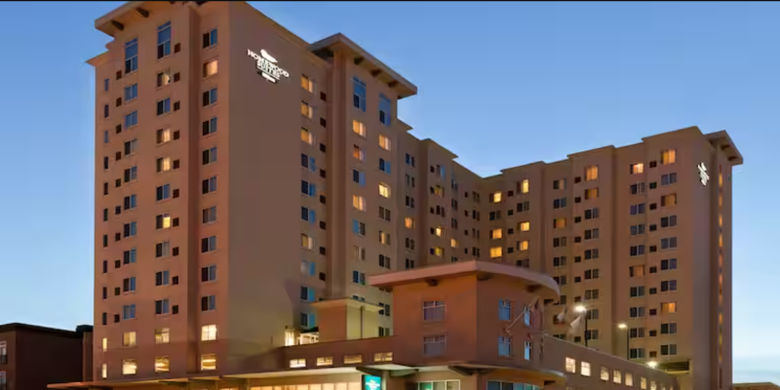
The Homewood Suites by Hilton – Houston Galleria was built in 2006,
While Lair wouldn’t disclose the
price, he said Partners feels good about the basis.
“It’s reflective of where the
Galleria market is now,” he said. “To get what I would call an institutional
grade Homewood Suites, for the basis that we got it for, it gives us good
confidence that we have a margin of safety.”
There isn’t enough time before
the World Cup for renovations to happen to the property, so Partners will wait
until after the event (Houston is hosting seven games) and before the city
hosts the Republican National Convention in 2028.
While the World Cup isn’t the
main draw for the property, Lair said the company had already done its research
on the event when it bought the property in Atlanta and likes the hospitality
draw of the event.
“We like markets where there’s a
slate of events that we know that we’re not really going to have a fallow
period in the market,” he said.
Despite some tough comps for the
Houston market this year, Lair said Partners is bullish on the city’s prospects
long term and the top markets in Texas in general.
“We’ve been looking at stuff in Houston all year. I
think after as strong as last year was, we felt like the market had some
institutional interest,” he said. “For us, it’s not as much a matter of looking
at 2025, it’s really the long-term prospects of the market… We’re always
going to follow what the demographic trends are and you can’t discount the
degree to which Houston has grown demographically over the past few years…
That’s going to drive demand, especially in a situation where you don’t have a
ton of supply.”
The current M&A
market
Despite Partners’ two
acquisitions this year, Lair said the M&A environment right now is tough.
“It goes through waves, and it’s
dependent on what’s going on with the macro economy… there’s a lot of
uncertainty out there,” he said. “The thing that’s changed for us this year is
we’re seeing better product. It’s maybe not more product, but it’s certainly a
better quality of product.”
Lair attributes this to more
owners having to make selling decisions.
There’s a lot of uncertainty out there. The thing that’s changed for us this year is we’re seeing better product. It’s maybe not more product, but it’s certainly a better quality of product.
Adam Lair
“We’re seeing situations where
people who own high-quality assets are being forced, maybe not a distressed
situation, but are being forced to sell by just the timing or whatever their
capital situation is,” he said. “So we’re slowly inching into a more favorable
position for buyers like us who are in that quasi-institutional space.”
While he thinks the M&A
market is slowly improving, he isn’t optimistic about big changes for the rest
of this year, especially with tariffs and a trade war still looming.
“It’s clouded by uncertainty. If
you’re in this space, you have to admit it’s headed in a better direction, but
it’s incremental,” he said. “I know we all go to these conferences every year,
and everybody’s like, ‘Oh, the next six months are going to be great.’ But it’s
not going to be the next six months.
“I wouldn’t be surprised if we
talk a year from now and we’re both saying that the market has improved
dramatically… but it’s certainly not going to be soon.”