Fresh
off its acquisition of Locale, Mint House CEO Christian Lee discusses why the
deal was a good fit, the stakes in an early-stage hospitality space and how
international clients could help the company grow.
NEW YORK CITY — Residential
hospitality provider Mint House has acquired one of its competitors,
Austin-based Locale, for an undisclosed amount, which Mint House says deepens
its presence in key markets and helps it expand into new ones.
CEO Christian Lee told Hotel
Investment Today the deal was complimentary for New York City-based Mint House.
“Everyone recognizes that scale
is important, but for us, it was really important that we get the right kind of
scale and that there was a good amount of market overlap, so we could really
drive efficiencies at the market level but then add a few new markets and some
new pipeline that that we didn’t have.”

From a property perspective, it is a substantial increase.
Christian Lee
Lee said the deal expands Mint
House’s presence in markets like Nashville, Dallas-Fort Worth and Washington,
D.C. and expands into new markets like Menlo Park, California; Madison,
Wisconsin; and Phoenix. Locale’s properties will be rebranded and integrated
into Mint House’s portfolio, which will now have 22 properties in 13 markets.
“From a property perspective, it
is a substantial increase,” said Lee, who didn’t disclose the total room count
for the combined company but said it helps Mint House grow by roughly a third
on the unit side.
Lee didn’t disclose the amount
for the acquisition but said it was a cash and stock deal and that Mint House
and investors are supporting it with some incremental capital. He said the deal
was not only a complementary real estate footprint but also a good fit from a
cultural standpoint.
“They have stayed focused on
apartment residential hospitality in premium apartments, the same way we have,”
he said. “When we spent time with that team, we’re coming at this from a best
of both approach. They’ve driven an efficient operating model…. [combined] with
the commercial engine that we’ve been driving. When we bring that together… the
combination was going to be value additive for everyone.”
Mint House works with
multifamily owners and developers and signs a management agreement to operate
inside some portion of their properties (anywhere from 10% to 100% of the
building). Lee said Mint House operates in the upscale to upper upscale hotel
segment space as an alternative for an affluent traveler looking for something
more than a hotel. The company’s original founding premise in 2017 catered to
younger corporate clients, but during COVID, the company discovered a much
larger opportunity.
“Even as you saw a lot of hotel
occupancy go down, companies like Mint House did very well, and that opened the
company’s eyes to the fact that there was a big corporate demand, but also a
leisure demand,” he said.
Now Mint House gets
approximately 40% of its business from corporate travelers and the rest from
leisure or bleisure clients.
“[Corporate] was the core focus
and it has now expanded out. It gives us a unique angle on it,” he said.
“Because instead of starting from leisure travel and trying to go to corporate,
we started from corporate and went to leisure. It has proved to be a bit easier
to provide that kind of consistent service. If you can meet those needs of the
large corporate customers, then it’s a good bet you can meet the needs of
different leisure travelers.”
Growth potential
The residential hospitality
space is still in its early days, Lee said.
We think that we could easily get to over 100-plus [properties]… in the next few years just because there are a lot of multifamily properties coming online. We see an increasing demand for this type of product and we’ve had lots of conversations with different types of folks.
Christian Lee
“We see the real demand for this
managed type of product, and we know that multifamily owners, especially in
markets where there was a lot of growth post-COVID, are looking for ways to add
value to their properties and NOI. There’s a long runway ahead of us,” he said.
“We see a lot of growth over the next five years. We’ve barely begun to scratch
the surface of the opportunity in this [space] longer term.”
Lee said the Mint House has a
robust pipeline of properties that the company hasn’t disclosed publicly yet as
it negotiates with multifamily operators (the company has announced two
upcoming properties in Nashville and Washington, D.C.). He sees an opportunity
for the Mint House to rapidly expand in the coming years.
“We think that we could easily
get to over 100-plus [properties]… in the next few years just because there are
a lot of multifamily properties coming online,” he said. “We see an increasing
demand for this type of product and we’ve had lots of conversations with
different types of folks.”
While much of Mint House’s
portfolio is in major markets, Lee said he also sees plenty of growth
opportunities in secondary markets. He brings up Greenville, South Carolina as
an example.
“It has a very robust corporate
sector between the car companies and a lot of the companies that support that.
It’s also a very big local tourist destination,” he said. “There are lots of
markets like that that have this mix of corporate demand as well as local
leisure demand. We think that those types of markets are very interesting for
us.”
Mint House’s growth is
asset-light and the company relies on technology, which is not a robust
staffing requirement. Lee said 2024 was a strong year for Mint House and the
company sees continued growth into 2025. He sees lots of organic growth
opportunities, especially with international customers.
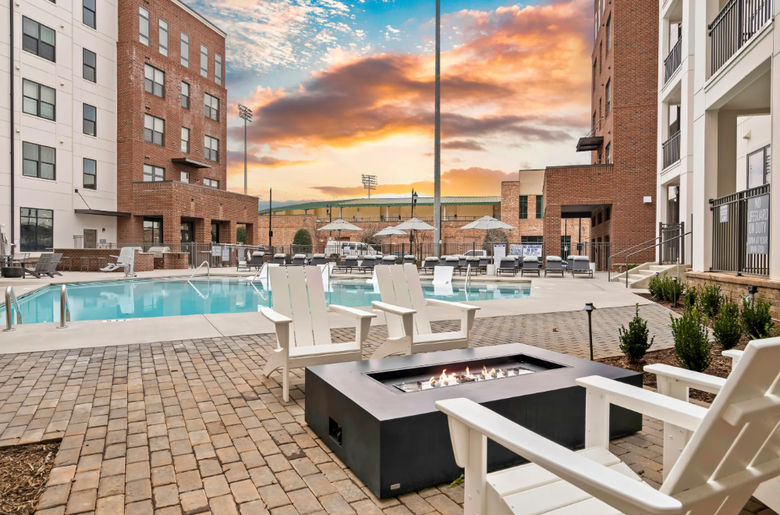
Mint House has two locations in Greenville, South Carolina.
“We’re seeing a pretty
substantial amount of international travel coming in and we expect that to
continue,” he said. “We see that as another big area for growth.”
Mint House’s customer
acquisition is about 50% for OTAs versus direct booking, with OTAs being the best
way to drive customers to new properties.
“That’s
the best way to get the word out there about the property,” he said. “What we
then tend to find, especially as we bring on corporate customers, but really
anyone, is [we get] repeat business. Once they find it, they tend to say.”