CEO
Randy Hassen discusses his 34-year career with the company, why the third-party
manager continues to grow, and what makes him optimistic for the second half of
2025.
TAMPA, Florida — Randy Hassen
has McKibbon Hospitality in his blood. In fact, he's never worked
anywhere else.
Hassen started with McKibbon in
1991 as a part-time houseperson (a jack-of-all-trades position) at the Days Inn
Athens and has worked for Tampa, Florida-based third-party hotel manager McKibbon Hospitality ever
since. He became CEO in 2022 as part of a restructuring for the family-owned
McKibbon Hotel Group, which also includes McKibbon Places (which handles hotel
renovations), McKibbon Equities, and the McKibbon Family Investment Fund.
Hassen said one of the things
that differentiates McKibbon in a crowded third-party management business is
the company's ability to retain talent at every level of management.
"A lot of those individuals
have been homegrown. They've got great tenure, great brand knowledge and great
market knowledge," he said. "In our select-service world, it is very
much a boots-on-the-ground, street corner sales business, which means being
active in the community, knowing the business players in the market, getting in
touch and having relationships with [the community]."
Retaining talent can make a big
difference for a company like McKibbon Hospitality, especially when servicing
its portfolio.
"Our stability and lack of
turnover at the corporate level, the GM level and the sales level helps us get
into a market, maintain and build and grow on those relationships. Whereas what
I see from companies that are either our size or larger is that they tend to
have more turnover and don't quite have the relationship depth."

There are some management companies that would try to skimp on costs. We're not a low-cost model. We're not trying to compete on costs or be a commodity and that shuts us out of a lot of [business] compared to companies that are willing to manage hotels for less of a percentage.
Randy Hessen
Hassen says that also includes
not skimping on costs or lowering percentages to chase new business. He said
the company prefers to grow organically through its current collection of
owners.
"There are some management
companies that would try to skimp on costs. We're not a low-cost model,"
he said. "We're not trying to compete on costs or be a commodity and that
shuts us out of a lot of [business] compared to companies that are willing to
manage hotels for less of a percentage."
Hassen said he's okay with not
chasing new business, mainly because of what it would mean to the hotels the
company already manages.
"If I were chasing new
business for less than I was charging existing business, that would create some
issues in and of itself," he said. "Just as we try to do with our
hotels, we try to maximize and protect the margins; we've been very protective
of the management company because it has fueled the growth of the development,
and it's been the engine that keeps everything going."
He used this analogy with the 50
new employees he talked to at the opening of Hilton Garden Inn Orlando I-4
Millenia Blvd Mall, which McKibbon added to its portfolio on Tuesday.
"I told them my main goal
is that if you're starting with us as a houseman today… if you have the work
ethic and the drive and the desire and you want to grow your career with
McKibbon, you have the same opportunities that I had 34 years ago," he
said. "There's even a better possibility of it happening today than it did
for me because we've got a more solid foundation to grow upon."
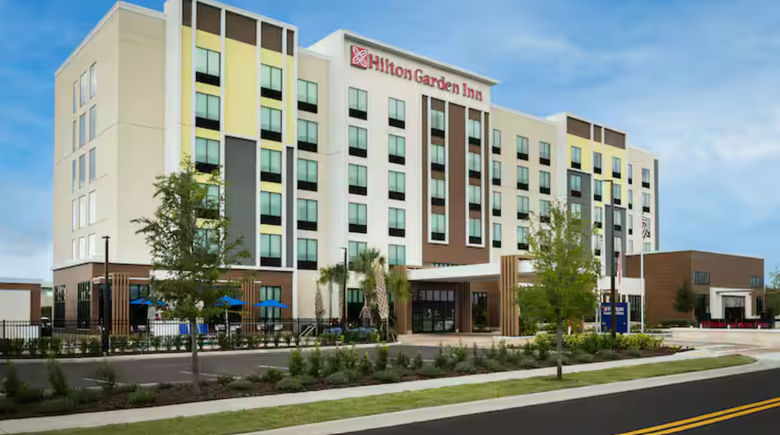
The Hilton Garden Inn Orlando I-4 Millenia Blvd Mall is the latest addition to McKibbon Hospitality's portfolio.
Growing the
portfolio organically
The numbers ebb and flow, but
currently, McKibbon Hospitality has around 100 hotels in its portfolio, with 12
projects in its active pipeline that are expected to open within the next six
months. The company recently added a Moxy in Asheville, North Carolina and will
add another Hilton Garden Inn in Cape Canaveral, Florida, in September.
McKibbon Equities is the
majority owner of 21 of those hotels, and Hassen says the company works with 20
ownership groups that are at every stage of the cycle, with Atlanta-based Noble
Investment Group having one of the largest numbers of properties in the
portfolio. Richmond, Virginia-based Apple Hospitality REIT is also an active
owner.
The company doesn't have a
specific target number for growth, Hassen said, but plans to continue growing
organically by adding properties that its ownership groups acquire.
"We've never really had an
active business development pipeline and had a strategic focus on growing
third-party," he said. "We have looked internally at how can we grow,
and our philosophy is if we operate great hotels… then the hotels are going to
perform well, and owners are going to re-up the contract or hire us for
additional projects. That's exactly how we've grown, certainly in the time I've
been here."
Geographically, McKibbon's
portfolio is primarily located on the Eastern Seaboard, with most of its hotels
situated in Florida, Georgia, North Carolina, and South Carolina. It also has
properties in Alabama, Tennessee, Virginia and as far away as Chicago and
Denver, but Hassen said most of the growth will be in the areas it already
operates. He said he would love to be in markets like Nashville and would love
to continue growing in Atlanta and Charlotte. McKibbon also has a good presence
in Asheville.
Hotel performance
Hassen said in terms of hotel
performance, McKibbon is mainly growing through occupancy right now.
"Government is certainly
down. Some of the transient leisure is down. Some of the trends nationwide
certainly are affecting our entire portfolio," he said. "There's a
little bit pinch on discretionary travel and all that, so, but the markets that
are heavy government travel have been impacted greatly."
Transient occupancy is
marginally up, Hassen said, but with ADR remaining flat, the company has still
been able to grow RevPAR and margins; however, it's not easy.
"It's one of those areas
from a hospitality standpoint, it's hard to sustain strategically," he
said. "We are looking for ways to continue to focus on mix, improve RevPAR
through ADR growth and help improve those margins as well."
About 20% of McKibbon's company
hotels are in Asheville, a market that is still recovering from the devastating
effects of Hurricane Helene last year.
"Year to date, if I exclude
[Asheville], the numbers are better, both on occupancy and ADR growth,"
Hassen said. "There is a huge asterisk because Helene is still having a
huge effect on Asheville eight months later."
Government business, which
roughly makes up about 10% of McKibbon's total revenue, has been down by double
digits this year, probably 15-20%, Hassen said, due to cuts. In some markets,
that percentage of government business has decreased by 25-30%.
"Where we're heavily
dependent upon it and haven't had a backfill. It's been challenging," he
said.
We're getting to the finish line. It's just a little bit slower than we'd like to have on the books and we can't be as aggressive with the rate in that situation; we're more focused on backfilling with discounts. It doesn't seem like the on-the-books demand is as strong as it has been in the past.
Randy Hessen
But Hassen said he sees many
signs of optimism for the rest of the year, especially in group.
"It looks to be good in the
markets where we're more group-driven," he said. "What we're seeing
on the transient side is the window is getting smaller. We're not having the
transient bookings further out as we typically would have, which tells me
people are a little bit more leery about committing to travel. However, when it
arises, it appears that last-minute bookings are exceeding our expectations.
"We're getting to the
finish line. It's just a little bit slower than we'd like to have on the books
and we can't be as aggressive with the rate in that situation; we're more
focused on backfilling with discounts. It doesn't seem like the on-the-books
demand is as strong as it has been in the past."
F&B is another reason why
margins are increasing at McKibbon's hotels, and Hassen said the company has
invested significantly in the corporate F&B side to create restaurants that
cater to the community, even more so than hotel guests. He said for the model
to work, the majority of restaurant traffic (in the 60-65% range) needs to come
from outside the hotel.
"Overall, we [want a
restaurant] to feel like what the locals want to come to and have that reach
and not have the stigma of being the hotel restaurant," he said.
Overall, Hassen said McKibbon's
asset management team and CFO have done a great job ensuring the companies have
the reserves to undertake PIPs, especially since many of its hotels were
developed in the mid-2000s and are nearing the end of their licenses.
"We look to how
[renovations] are going to serve us and serve the investors of that hotel for
another 20 years. To do that and do it competitively in a market where new
competition is still coming on board, the product has got to be there," he
said. "We're not looking to cut corners and skimp on a renovation.
We're going to make sure these hotels remain competitive for the next stage of
their license."