As third-party managers jockey for positioning, what are the
opportunities and potential pitfalls? Noble Investment’s Mit Shah offers an
insider’s perspective.
ATLANTA – The third-party management space has captured a lot of
headlines in 2023 with everything from mergers and acquisitions, boasts about
boutiques offering more personalized services, moves to grow more outside the
U.S., and more recently a change at the top of the world’s biggest management
company, Aimbridge Hospitality.
The news begs the questions: what does this activity mean
and where does the third-party space go next?
To gain some perspective, Hotel Investment Today talked to
Mit Shah, CEO of Atlanta-based Noble Investment Group, which is now investing
$300-400 million a year in equity (about $1 billion in hotel assets) and had its own lengthy history in the
third-party space. It both owned and managed assets for several years before
merging its management platform in 2011 with then-Interstate Hotels &
Resorts, where now outgoing Aimbridge CEO Mike Deitemeyer took over in 2017.
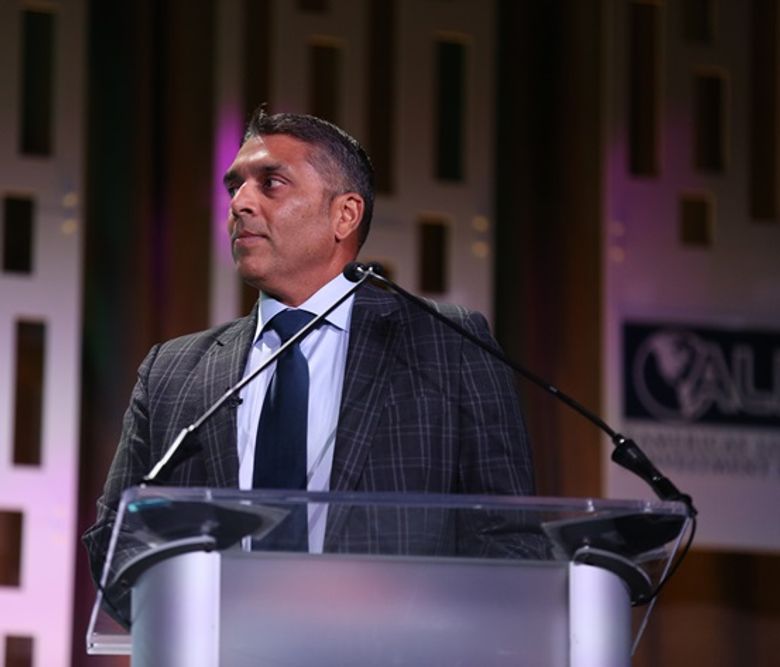
Mit Shah speaking at ALIS
We asked Shah about the state of competition in the
third-party space, whether bigger is always better, pressures on the
third-party model and even where he thinks Aimbridge might be headed next.
Hotel Investment Today (HIT): The word on the street is
perhaps Aimbridge Hospitality grew a bit too fast in its quest to go public,
especially when you consider having to also manage through a pandemic and now a
capital crunch. What’s your take as it makes changes at the top?
Mit Shah: What Aimbridge has is the ability to be big and have
that entrepreneurial spirit on a local basis. Part of their acquisition
strategy was to acquire management companies that had that DNA at a local
level, and then use that DNA as a collection of companies to the benefit of
their owners.
It has been in the process of syncing up all the technology
and all the toolkits that allowed that to actually happen. What I’d say is that
no organization is perfect; we have some really good assets with them and some
that continue to need improvement. But that’s the case with every management
company.

If you have a larger platform to draw resources from, that just helps make hotels more valuable.
Mit Shah
I actually do believe that a company of that size, once
fully integrated with the ability to invest in technology in a meaningful way
that has not been done before [among management companies], and the ability to
attract world-class talent, which I think they would have the ability to do –
and I like a lot of their existing talent – there’s a place for that kind of
company in our industry… If you have a larger platform to draw resources from,
that just helps make hotels more valuable.
For Aimbridge, they’ve just been growing at such a clip, and
then you had the pandemic and a lot of other stuff that’s going on, but the
model still works.
HIT: So, is Aimbridge just experiencing growing pains?
Shah: It’s normal integration, and growing pains on top of a
global pandemic and the immense amount of time, effort and energy that went into
either keeping hotels open and afloat, or to close them and then to reopen them
– all of that is just painful for all operators. And with that kind of scale,
culturally, it sets you back.
You just have to acknowledge that all of these hotel
operating organizations – and everybody in the industry – went through pretty
significant ordeal. Now we find ourselves in a place where there’s substantial
need for capex, demand has come roaring back, there are capital market issues
as it relates to servicing debt for a lot of owners… There are just a lot of
challenges that can take place.
Going through a tremendous growth phase with a plan to build
this big company – forget about whether it was public or private – Aimbridge is
a company with scale and resources. And Mike [Deitemeyer] was really fantastic.
He got it. He was a very good leader at that time… Now they have a search going
with Steve Joyce playing an interim role. He knows how to take organizations
and help make them better. That’s his MO…
But it’s a big job because talent is at a premium… They don’t
have a ‘competitor’ from a size standpoint, but they have a bunch of smaller operators
that do a good job. It’ll be interesting to see what happens going forward.
HIT: Is the moral of the story ‘bigger isn’t always better?’
Shah: That is an appropriate question in all types of
organizations. You have those that are small and may call themselves nimble and
sharpshooters. They approach things in a very deliberate, dedicated way, and
you know who you’re dealing with. But they lack the scale and the resources
that oftentimes really are required to go from one point to another.
If you look at our space with the Blackstones and Brookfields,
some will say that scale matters because they have knowledge, can attract
capital and talent. They focus on things that others cannot. And that’s all very
true; they have become the index.
You have meaningful capex and nothing has been spent. So, those third-party operators will have a real challenge because hotels will start going into red zone status. There’s just a lot of pressure.
Mit Shah
In hotel management, both can also be true. We utilize
smaller operators to focus on local geographies, and they have a unique ability
to create alpha with us in those areas because they can attract really good
talent. McKibbon Hospitality [Tampa, Florida] is a good example. We use them
for all of our Florida hotels and their ability to attract talent is really
good. Their ability to focus on the details is really good, and they have
enough scale and resources to bring to bear. But we wouldn’t take them out to
San Diego or Seattle. That’s just not them.
So, what Aimbridge has is the ability to be big, but also
have that entrepreneurial spirit on a local basis.
HIT: What kind of pressures are third-party management
companies facing?
Shah: Hotels are made to be built, create income streams and
be sold; or to buy, fix and sell.
For Aimbridge, they were losing a number of hotels a year.
From a growth standpoint, you have to not only fill in the number of hotels
that you’re losing, but you also have to add on top of that. That is a hard
endeavor. That’s the difficulty of the third-party model… They’re not always losing
hotels because they’re bad operators, but because hotels trade hands and maybe
there’s another scenario that’s taking place.
Also, how do you continue to add talent when you’re losing
assets, and also growing assets? That’s a little bit challenging, right?
HIT: Are there pressures between brands and operators?
Shah: I don’t really see a rub between the brands and the
third-party operators. They need one another. The brands require third-party
operators to continue to promote the integrity of the brands and their performance.
The real issue is that what the brands do with all the capex
that’s really required. After the GFC (global financial crisis), capex spending
dropped 40% because people needed to pay the lender. Everybody used every bit
of FF&E reserve and liquidity to do that – and it took five years for capex
spending to return, and that was at 0% interest rates.
Today, post-COVID, that number in terms of capex spending
dropped 80% – double what it did during the GFC. So, how long does it take to
come back now? Not only do you have some PPP loans that need to be repaid, you
have 75% loans that don’t size to anything more than maybe 50% to 55%. You have
meaningful capex and nothing has been spent. So, those third-party operators
will have a real challenge because hotels will start going into red zone
status. There’s just a lot of pressure.
But [Aimbridge majority shareholder] Advent International is a very strong PE shop and has put together some really good talent on the board. I bet on them to go and figure it out.
Mit Shah
It's kind of hard to run a hotel that is running 75% to 80%
occupancy, needs a big renovation, the owner doesn’t have the capital, and you’re
just not able to drive market share, rate, and all those kinds of things that they’re
supposed to do. That’s probably the other challenge that third-party operators
are going to have. That’s not a fun job, right?
HIT: What happens next for third-party operators?
Shah: Leadership matters.
The big challenge for Aimbridge right now is that it’s not
clear and obvious which leaders have the operating acumen that cannot only pull
all these separate companies together from a cultural basis and be
entrepreneurial on a local level, build out technology platforms, etc. It’s not
like you sit there and say, ‘Oh, my gosh, there’s five people that could do
that job tomorrow.’
But [Aimbridge majority shareholder] Advent International is
a very strong PE shop and has put together some really good talent on the
board. I bet on them to go and figure it out.
HIT: Will there be more third-party consolidation?
Shah: Maybe. The market got really frothy in terms of the
multiples people were paying, and now the multiples are kind of back down to
mid-single digits. So, maybe, and probably more out of necessity than greed.
HIT: There has been a rumor circulating about Highgate
potentially being interested in Aimbridge. Any thoughts?
Shah: I would never sleep on Mahmood Khimji [co-founder and
co-chairman of Highgate]. He’s one of my very best friends in the entire world,
and he is as strategic and as thoughtful as they come. He has a really great
company. So, yeah, I would pay attention to them.