Ben Campbell, the new CEO of Hospitality America, talks about
growth in tertiary markets and attracting smaller fish for bigger goals.
GREENVILLE, South Carolina —
Is there a sweet spot for a “mid-major” size third-party hospitality management
company? Hospitality America CEO Ben Campbell thinks that number is in the 25
to 40 range.
He
said hotels managed by larger companies have approached his company in the
past. They tell him they like the company’s resources and procurement power but
ultimately feel like a number on a spreadsheet. He said he’s also heard from
hotels managed by much smaller companies that don’t have the power of the
bigger companies.
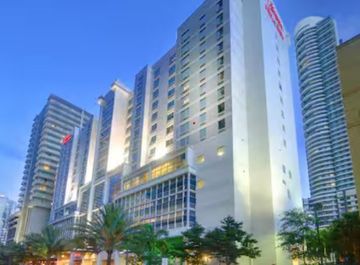
Hospitality America has a speciality of managing Hampton Inns in urban cores like the Hampton by Hilton Miami Brickell.
“They
see value in us as a mid-major company to be able to play in both fields,” he
said. “That’s what I tell a lot of our owners all the time: you can use our
expertise but also get your individualized attention. All of our owners can
pick up the phone and call me at the drop of a dime, and we will focus on the
property.”
Campbell
transitioned to the CEO role for Greenville, South Carolina-based Hospitality
America after spending the past two years as COO.
Hospitality
America currently has a portfolio of 17 hotels, but it will have 19 by the end
of the year and 25 by 2025. Ultimately, he wants the company to reach 40 in
five years.
Where it wants to grow
Hospitality
America currently works with five different ownership groups in Chicago;
Washington, D.C.; Greenville, South Carolina; Northwest Arkansas; and Miami.
Campbell said in the past, the company has specialized with Hampton Inns in
urban settings.
“It
really comes down to our development partners. They have a keen eye on how to
make a project like that happen in an urban setting,” Campbell said. “Then, for
us, it’s execution from an operations standpoint. We’ve been able to help with
the site selection and [finding out] what hotel will work and where and why.”
Campbell
said Hospitality America is now looking to grow in more tertiary markets (think
second or third-tier markets on the rise — the company’s biggest pipeline
is now in Northwest Arkansas). He would also like to be in Texas and Ohio. But
he isn’t looking at the biggest markets.

We’ve found a niche with owners and new developers who may have been in multifamily or office and are looking at hospitality but haven’t done it before and are looking to get into it. It can be intimidating. We help them through the process.
Ben Campbell
“We
like to play more on the fringe and then ride a market that we think is on the
rise,” he said.
Campbell
said his company has worked successfully with owners with other real estate
experience and now looking for their first hospitality investment.
“We’ve
found a niche with owners and new developers who may have been in multifamily
or office and are looking at hospitality but haven’t done it before. It can be intimidating,” he said. “We help them through
the process. We have it lined out from A to B, even on the acquisition side,
and then we’ll do the underwriting.“
Hospitality
America was founded in 1995 by its two owners, Bo Aughtry and Chris Cargen, who
recently stepped down from the CEO role and assumed the newly created position
of board chairman.
Campbell
said Hospitality America will have equity stakes in the hotels they manage,
ranging from 1% to 10%.
Attracting smaller fish
Campbell
said to mitigate the fact that business travel hasn’t fully returned to 2019
levels, Hospitality America is going after the “smaller fish.”
“We’re
going after the small corporations that are traveling. So, we’re not going after
the big fish in these markets, the Fortune 500 companies, because much of
their travel hasn’t returned,” he said. “Traditionally, in our industry, we
would say, ‘If they can’t give us 100 room nights a year, don’t give them a
contract.’ We are looking at those companies and asking, ‘Can we build a
coalition of these travelers to give us that base to replace the Fortune 500
businesses?’”
Catering to different hotel guests
Campbell
says the company’s core hotel guests are transitioning away from baby boomers
who were driving corporate business to millennials.
“That’s
why we are really leaning into the soft brands, making [the hotel] unique, and
looking for brands that can embed into the community. So, it doesn’t seem like
it’s your mom and dad’s kind of hotel,” he said.
He
also said the company leans on local experts in the markets when finding better
F&B options for its hotels.
“We’re
not standing up a restaurant or establishing a concept. What we do is find the
right fit for the hotel. So, we might find a restaurateur that is local to the
community,” he said. “We’re building a demand… We see it as taking risk off the
table by bringing in someone who already knows the market's clientele or
someone who has experience in entering a new market. We see it as a good play
for us to have the hotel side and for them to be able to scale their business
on the F&B side.”