CEO
Kyle Hughey said Charlestowne’s portfolio of mostly independent lifestyle
hotels focuses on experiential and specializes in F&B.
CHARLESTON, South Carolina — Charlestowne Hotels CEO Kyle Hughey said
the biggest thing he’s hearing from owners is to hold on to the way
things are right now.
“Over the last, say, five years,
coming out of the pandemic, they saw a nice uptick in revenues, and that
covered all sins,” said Hughey, who has been with the third-party manager for the last 10
years. “Over the last two years, it rebalanced with a reset of the labor
market… and now they just want to hold that. They’re in a good spot. Most
of our properties have been stabilized... They don’t want to go down and are happy with that.”
Charlestowne currently has a
portfolio of 60 hotels in 26 states across the U.S., with five in its pipeline. The company is funded through some members of the executive team and its Founder Everett Smith, who started the company 45 years ago.
About 45 of the hotels are traditional full management, while the other 15 use
the company’s revenue management or marketing services. Charlestowne’s portfolio
has a mix of independent, lifestyle hotels (with a few soft brands under
Hilton’s Tapestry collection) and 14 university properties. While the hotels
tend to be on the smaller side, Hughey said Charlestowne is comfortable
managing anywhere from 25 to 200 keys.
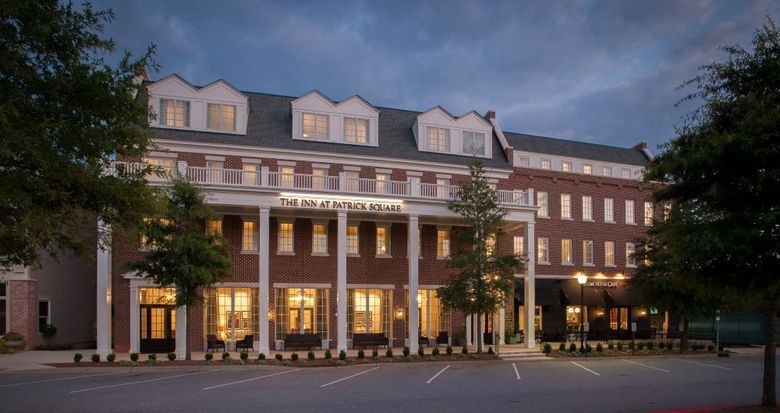
Charlestown added the Patrick Square and Granville Inn in Clemson, South Carolina earlier this year to its university hotels portfolio.
In general, Hughey said the portfolio's RevPAR in 2025 is up 3% to 5%, which is ahead of where most of the industry is right now.
But for the hotels whose
performance is down, Hughey said those owners are really pushing for ways to
maximize revenue.
“They’re pushing us as a
management company to really ideate and come up with new revenue streams and
to really squeeze out every dollar of revenue we can get,” he said.
Strength in luxury
Hughey said about a third of
Charlestowne’s portfolio is luxury (more in the 4-star or
4.5-star space), which helps drive the higher-than-average performance for the
portfolio.
“We’ve seen some good results
from those properties this year. We’ve been able to hold the rate,” he said.
“In the independent space, it’s all about experiential programming. We’re
layering that into our properties to bring value to that guest and that keeps
them coming back.”
A lot of the portfolio’s
business comes from leisure and smaller groups, Hughey said.
“We’ve learned to extend our
shoulders and give value to the leisure-transient guest and that’s allowed us
to fill the property and hold that rate,” he said. “Our group base has
been consistent in certain markets. We work with some Fortune 100 companies and
they’ve seen a little decrease, but we’ve been able to backfill with leisure
guests.”
There was a great expense reset
in the hotel industry in 2022-23, which needed to happen, Hughey said. Now,
Charlestowne has been able to go back to more traditional management of its
hotels.

We really flex on anything that’s variable. So if we see some efficiencies that can be done, we flex down labor in regard to our expense controls.
Kyle Hughey
“We really flex on anything
that’s variable. So, if we see some efficiencies that can be done, we flex down
labor in regard to our expense controls,” he said. “Our company, with our size,
we have some economies of scale… so that we can drive costs down where it
makes sense.”
Hughey said for hotels that
focus so much on experience, you can’t cut too deep.
“We’re trying to walk a fine
line. Luckily, our revenues held. So, we’ve been able to flex down and get
returns that our owners have gotten in the past and are expecting,” he said.
About two-thirds of Charlestowne’s
hotels include F&B, Hughey said, and the company tries to treat those
operations as standalone as possible. In fact, the company hopes 60%-plus of their business
is coming from outside the hotel.
“If we have a restaurant in a
property, or in a property we market, we have a standalone website…. There are
a lot of times people will come to our restaurants attached to our hotels and
not realize they’re part of the hotel,” he said. “That’s been a differentiator
for our company.”
Another important differentiator
for F&B is holding costs, Hughey said.
“In F&B it’s a slim,
razor-thin margin,” he said. “So, you really have to be ready to adjust costs or
change the menu.”
University hotels
Charlestowne has been managing
university hotels for the past 10 years. So, Hughey said the company sees itself
as an early adopter in an increasingly crowded space.
“We’ve learned a lot over those
10 years and we try to really meet the owners where they’re at,” he said. “If
you look at the college markets, they have, let’s call it, guaranteed demand.
But they’re having their challenges, too.”
This becomes yet another area
where the experience matters, Hughey said.
They’re generally the first stop for a potential student or potential faculty. So, we really elevate the experience because it’s their first exposure to that university. When they step into our hotel and realize that the university owns that hotel, we try to make a great first impression.
Kyle Hughey
“They’re generally the first
stop for a potential student or potential faculty. So, we really elevate the
experience because it’s their first exposure to that university. When they step
into our hotel and realize that the university owns that hotel, we try to make
a great first impression.
“It sets the tone for that
visit, especially with student-parents and we want to make them feel very
comfortable with the offerings and services we have because we know that
they’re going to be coming back to that hotel for the next four to five years.”
Hughey likes to project a slow,
organic growth model for Charlestowne, which ideally would like to add three to
five hotels a year, while naturally losing some hotels to attrition when
ownership changes. But that doesn’t mean they will take on just anything. In
fact, Hughey said the company often says no.
“We
take projects that fit within our lane where we know have proven success,” he said. “Unfortunately, we have to tell a lot of people no
because we don’t have the resources at that moment. If someone calls and says,
‘I need you to take over a property in two months.’ We’re probably going to say
we just can’t do it. We’ve committed our resources and we’re not going to back
off on those because we want to make sure that for every owner, we deliver what
we say we’re going to do.”