Tech-forward
Ben Rafter talks about opportunities in CALA, more deals and the importance of
embracing a tech-led platform.
NEW YORK CITY – New Hotel Equities CEO Ben Rafter says word
on the street is that management company business practices are stale. In the
next breath, he said the recent merger of his old Springboard Hospitality with
HE does create something different – a hotel operating company for the first
time run by a tech-forward executive with a heavy focus on revenue generation now
fused with an historical operating company. “If this isn’t reinventing a management
company, I don’t know what is,” Rafter told Hotel Investment Today during an
interview at the NYU investment conference earlier this week.
Rafter added that HE is going to get more aggressive with
growth, but not growth for growth’s sake, and mostly led by organic
opportunities.
They just hired Juan Corvinos to take advantage of the
potential that lies in the Caribbean/Latin America region (CALA) and Rafter
said they are looking for another acquisition if it fits the cultural and aligns
property-wise, which could mean a company strong in the soft brand space.
Yes, HE likes CALA because leadership brashly believes that
there aren’t many good third-party operators there. “I don’t think it’s easy to
manage if you’re trying to do it from the mainland U.S.,” Rafter said. “So, in
hiring Juan as president of CALA, having him build out a team that’s local to
either the Caribbean or Latin America, we think it's almost like a startup,
which obviously I love.”
With Corvinos working out of Miami and Mexico City, HE will
base several executives out of Mexico, with Rafter adding that they are hiring
selectively. He added that they are also hiring for the Dominican Republic and
other Caribbean countries, and they have former Trust executive Michael
Register on its development team for CALA.
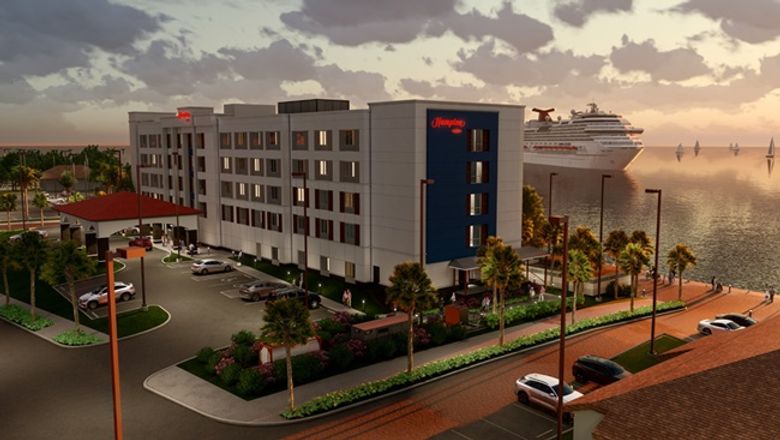
Hotel Equities has won management of the Hampton by Hilton hotel in St. Thomas, U.S.V.I.
“My mentality as a startup person is that’s how we like to
enter a new market [with boots on the ground] because it gives us flexibility, nimbleness
and entrepreneurship to grow under the umbrella of Hotel Equities,” Rafter
added.
CALA pipeline
At the moment, the CALA pipeline has more than a dozen
properties with 11 new-builds already started and set to come online. Rafter
added that HE could easily have 15 to 20 third-party properties in the region
inside a year.
An obvious opportunity is in the upscale and upper upscale all-inclusive
resort space, while HE also wants to build out an urban lifestyle business,
especially in Mexico and starting in booming Mexico City.
To convince and make owners more comfortable with their business
plan, Rafter also said they are investing in building out separate operating
structures for the resort and urban businesses.
Rafter is particularly excited about the lifestyle brand
opportunity in Mexico as he sees the market functioning as a bit of a hybrid between
the mainland U.S., the Caribbean and Latin America all-inclusives.

Have you been to Mexico City lately? It’s aching for a great set of boutique or lifestyle hotels. We have a little bit of the experience in Hawaii doing that.
Ben Rafter
“Have you been to Mexico City lately? It’s aching for a great
set of boutique or lifestyle hotels,” Rafter said. “We have a little bit of the
experience in Hawaii doing that.”
More likely, HE will first focus on building out its branded
business in Mexico, including the traditional resort markets, and they are talking
to all the brands about expansion there.
Rafter added that they have a separate vehicle to make sliver
equity investments – maybe 10% – into projects where they have especially
strong convictions.
Merger perspective
With the ink still drying on the HE-Springboard merger deal,
Rafter said the two companies bring their own unique skill sets to the table.
Springboard was heavily built out on the commercial side, marketing, revenue
generation and digital capabilities, while HE was very strong on the core brand
development and revenue management that goes with that. They also had diverse geographic
strengths.
“I’ve seen in this space two companies merging with the
bigger one keeping the culture. There are ‘synergies.’ People get laid off. We’re
taking the opposite approaches,” Rafter said. “We’re merging the two for
growth. There are no synergies, and it’s almost a combination of cultures where
we want to keep the entrepreneurial, nimble, startup nature that Springboard
had as part of a bigger entity, which was what Hotel Equities had.”
With a background in technology, Rafter is quick to add that
any hospitality company that doesn’t understand how to embrace tech and infuse
it into the culture will eventually fail.
He said AI first will help with things like building systems
and various back-office functions such as labor management. “If you’re not
embracing all of this, you’re just not going to have the sophistication to be
able to respond in a way that maximizes your owner’s investment,” he said.
Rafter estimates that within one to three years the benefits
from well-run AI-driven systems will be double digit percentage savings in
larger, more heavily staffed hotels, and maybe a bit less for smaller
properties.
“If you’re not excited about embracing it, you probably need
to look in the mirror and either find a way to be excited about it or look for
a different industry,” he said. “We have a strategic initiatives department,
and part of their role is to embrace these things, figure out which ones
benefit and which ones don’t.”
The lingering issue with AI-based technology and the speed
of its application, Rafter said, is that so many vendors can’t finalize current
solutions without getting caught up in what’s next. Ultimately, he said they
reject four out of five solutions and move on. “It’s happened again and again.
The startups of today do not know how to finish off their products.”
Almost as bad, Rafter continued, is that operators are
building out new solution on legacy backbones. “We’re sort of limited on the
amount of innovation we have. What somebody should do is change the whole
legacy backbone, but that’s not going to happen anytime soon.”
For the moment, Rafter said his job Number One is to instill
a culture of pride. “That obviously gets reflected in the guest experience. How
to do that over a much larger company is obviously a challenge,” he said.