Existing real estate partners take big stake in management company;
CEO Laport discusses implications, growth plans and why he believe “new wins.”
About 18 months ago, Concord Hospitality almost became the
first hotel company owned by Warren Buffet’s Berkshire Hathaway, and Concord President and CEO Mark Laport thought that would be
pretty cool. But an old, Depression-era law that does not allow alcohol
distributors (Berkshire has one of the biggest) and retailers (Concord has more
than 100 liquor licenses) to be owned by the same company required then-Concord
majority owner Alleghany Capital Corp. to divest of Concord to close its sale
to Berkshire. Concord principals were able to buy back the company in November
2022 and this week announced that two long-term real estate co-investors were
taking a big stake in the operating company that boasts a
portfolio of more than 150 hotels across the U.S. and Canada.
All’s well that ends well and the new capital infusion removes
any debt from Concord’s books, according to Laport, and sets it up for even
more growth. Laport added that the two new partners have taken a 55% position
in Concord but one of the investors, by proxy, gave Concord’s principals (Laport
and his partner Richard Branca) 50.1% control of the business as well as control of
the seven-person board. Laport said he also created ownership stakes for some team members
who are thrilled to have a profit interest in the company.
The investors, Whitman Peterson and The Aztec Group, have acquired
properties with principals of Raleigh, North Carolina-based Concord for more than 20 years with the operating company
taking management. They have been instrumental in molding Concord’s strategic
direction and Laport told Hotel Investment Today he is very pleased to have the operating company aligning
with like-minded developers.

You may see more of these deals happening. When I spoke to other potential investors there was great enthusiasm. I could have sold all our stock, but I didn’t want to that.
Mark Laport
“More and more, this is somewhat of a trend with
institutional investors like Whitman Peterson aligning their interests to a
great degree with their operating managers. Investing in the operating company
creates greater alignment,” Laport said. “You may see more of these deals
happening. When I spoke to other potential investors there was great
enthusiasm. I could have sold all our stock, but I didn’t want to that.”
Penchant for new brands
While the new deal gives Concord growth impetus, don’t
expect the culturally rich company to act like some of the bigger third-party
players and run out to acquire other management companies. It’s not their MO,
according to Laport.
Concord, whose principals separately own assets
with investors like Whitman Peterson and The Aztec Group, prefers to grow with
like-minded partners who appreciate the Concord culture and the quality of the
assets it operates. “If assets are not number one or two in their comp sets, we
want them to be there,” Laport explained. “You don’t get there by acquiring a
bunch of tired, 40-year-old assets, which is not our expertise… The biggest
will manage anything that says ‘hotel,’ and they’ll buy companies and send home
their existing leadership teams to grow inorganically, which is not really
appealing to us.”
Laport is more of the belief that management companies that
can grow aggressively and organically will likely come out on top because they
create more synergies and deals are not about who is sent home. “That is tough
on the people that make it happen – the associates,” he said.
That’s not to say Concord would ignore an opportunity if it
met a company that had a very similar culture and it made sense to merge,
Laport added. But it is not high on their priority list.
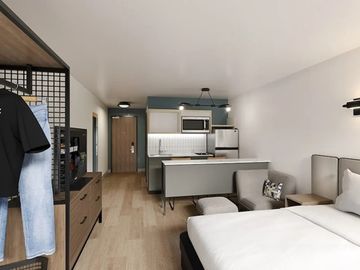
Rendering of StudioRes guest room from Marriott International
What it does like today is some of the emerging
apartment-like brands like Marriott International’s StudioRes. It is going to
break ground on the first one next week in Fort Myers, Florida, and has signed
a deal to develop 55 of those assets. It is also working with Hilton on its
just-named LivSmart Studios by Hilton with plans to develop 20 to 30
properties. Concord is already active with Choice Hotels Woodspring Suites
brand and Laport said the plan is to reach 100 of these apartment-style
properties that it will own with syndication to some of its long-time real
estate partners. In fact, it set up a separate division from its full-service
portfolio to operate these hotels that only have eight or nine full-time
equivalents.
Concord will continue to develop bigger properties and has
nine full-service properties under development such as the Westin Atlanta Gwinnett, but with the current state of
the economy and higher interest rates it has shifted its focus to these
emerging brands with lower cost structures.
However, as owners struggle with debt-related challenges,
Laport does see acquisition opportunities with real estate partners to present
themselves. “Owners that maybe haven’t been in the business as long or as
committed to the business may say, ‘to heck with this, I don’t want to put more
equity in my deal. I want to be a seller.’ It’s an opportunity for people like
us who would like to acquire assets that we can add value by refinancing and
bringing new equity to the table.”
Concord is also growing its third-party business and is
about to open a 357-key, dual-branded Hilton Garden Inn-Homewood Suites in
Dallas and owned by the city.
Being debt-free also gives Concord the opportunity to
provide more key money to find “great long-term assets” that Laport said “often
requires an inducement” to win management.
Its new investment partners will also widen Concord’s span
of influence, Laport said, which should open doors to more management
opportunities with new groups of developers.
Concord also plans to hire more business development people
and senior level operator to oversee multiple hotels to expand that capability.
Bigger picture, Laport said Concord should have 170 to 180
assets open or under development by the end of 2024. He calls this year a solid
one for performance and expects operational returns to beat 2023.
Like many, Laport sees stronger group business, lagging
business transient and normalizing leisure demand this year. But he does think
as business transient does rebound, those travelers will prefer new and fresh
concepts, which is why they like the new apartment-style brands from Marriott
and Hilton. He said Concord has already seen this as one of the biggest
developers of the still relatively new and differentiated AC by Marriott brand.
“New wins in America and I think those will come back
first,” Laport said.