At Lympstone Manor in Devon, England, Michael Caines is creating career opportunities for a more diverse workforce that builds a loyal foundation for team members and guests.
DEVON, England – In an industry notorious for high employee
turnover rates, Michelin-starred chef and hotelier Michael Caines, MBE has found
an antidote. His investment in a culture of inclusivity combines the financial
benefits of greater team loyalty with a personal commitment to creating social impact.
The ethos of the British chef patron and hotelier becomes
especially meaningful due not only his life story, including the loss of his
right arm in a car accident in 1994, but also the history of Lympstone Manor.
The 21-room with six-standalone shepherd huts make up the Grade II-listed
Georgian mansion Caines restored and transformed into a Relais & Châteaux country
house hotel, Michelin-starred restaurant and vineyard that opened in 2017.
Set amongst 28 acres along the Exe Estuary in Devon,
England, the former private estate was built in the 1760s for Charles Baring, a
slave trader and wealthy financier whose bank facilitated the Louisiana
Purchase, bankrolled America in the War of 1812, and gave monetary support to Southern
plantation owners in the American Civil War.
According to governmental body Historic England, black
people previously enslaved in the colonies overseas and then brought to England
by their owners were often still treated as slaves, so it is possible this
practice existed at Lympstone Manor.
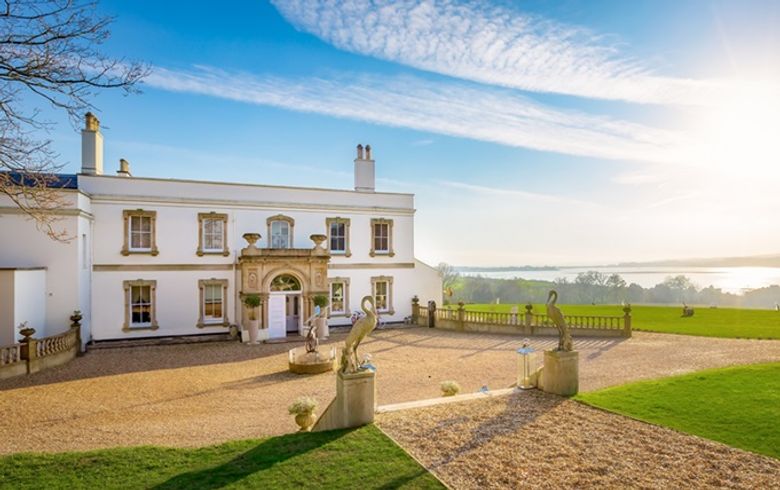
The 21-room hotel with six-standalone shepherd huts make up the Grade II-listed mansion Caines restored.
Today, the existence of British estates funded by the
slave trade has been, to a degree, 'whitewashed' out of everyday awareness of
British history. Yet it wasn’t until 2015 that Britain’s debt for abolishing
slavery in 1832 was repaid, £20 million
– 40% of the government’s 1833 budget and equal to £20 billion today – borrowed to buy out enslavers and
free the enslaved.
Caines’ investment in inclusive hiring at Lympstone
Manor is more than just a version of “restorative justice” – it also stems from
his lived experiences. Born to a black Dominican father and a white British
mother who could not keep him, he was adopted as a baby by a white family in Exeter,
the largest town in Devon but, at the time, still not multicultural. He grew up
attuned to the opportunities he was given that others from BAME ancestry did
not have - and even today, he is amongst only a handful of non-white Michelin-starred
chefs.
“There's always a bit of dark history involved with
modern reality,” Caines said. “We need to understand why we’ve repurposed this
building, take in its past, learn the lessons so we don't forget the history,
and recognize that times change so we have to move forward. I don't feel
oppressed by it – I feel liberated by knowing. I’m the descendant of a slave,
with my father from Domicia, and reside over this house now repurposed into a
hotel. I’m free to be expressive as an equal in society and respected amongst
my peers, and, of course, the people who frequent the property. In history,
I'll be considered its first custodian of color, and that’s a real mark of
progress.”
‘Engineering your future’
Caines’ approach to inclusive recruitment shares a
synergy with Mercedes-Benz’ method for attracting employees with wider ranges
of perspectives, what he calls “engineering your future”. “Rather than going to Oxford
and Cambridge to seek the brightest people, Mercedes-Benz chose to go to
universities that offered engineering qualifications in places with more
diversity like Birmingham, Manchester, and London,” he explains.
However,
Southwest England is rural and doesn’t have big urban populations, so
Lympstone Manor needs to cast a wider net to attract a more diverse talent
pool. “You
need to look where diversity exists and create relationships beyond your own
boundaries. If you see people with talent but not the opportunity, sponsor them.
Help them achieve their goals through education, apprenticeship opportunities,
or funding their training with a bursary, and then give them a chance to come
onboard afterwards. With opportunity comes progression.”

You need to look where diversity exists and create relationships beyond your own boundaries. If you see people with talent but not the opportunity, sponsor them. Help them achieve their goals through education, apprenticeship opportunities, or funding their training with a bursary, and then give them a chance to come onboard afterwards.
Michael Caines
Launched in 2011, the Michael Caines Academy is a
division within a wider culinary education program at Exeter College, which
attracts a multicultural student body aged 16 to 18 in line with the British
education system. “The academy is a two-year program for excellence in
hospitality with a cohort of 16 students,” Caines said. “It’s a feeder program for the
wider industry. We couldn't take them all at Lympstone Manor, maybe one or two per
year, but some want to seek employment elsewhere.”
Caines also advocates for hiring disabled team
members, explaining it costs no more than it would to accommodate hotel guests
in similar ways.
Lympstone Manor has had four disabled employees since
opening. “You have to consider disabled access for guests, so why not take that
mindset into workspaces for employees?” he asked. “It's about adapting to
individuals’ very specific disabilities, putting them where they feel
comfortable and managing expectations.”
While it may be difficult for someone with limited
sight to work in a kitchen, they can be trained to answer the phone. Someone
hard of hearing might need equipment to hear better, or chairs and worktop
heights might need adjustment. “I mean, why would you not employ people in the
workplace if they can make a valuable contribution, for the sake of adapting
very small areas around those challenges?”
However, when it comes to benchmarking inclusive investment
strategies against industry standards and competitors, metrics become difficult.
“Is there an industry standard for us to measure against, and has the industry
got its head around what amount of investment in inclusivity is needed for
businesses?” he asked. “Those are the questions the industry needs to assess.”
Caines said the first metric should be employability,
given the industry’s high levels of staff turnover and challenges in accessing employees.
He firmly believes that giving disabled people opportunities
in the hospitality industry is a sound solution to staffing issues. “People
with disabilities are very loyal and hard working,” Caines said. “They're not
looking to move on, they're looking to settle and have a career. If we see
people who can be brought into our environment, then we should obviously seek
meaningful ways to make that happen, even if that means a small investment in
return for reducing the costs of staff turnover and employment agency fees.”
Clearly
the inclusive culture Caines and his team have created at Lympstone Manor has
paid dividends in knowledge retention and a dedicated team, especially amongst senior
management. Turnover is about 21%, which is significantly lower than the
U.K. hospitality industry’s averages that can range from 35% to 52%. Some team
members have been around pretty much since the very beginning, including seven
and eight years of employment for the financial director, the sales and
marketing director, the head chef, and the head pastry chef – and almost five
years for the head of housekeeping.
For Caines, opening up career opportunities to a
more diverse workforce has not only helped Lympstone Manor write an empowering
new chapter, it has also built a loyal foundation of team members and guests who
enjoy interacting with them.