Top
hotel executives talk about why current instability in the US isn’t diminishing
CALA’s long-term prospects and why deal volume in the region is “frothy.”
Click here to access all of this year's 2025 ALIS CALA Conference coverage
CORAL GABLES, Florida — The
Caribbean and Latin America (CALA) has a lot of experience with
instability, which is proving instructive at a time when the U.S. economy, and
potentially the hotel industry, are volatile, as well.
But that hasn’t ever stopped
Gilda Perez Alvarado, CEO of Orient Express and group chief strategy officer
for Accor, from having an optimistic view of the region.
“As the only Latin American on
the panel, one thing that we’re used to in the CALA region is uncertainty,”
she said on Tuesday during the Views from the Board panel at the ALIS CALA by Northstar events at Loews Coral Gables Hotel in Coral Gables, Florida. “We do have quite a bit of government changes and social economic
situations happen on a regular basis. So, from a long-term perspective, we’re
very bullish on the region.”
Perez Alvarado said CALA
benefits from a lot of investments in infrastructure and many countries with
pro-business attitudes.
“What we’re tracking very
closely is more what’s happening to international travel going into the U.S.,”
she said. “We have seen a little bit of a deceleration, but as it relates to
American travelers, in particular, going into CALA, especially those dollar-denominated
destinations -- it’s looking very robust.”
Perez Alvarado said the CALA region
has a lot of different travel opportunities.
“There’s quite a bit to do:
experiential travel, all-inclusive luxury, etc., and maybe some of that is a
little bit more resilient to the short-term movement or challenges that we’re
hearing right now,” she said. “But if there’s one thing about CALA, it’s that
this region is super resilient.”
Perez Alvarado was joined in the session by Jolyon Bulley, CEO,
Americas for IHG Hotels & Resorts; Larry Cuculic, president and CEO of BWH
Hotels; Sloan Dean, CEO of Dallas-based Remington Hospitality; and Keith Pierce,
executive vice president and president of franchise & development for
Sonesta International Hotels. John Fareed, global chairman of New York
City-based Horwath HTL, moderated the panel.
Pierce said there are plenty of
positive signs for CALA right now, including a “frothy” deal volume.
“The region is so diverse. What
happens in Colombia is not what happens in Brazil is not what happens in the
Caribbean, etc.,” he said. “Another way to look at it is deal volume… The
deal volume in the Dominican Republic, Panama, Colombia, Peru, Chile,
Brazil and Argentina is frothy and if the deal volume is frothy, then the
anticipation is that the performance will come right back because of demand
and supply.
“There’s an undersupply and
that’s proving out. Look at all of the major hotel companies over the course of
the last decade… they have all penetrated [the region] and certainly in the
all-inclusive space… That is an indication that CALA is going to continue to be
robust.”
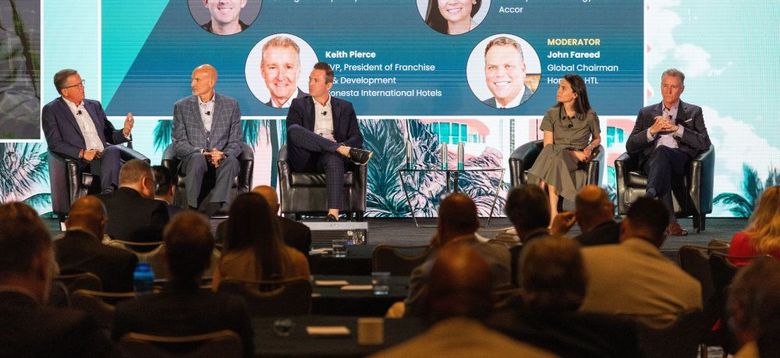
(From left:) Jollyon Bulley, Larry Cuculich, Sloan Dean, Gilda Perez-Alvarado and Keith Pierce.
CALA deal structure
Branded residential and
mixed-use projects are important components of any luxury or lifestyle
developments in the region, Bulley said.
“Over 50% of our luxury lifestyle developments in
this region, and also in the U.S., have some form of branded residence as a
combined component to it,” he said. “That helps with the capital stack and the
access to development capital to get a hotel for almost nothing if the
brand is strong enough.”
Bulley noted a deal IHG made
last in 2024 for the Kimpton Monterrey, which will be located in the new-build
mixed-use Torre Rise and is set to be the tallest tower in Latin America.
“It’s retail, office, hotels and
branded residences. That has proliferated all across our business and that
helps drive availability and cash flow, not only to develop, but ongoing cash
flow,” he said.
Cuculic said BWH looks at every
deal as an opportunity to be aggressive with that developer to stabilize the
asset as soon as possible.
“We can have aggressive deal structures. We’re a privately owned company,
we don’t have shareholders, and our success is defined by the success of our
hotels," Cuculic said. “To me, a contract that stabilizes the hotel as soon as possible is what
drops to the bottom line. That makes the bank happy, as well as the owner of
that hotel. So, deal structure, to us, is our way of making sure that the hotel
knows we’re in it together.”
Dean, who recently announced he
was leaving his position at Remington, was asked about AI and whether it’s
already disrupting labor.
“It’s first disrupting hotel
distribution and how customers book,” he said. “We’re in this stage where
the consumer is now going to Chat GPT or other AI agents and giving it
specifics and it spits out a hotel or an itinerary.”
So, does AI become a pay-to-play
industry? Dean said he hopes not.
“This is actually one of those
step changes in the industry. It can level the playing field for hotel owners
and hotel operators,” he said.
In his experience, Dean said AI
is already “intermediating” some white-collar jobs, like paralegals, for
contract review.
“We’re on the fringe of
productivity gains in white-collar jobs… I grew up in revenue management.
Eventually revenue management will be fully automated,” he said. “We’re a
physical business so full automation for very physical jobs… is a bit behind.
“We’re definitely in this
[space] where distribution is being intermediated very quickly, and
white-collar jobs are being replaced. We’re going to have productivity gains
that will help hotel profitability for the next several years.”